


In Hollowbody, an early 2000s-style third-person survival horror game from Nathan Hamley (solo developer at Headware Games), the true terror comes not from terrifying monsters, but from living in a world where ordinary people are abandoned by the system and left to die.
Hollowbody pays homage to the PlayStation 2-era classics that helped define the genre, but also adds elements of “tech noir” – think the first few Silent Hill games, Silent Hill 2 and a touch of Blade Runner – with an emphasis on atmosphere and relying almost entirely on building tension over action to create a palpable sense of unease. The game also brings back PS2 graphics, but without the tank controls (though if you want tank controls, there’s a toggle for that).
The story is set in a ruined city somewhere in the British Isles in the not-too-distant future. Decades later, the area is bombed during quarantine after a supposed biological attack. A short prologue hints at corruption and conspiracy surrounding the truth of the catastrophe. The initial attack targeted a city “plagued by economic hardship and corruption”, and to stop the spread of the infection, the affected area was quarantined with a wall, but before that, those deemed “high-value” citizens were allowed to take refuge on an artificial island with a suspiciously utopian name (Ionis).
The game begins with a group of researchers and activists gathering at the entrance to the Exclusion Zone, planning to go in search of answers. After one of them, Sasha, goes missing, her partner Mika sets off in his hovercar to find her at all costs.
This early scene is where the tech-noir element of Hollowbody’s depiction really comes through, as Micah gazes out the giant glass windows of his apartment building overlooking a densely packed city, Blade Runner 2049-style, before darting between skyscrapers in his flying vehicle and having cheeky conversations with its intelligent navigation system. Naturally, when Micah has an accident in his vehicle and loses contact with the only person who can help him, he has to walk to Sasha.
Headwear Games
From then on, the tech noir elements are mostly out of focus, only to come back into focus at the end of the game. Hollowbody is in the more traditional survival horror mold of a scientific experiment turned regional extinction event. There are some touches of distinctive tech-infused vision — at one point Mica walks past a broken-down mech the size of an apartment building, and in one room there’s a glowing child’s toy that looks vaguely robotic — but it doesn’t go all the way through. Mica’s personal gadgets and the style of the inventory menu are the only reminders of that angle for most of the game.
There are a number of puzzles to solve as you explore the abandoned buildings and city parks and figure out how to escape from them. Exploration is more fun as the solutions to most of the puzzles are pretty obvious if you find the clues scattered around each location.
But occasionally, a head-scratching problem would crop up, sending me spinning in circles. It didn’t help that surfaces I could interact with would sometimes continue to display indicators like “Pick up” or “Find” even after I’d cleared them of everything usable. A messy room had me rechecking places over and over, wondering if I’d missed something. These prompts also appear in some places just to get Mika to make inconsequential observations, like commenting on dirty dishes or sheets that haven’t been washed in years, a remark she’ll repeat when she encounters the same settings in different apartments.
Thankfully, that doesn’t take much away from the creepiness of the setting. The music is haunting, and combined with environmental sounds like rain, radio static, and Mika’s echoing footsteps, it creates a very vivid soundscape. If Mika is inside a building or underground structure, it’s guaranteed to be dark and labyrinthine. It always feels like a monster could jump out at any moment, but that usually isn’t the case (though sometimes it is). Outside, Mika is defenseless, and it doesn’t take long for monsters to notice her and start congregating around her.
Headwear Games
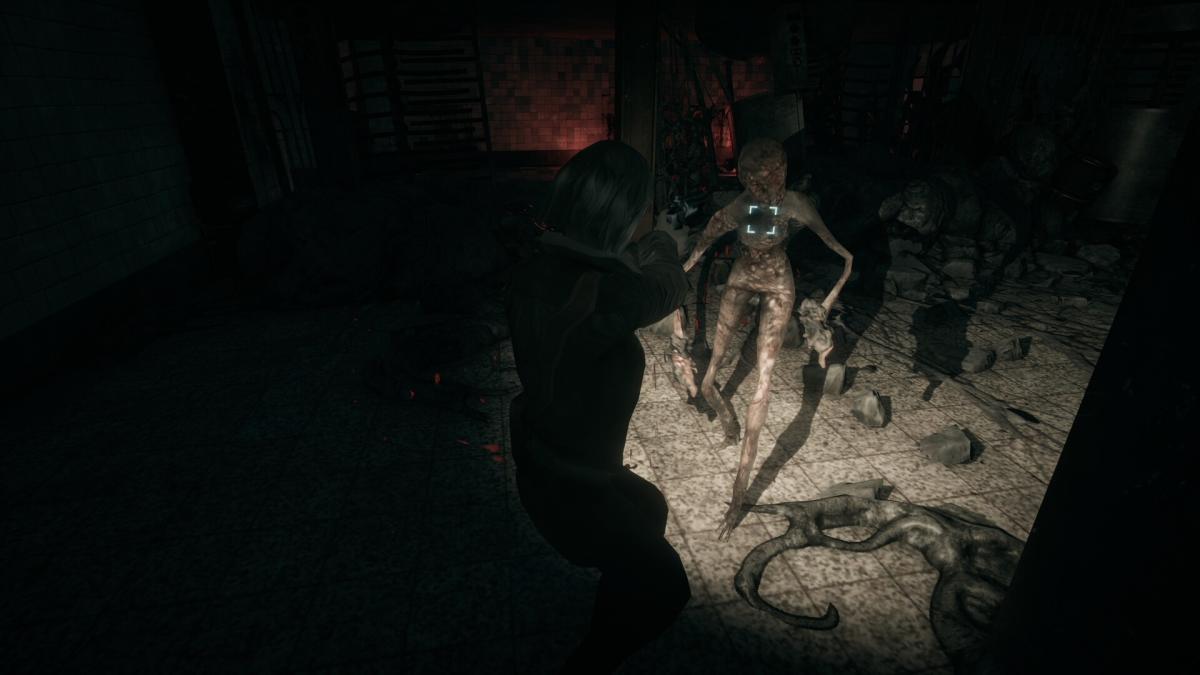
The monsters themselves are wonderfully gross – bipedal grotesqueries, some emaciated, some with heavy heads and nasty tentacles flaring from their upper bodies. Hollowbody also has demon dogs and a few slithering insectoid creatures that don’t seem to pose much of a threat beyond scaring you; a cat-sized bug-creature slithers past you in a comically awkward animation that may be the most PS2-esque thing in the whole game.
It’s not combat-focused, so you often just have to run past enemies, but you do get a few guns and makeshift melee weapons. The melee weapons felt a bit stiff and slow at times, especially when facing packs of beasts, but I still managed to make do by using bludgeoning implements to conserve ammo. I also enjoyed the thud of the road sign axe hitting monster flesh. I also liked that Mika could grab an electric guitar from the wall to use as a weapon. It may not be the most practical approach given its weight, but the sound it makes when it hits its target is very satisfying.
There are corpses in various states of decay throughout, and Micah’s scanner can instantly read the dead, telling them who they were and how they died. Often the cause of death is not paranormal: dehydration, starvation, murder, etc. A background story is formed through documents and audio flashbacks that are activated at specific locations, telling of the city’s economic hardship and gentrification long before the biological disaster, and then the eventual devastation endured by the people of isolated areas, unable to do anything but survive as long as dwindling resources allowed.
Micah finds notices of impending rent increases, letters mentioning ongoing construction disruptions at all hours of the night, and overdue utility bills stating that monthly rates have quadrupled. She finds a note left by a dying man, pleading for a better future for his family and humanity. A post-quarantine recording shows starving civilians pleading to leave the city and being shot at by militants. It’s all incredibly bleak. It didn’t take much skepticism for me to imagine the reality of things unfolding this way.
Headwear Games
But the explanation for why horrific flesh-eating humanoid monsters are roaming the city is never directly revealed (at least in the ending I reached and all the materials I’ve gathered). The most significant hint on that point comes from a newspaper clipping, the contents of which I won’t reveal here. The article plants the seed of the idea, but it’s mostly up to the player to fill in the blanks from then on.
There are some touching snippets of Mika and Sasha’s story, but the connection between them and this place and the obvious importance of what’s happening there now didn’t wrap up in the neat way that I was hoping for. The ending was a beautiful and moving scene that felt like it brought the story full circle thematically, but at the same time left me with a feeling of “wait, what just happened?” However, there seem to be other endings, which may become more definitive on subsequent playthroughs. Beating the game unlocks harder difficulty options and a first-person dungeon crawler mode, which made everything feel a lot scarier as soon as I turned it on.
Despite its flaws, Hollowbody is a solid survival horror title, and it feels especially impressive when you consider the fact that it was made by a single indie developer. Atmosphere is one of the things that made the first game so memorable, and Hollowbody’s oppressive atmosphere is just perfect.
