


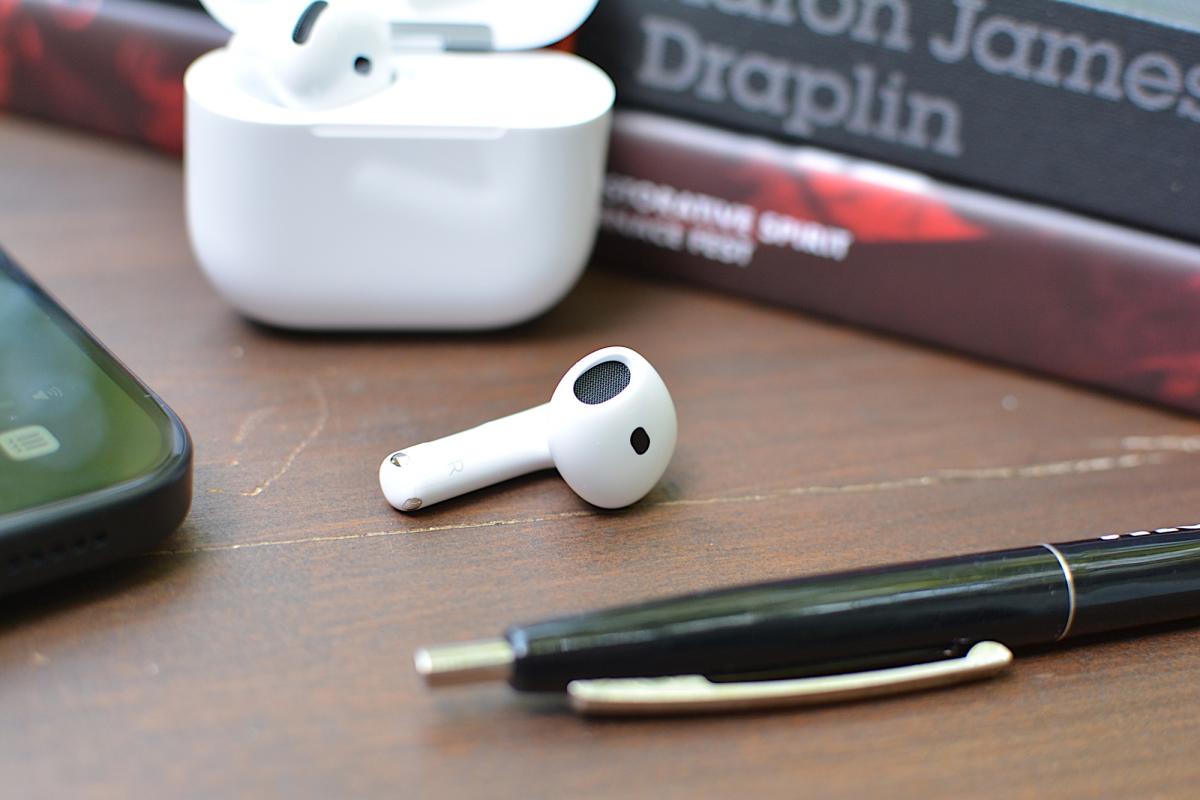
The story of AirPods actually begins with the iPod.
Apple shipped its first earphones alongside its popular personal music players. Though they were wired and very basic, the accessory laid the foundation for what would become AirPods. EarPods were then bundled with iPhones in 2007, and a 2012 redesign resulted in a product similar to what would become the first-generation AirPods in 2016. The company’s work to improve the fit of EarPods continues to pay off as Apple prepares to ship the noise-canceling AirPods 4.
“We started learning a little bit about human physiology and figuring out what shape would fit in the human ear,” Kate Bergeron, Apple’s vice president of hardware engineering, said of the early days. “We did some MRI scans and started figuring out how to collect the data, but we had no idea how many scans we would need or how many different ear types we would need.”
Over the years, Apple has developed more efficient methods of data collection, allowing it to build up a database of ear shapes more quickly than it could in the early days of EarPods, and Bergeron explained that the company expects to “continue that journey forever” when it comes to developing new versions of AirPods.
Billy Steele (Engadget)
During what Bergeron described as the “dark days of COVID,” a small group on the AirPods team was trying to solve a dilemma: They wanted to bring effective active noise cancellation (ANC) to the open design of the “regular” AirPods. The team had already done this successfully with the two AirPods Pro models and the AirPods Max headphones. But this time, it was essential to maintain the open nature of AirPods while also providing noise-blocking technology.
So over the course of a few days in 2021, Bergeron and Eric Treschi, AirPods marketing director, gathered in one of Apple’s acoustic labs for a demo. At that point, the team wasn’t sure they had a viable idea, but they still wanted feedback from executives.
“We were just blown away,” Bergeron recalls. “And we said, ‘This is definitely something. We have to go after this and make it happen.'” The acoustic and computational work required for an effective ANC algorithm happened in tandem with iterating to improve the fit and overall comfort of the AirPods 4.
After testing the AirPods 4, we can say that the fit and comfort have improved from the third-generation model. But Apple has also expanded the earbuds’ capabilities with the H2 chip and microphones in the AirPods Pro 2. This combination of advanced technologies allows Apple to continuously monitor the fit in your ear and update the ANC algorithm in real time to ensure that noise isolation remains effective even when the AirPods move.
“There’s a lot more computation involved in a lot of ways compared to AirPods Pro,” Bergeron said. “The ear tips give you a pretty consistent fit.”
Apple’s ANC journey began with the development of the first-generation AirPods Pro, which debuted in 2019. While effective active noise cancellation has typically been more prevalent in over-ear headphones, with a few exceptions, Apple realized that a “pocket-sized” distraction-free music listening experience would appeal to users. Of course, the company launched its own headphones, the AirPods Max, before the powerful second-generation AirPods Pro.
Treschi explained that the ANC setup, or third-generation Adaptive EQ as he calls it, constantly manages and adjusts both the active noise cancellation and audio quality equalizers simultaneously, and in real time, so in addition to the improved shape, the acoustic architecture of the AirPods 4 also helps them provide effective ANC in open earbuds.
“It’s really hard to achieve this great ANC quality in a product that doesn’t have ear tips,” he says, “and the power of the H2 makes it possible. So we’re actually using the H2 tip to manage the ANC quality, listening to the environmental noise through the microphone and making sure we cancel it as much as possible.”
Billy Steele (Engadget)
The lack of ear tips on the AirPods 4 also poses a challenge for Transparency Mode, which Treski says is “probably even harder” than mastering ANC on open earbuds, because it has to blend the ambient sound from the microphone with the sound you hear naturally through your unplugged ear. It creates a perfect mix that sounds real to your brain, but it all has to be done with ultra-low latency so that automatic adjustments don’t introduce delays into the sound you hear through the AirPods.
The new shape of the AirPods 4 also provided an opportunity to improve the sound quality of the entire earbuds. As Bergeron revealed, the tip of the earbuds, which the team calls the “snorkel,” is very different from the AirPods 3. Bergeron said the previous model was more open, giving engineers more freedom to work. In the new version, they had to tune the drivers to prevent sound from reflecting back into the internal microphone that monitors noise inside the ear. So the drivers are now pointed further into the ear canal and slightly recessed.
“We had to adjust the drivers and the front of the product to improve the fit,” she said. “The mechanical engineers are packaging the whole product and trying to fit everything in. The acoustic engineers are saying, ‘Based on these constraints, this is the best place we can put the drivers.'”
The AirPods 4 redesign extends to the case, where Apple managed to slim down the accessory while also simplifying how it’s operated. The end result is “the same magical experience,” Bergeron noted, but the lack of buttons allowed engineers to eliminate overall thickness and rely more on the accelerometer. The lack of buttons also removes one potential place for liquid to get in, and the case has the same IP54 rating as the new AirPods.
“We’re definitely going to get a double win,” Bergeron said.
