


From Tommy to The Rise and Fall of Ziggy Stardust and the Spider From Mars, the rock opera is this weird and wonderful amalgamation of theatricality and great tunes. But what about a comics opera instead?
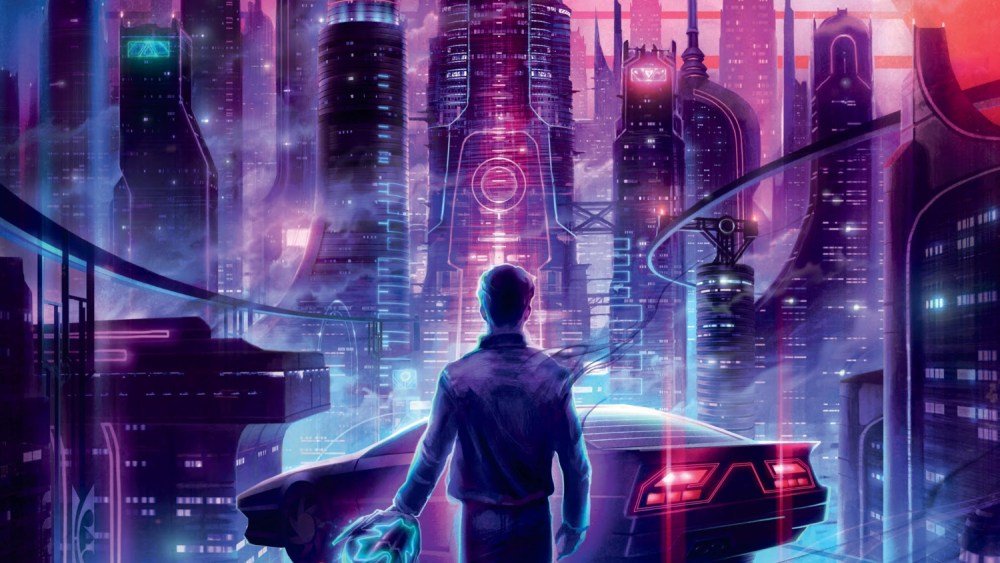
That’s basically the premise of The Midnight: Shadows, a brand-new OGN from Dark Horse Comics. Here, comics folk — writer Zack Kaplan and artists Stephen Thompson and Jahnoy Lindsay — team up with Tyler Lyle and Tim McEwan of synthwave band The Midnight for an “electrifying and original sci-fi adventure inspired by the poetic storytelling and the neon-soaked aesthetics of their music.” Eat your heart out, A Teenage Opera.
“I knew Tyler, who’s the lead singer, before The Midnight even formed,” said Kaplan during a Zoom call earlier this summer. “And just by happenstance, he started a band that I absolutely loved and became a super fan. I would listen to the music weekly as I would write other things. We traded this idea about doing a comic together and doing a graphic novel and it finally came to be.”
Kaplan went on to call the collaborative process “such a great sync from the get-go; it’s been a very copacetic collaborative experience.” He added, “Sharing that with the band, we would have a lot of conversations about themes that are present in the music and designs,” said Kaplan. “They were instrumental in looking and participating in all the designs of the characters and the monsters and everything that formed. It’s been a really amazing positive experience.”
And it’s not just cause Lyle and McEwan are cool rock stars; The Midnight very much know themselves, and that translated directly to the OGN.
“Here’s what you have to understand about The Midnight: this band has created such an aesthetic to their music,” said Kaplan. “There is such an experience wrapped around being a Midnight fan. And Tyler and Tim, they bring such storytelling and lyrical presence to the music that there is a real narrative foundation in the music. The themes are the same, and with the journey, there are touchstones like abandoned malls and driving on a highway.”
The task for the creative team, then, was to react to those ideas and existing media and do something truly novel and inventive.
“I found it really to be a beautiful experience to ask how (to adapt) the aesthetic that they had already created in their album art and in the experience that they create around their music,” said Kaplan. “How does that translate to the graphic novel form? How do these really Joseph Campbell-ian storytelling ideals that Tyler brings to his music, how do we narrate that into this story? It wasn’t like, ‘How do you translate notes’ — I just felt like there was such a foundation already. I have a lot of bands that I love and that I listen to. I don’t know that I would be able to take a lot of bands music and do this. It was just because their music was so rooted in this narrative and aesthetic experience that it made it really perfect.”
Courtesy of Dark Horse Comics.
The end result of The Midnight: Shadows, then, is a story plucked from the traditions of both comics and rock operas.
“It’s a variation on a Tron-style story about a character, Jason, who is sucked into a video game from his childhood called The Midnight,” said Kaplan. “It’s a world of perpetual darkness that’s terrorized by monsters and filled with cyberpunk nights. But when he gets there, the twist is that he discovers that the characters of this world say that he is actually the hero from that world and that he’s been missing and that he actually disappeared into the ordinary world as an escape. So he doesn’t know which world he comes from.”
But there still comes the actual process of adaptation. On the practical end, Kaplan relied heavily on the art team to develop the world.
“I’m very proud of the collaboration with Jahnoy, Stephen, (colorist) Thiago Rocha, and (letterer) DC Hopkins,” said Kaplan. “We have two different artists drawing the two different worlds. Jahnoy does the ordinary world, and it feels very humble and beautiful, but then the irony is that it’s all about the characters, basically. It’s all character work. Then Stephen takes over and transitions us into the extraordinary world, which is far more detailed and environment-based. And we have post-apocalyptic malls and sci-fi cities and cyberpunk cars and it’s far more fantastical. And so there’s a real dichotomy there between those two styles.”
Kaplan added, “We have one colorist doing two completely different coloring styles across the whole thing (Thiago), and he does an amazing job. And also DC does two completely different lettering styles across both. So we had a lot of fun playing with the different visual representations of these different worlds.”
For his part, Kaplan tried to maintain a specific approach, and one that was about engaging directly with the material with a singular goal in mind.
“It wasn’t purely translating, but it was reflecting,” said Kaplan. “It was coming up with an original graphic novel story that reflects everything from their music, and the lyrics to the band’s aesthetic. And so that you could look at the band’s experience and the music and you could look at this and say, ‘It’s not an extension, it’s a reflection.’ And I use that because an extension feels structured and rigid and finite. I feel like this is more loose. Like, this is not pure canon. This is one interpretation of the music and of the band’s experience. I feel like it’s very me, too. It’s very sci-fi. It’s very hopeful. It’s very dark at times. It’s very character-driven. It’s very action-packed. It’s very thought-provoking.”
But at the same time, this isn’t like those “typical” rock operas, and The Midnight’s influence only goes so far.
“Tyler and Tim…don’t pop into this story at any point,” said Kaplan. “They’re not time travelers or anything like that. It is a story made of really heartfelt, three-dimensional characters and going on a completely separate experience that has reflections inspired by the themes and lyrics of the music. And it’s very much about our relationship with nostalgia and our relationship with fantasy.”
So, then, there’s a few different layers or textures here, and The Midnight tries to build from the music and aesthetic with a few novel observations and interests. The first is parenthood: Jason’s “transition” back to the game world (called Neverland) comes as he’s a newish parent, with all the corresponding anxieties and struggles.
“I’m a father myself, and I definitely think it’s about moving from adolescence to adulthood and into being a father,” said Kaplan. “That transition is powerful and something to cope with at times. And so I think that, it’s a story about a character that has been enjoying the thrill all his life, and now he finds he’s facing a whole new chapter and he’s not sure how to deal with that.”
Courtesy of Dark Horse Comics.
It’s about parenthood, yes, but there’s other “applications” — it’s about key life stages and transition and facing these changes head on.
“I identify with Jason, but I’ve been a parent for a few years now and I think I’ve come to find my place in it and understand it,” said Kaplan. “But I think that, whether it’s facing parenthood or really just facing adulthood…I think that even twentysomethings who get out of college and face their first job and face their first time on their own and face a real conflict in their life for the first time when they’re on their own, it’s a different ballgame. And I think that that experience of facing real stakes when you have to handle it in a different way, that’s the difference between adolescence and adulthood. I feel like everybody who has made it to adulthood, who came from adolescence, has a story about the wakeup when they went through.”
We also talked about this idea of a parent’s responsibility. More specifically, how do you balance your duties to a child and still engage in the kind of fantasy that sustains the human spirit.
“I think you’ve come to the end of that discovery — the marriage of being able to enjoy fantasy while still maintaining your responsibility to someone else,” said Kaplan when I’d mentioned experiences with my own step-child. “Prior to understanding that, and to think that this is an either/or choice, that you must either be responsible and potentially miserable because you are sacrificing your own enjoyment and entertainment. To think you are stuck in the daylight or to think that you can purely escape into a fantasy of nighttime romance and thrill-seeking, it’s not an either/or.”
And that’s where another layer of The Midnight gets folded in: dreaming. They’re a form of pure escapism, and that’s a deeply compelling spin when you’re exploring something as primal as life and reality and its perpetual arc toward the future.
“I think it’s built into the identity of a dreamer, which I believe that The Midnight embodies,” said Kaplan. “With The Midnight, there’s a lot of songs about being lost in the fantasy of a midnight and being lost and finding love and driving fast. And then there’s a lot of lyrics about the dark side of that and like how that can turn us into monsters and how we can lose ourselves on that and how we are running so much. And what are we running from? So there was already that character exploration already at the root of it.”
At the same time, there’s clearly a noticeable downside of such fanciful thinking.
“A dreamer has both a good and a bad side. The good side is you can dream up some wonderful things to experience and to visualize, and who doesn’t want to be participating in a dreamer’s amazing dreams,” said Kaplan. “But the downside is dreams are not built on reality. Dreams are fantasy. And when you lose focus on reality, you lose focus on your responsibility, you lose focus on your relationship with others, and you lose focus on yourself. Nothing will confront that dichotomy more than parenthood, fatherhood or motherhood. Parenthood will slap you in the face and make you have to find a marriage between fantasy and reality and between dreams and responsibility, for sure.”
But some of this can feel a little nebulous or abstract. That’s why Kaplan emphasized the importance of the video game “aspect” of The Midnight.
“Wrapping it all up in video games feels very timely,” said Kaplan. “I grew up on video games in the ’80s and ’90s, and all of them were an escape. I think it’s really interesting to go, ‘What if you were using reality as a fantasy from avoiding your responsibilities?’”
Kaplan added, “Like, the game ends, and it’s over. It’s over so easily, but life’s problems are not. And so what if the what if the game problem, the challenge of saving the world in a game, was the equivalent of raising a child? That it was that hard and the stakes were that demanding. How would that character handle that? You’ve got to save the world, but it’s hard; you only get one shot to do it. You don’t get to repeat this. You ran away from this game because you couldn’t beat it, but now we expect you to beat it. That’s a heavy responsibility that he’s not sure he can handle. It’s another really introspective and interesting character journey to play with.”
Courtesy of Dark Horse Comics.
For Kaplan, it goes back to another thematic idea and influence.
“That, to me, evolves the Tron foundation into something that’s more modern because I think that we all grew up on games and they were this escape,” said Kaplan. “And then the thing that you have to learn in adulthood is that you have to face challenges and you cannot escape them. And that is challenging. So the dilemma for that character who is, like many of us, trying to chase a little bit of a thrill and dreaming of what’s to come and then being confronted with the reality of what his life is going to be. Like, ‘Oh, I cannot handle this as a teenager anymore. Oh my God, I have to evolve.’ And maybe they evolve a couple of times over.”
Video games, then, “epitomize how we view things as adolescents versus adult adults,” said Kaplan. It’s about our understanding and perceptions of power, and how we grapple with that between life stages and events.
“I think Jason is a very interesting character because when we meet him, he’s stuck,” said Kaplan. “He’s stuck in his life, he feels lost, and he feels like something’s off and he hasn’t found it. And then he finds the opportunity to have tremendous power and he’s equally terrified of that — because with power comes responsibility. Someone said that once.”
It’s very much, then, about embracing that kind of dichotomy.
“It’s not either/or — it’s not being ordinary or extraordinary,” said Kaplan. “Do you want to be stuck in the ordinary or thrust into the extraordinary? Both can be terrifying or both can be beautiful. And I think the real challenge in life is finding the balance between both, finding the fantasy and the magic of ordinary moments and finding the responsibility to do extraordinary things with the ones you love.”
Even from a visual standpoint, The Midnight‘s depiction of Jason promotes this idea of growing up and grappling with self-perception and reality.
“You can tell he’s the same character, but when in the game world, it’s almost like some idealized version of himself,” said Kaplan. “Like, this is how maybe he sees himself, or how he wants to be seen. As opposed to in the world, he’s maybe a little smaller, a little more quiet. I love that interplay. Or, has he been seeing himself as a younger, more boyish, more simpler version of himself? And then he gets into The Midnight world only to find that he’s a little grittier and rough around the edges. You are more of an adult than you think that you are.”
Said dichotomy is even, without the team having had to try all that hard, reflected in the OGN’s very title.
“There’s a great happy accident that comes out of The Midnight name,” said Kaplan. “Midnight is a moment in time between. Even though the minute before midnight and the minute after midnight are dark, I generally think about midnight as an idea that represents between day and night. There’s a real duality to the premise of this book about two worlds and one world is in the day and one world is at night. One is ordinary and one is extraordinary. One is a game and one is a dream or vice versa. There’s a lot of duality to this book and I think it’s all about trying to find balance.”
Still, here’s another angle to the whole “video game and maturity” angle. The development of games over the last, say, 30 or so years is indicative of this larger change — from the simple to the complex, it’s been about moving the player from active participant to occasional audience member.
“I’m thinking about all the games I liked in the early ’90s, late ’80s, and just how weird they were,” said Kaplan. “And they were all some kind of side scroller. There’s something very immersive about that experience. Whereas like now I think games maybe do feel a little more cinematic and we’re a little more detached and they’re a different experience. I don’t think it’s as much of a communication between player and the game. If I play the old Contra, it’s me against the machine. Whereas with games now, I’m supposed to be a part of this kind of bigger world. We’ve lost something in the way that gaming has evolved over the last 20-some-odd years.”
Courtesy of Dark Horse Comics.
Kaplan added, “I love some video games now where it gets complex, and where you have a storyline and you complete a side quest, but it ends tragically, and you feel sad about it. I like the mature, modern storytelling that goes on in some games. But I think you’re right to identify that that kind of nuance was not there in the ’80s and ’90s as much. I think that it was a lot more standard quests and good guys and bad guys. And it was a bit more two-dimensional and it was a bit more focused on the fantastical and the spectacle and the simplicity.”
In fact, that very concept is baked into the structure of The Midnight.
“We tried to emulate that in designing the game world of The Midnight that this character finds himself thrown into,” said Kaplan. “You definitely feel like you’re the good guy. There’s the bad guy — now go save the world. The hero’s at point A, and the villains at point B. Go make your way over that way. You’ll get stopped along the way, you’ll pick up some better things, and you’ll become more powerful.”
It’s not just about games, either. Kaplan and company also focus on gathering places like malls, and how their continued obsolescence (like ’80 side scrollers, perhaps?) but nostalgic status speaks volumes about other important social changes and shifts.
“The mall is the portal for this character,” said Kaplan. “Not to beat a dead horse, but I think malls, maybe in my own experiences, have this weird dichotomy to it. If you’re young, especially, malls are a place to escape. And then, a few years later, it’s probably going to be the place that you get your first job. You drag your own family to yours down the line.”
Kaplan added, “I think that there’s just that novel interplay of malls that are this weirdly important part of our lives that we’re nostalgic for because I think they’re evolving and they’re changing and maybe going away. It means something different depending upon where you are in your life. And we see the mall both in its present form, where it’s functional and it’s normal, and then we see it post-apocalyptic destroyed and decayed. And so seeing that is very startling, but indicative of that childhood that has died, and that nostalgia that has ended.”
And that’s what The Midnight might ultimately be about: an exploration of nostalgia, and perhaps more importantly, how entropy may be king.
“The Midnight does this also in their music. They even have one of their songs start off on some sort of broadcast about the latest game craze and how great games are and how technology seems to be great,” said Kaplan. “Obviously, again, wrapped in the nostalgia of a time where we thought that these things were all going to be great. Now we live in a world where we know that none of that’s true. All of this has shades of corruption and shades of immorality and nothing is pure and the fantasy is over.”
It’s about tying together these feelings and the technology we have to fully understand where we’re really at collectively.
“So I think it’s a metaphor that translates to the internet and translates to all this technology that we’re now immersed in,” said Kaplan. “But at its core, again, it comes back to idolizing nostalgia and then facing the reality of the situations we have today.”
Kaplan added, “I’m really excited for readers to read it and put their stamp early on about just which one they think is the real world and which one they think is not the real world. We tried to make sure it would go both ways enough to give readers a real mystery and subjective experience about the whole thing. I love that there’s that uncertainty. I think that that makes nostalgia feel more robust. It’s like, ‘What have you really lost and what are you really trying to regain?’ And is it worth it? And are you an idiot for this whole process?”
Even this idea and/or energy of nostalgia is wrapped into another device/further layers within The Midnight. Cyberpunk, for Kaplan, is a kind of “catch-all” for everything going on in the course of this story.
“I think it’s because cyberpunk is really rooted in technology run amok,” said Kaplan. “I really think that the premise of cyberpunk is a future in which technology has become so pervasive in our lives that we cannot separate it or control it. That is, to me, the definition of good cyberpunk. And this is a story about how the nostalgia of technology matures from its origin, from its birth in the ’80s and ’90s, to a place that requires a new perspective to process and comprehend it.”
In turn, that brings it all back around to the music that informs and defines The Midnight.
“Those themes just perfectly connect with the nature of cyberpunk and synthwave music,” said Kaplan. “The Midnight is one of the largest synthwave bands in the world, and synthwave, the genre, is built on the same iconography and values as cyberpunk. I’m no expert, but they’re cousins. A lot of synthwave comes out of ’80s and ’90s movies and TV shows that were also, at the same time, looking at cyberpunk themes. Whether it’s Tron or Terminator; there are certain movies and touchstones that are synthwave and are cyberpunk. And so I think they all have the same origins. I’m no musician, but I think that that synthy sound is kind of technological, right? It’s kind of got that energy of technology coming into music. So it just all feels very connected.”
But, and just so it’s 100% clear, you don’t actually have to listen to the music to enjoy The Midnight.
“Ultimately, there is a read that will be very fun and powerful to put on The Midnight music and maybe even curate which songs go where and to try to do that,” said Kaplan. “And I’m sure there’ll be lots of fan playlists about the best 10 songs to listen to in this order while reading this book. But I think you could also read it completely on its own. I think it will speak to readers without the music addendum. I really feel like it’s as strong as any other comic series that I’ve created and just could not be proud of it.
Kaplan added, “But I think if you are a fan of The Midnight, there are tons of Easter eggs and lyrical references and tidbits, and I think the fans are going to have the time of their life spotting all sorts of those little things here and there.”
But there’s no denying that the music and storytelling elements have coalesced quite brilliantly. Not only into some deeply compelling narrative, but into this “organism” that continues to evolve. A kind of pseudo-living thing that marries the best of two different mediums in the way we’d hope might happen in, say, a rock opera. The Midnight is this free-form creature about the warm past and the jagged future; the wonders of fantasy and the pains of maturity; and the ups and downs of technology. I can’t wait to see what’s in store for its next act.
“And then one of the coolest things is that this experience continues to evolve,” said Kaplan. “The Midnight has said they have new music coming out, and it’s very likely that that new music will be building on the experiences being laid down in the graphic novel and perhaps even they’ll have lyrics and themes and thoughts that coincide or reflect this.”
Kaplan added, “So I’ve taken their music and reflected it into the graphic novel form. And by all indications, there will be new music that takes that reflection and continues it. So I think that it will create, by the time the book comes out in October, a really fascinating experience to digest the graphic novel and then digest the music both before and after that. And to continue that conversation and exploration.”
