


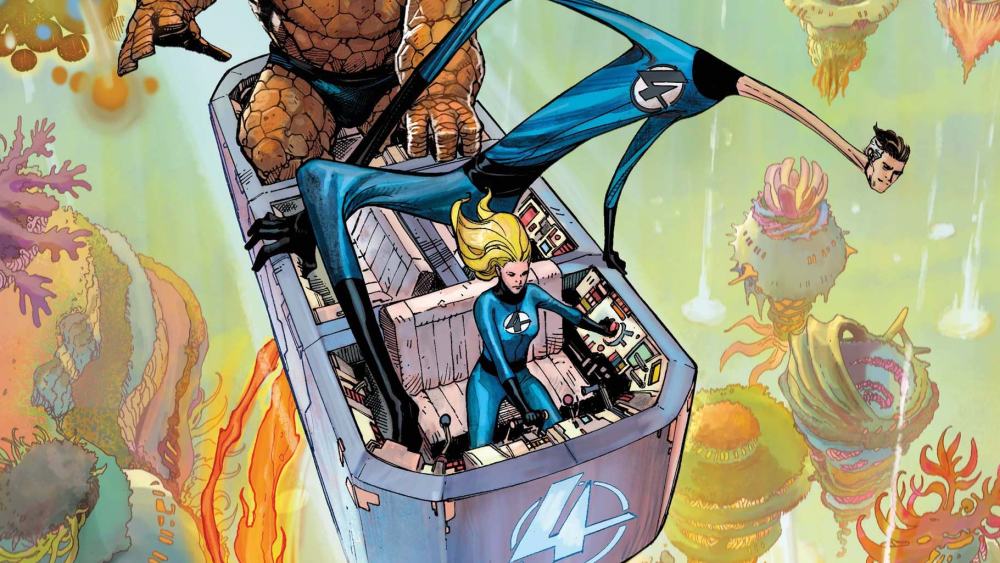
In Ryan North’s Fantastic Four #25 story “Star-Crossed,” artists Carlos Gomez and Jesús Abulutov give us a beautiful image of life on another planet that evolved without a moon. will give you. Detailed depictions of towering plants, terrifying creatures, and intelligent societies are inspirational. But are they inspired by reality?
The moon has been part of the development of life on Earth ever since proto-Earth collided with another protoplanet, Theia, thought to have been about the size of Mars. The environment created by our unique moon helped make our existence possible. So what would life on Earth be like if there was no moon?
wonder
The moon is directly involved in several things that make our planet suitable for complex life. The collision between the proto-Earth and Theia caused a tilt of the Earth’s axis, which helped the Moon itself maintain an angle of 23.44°. Without this, the seasonal changes we are currently experiencing would not exist. The moon’s gravitational pull also affects the Earth’s rotational speed, which directly causes wind speed and tides. Since its birth, the Moon has been slowing down the Earth a little every day. The Moon’s presence and gravity also prevented many of the early asteroids from colliding with early Earth, which would have had a disastrous effect on the development of life.
Scientists have long speculated that without the Moon, conditions on Earth would have been very different throughout Earth’s history. The increased rotational speed means that wind speeds at the surface regularly remain close to 200 miles per hour, and day lengths are only 8 to 10 hours long. The unstable tilt of the Earth’s axis means an unstable climate where large temperature changes occur over geologically short periods of time. The night will be as dark as when you experience a new moon, and the number of visible stars will increase significantly.
We will probably never know what kind of life would evolve under such conditions. Increased early asteroid and comet impacts could have destroyed many early attempts at life, and smaller tides would have reduced the chances for evolutionary leaps. The complex life that actually evolved would likely have a shortened lifespan due to extreme weather and climate. Plants and animals have a short, stocky silhouette, which helps them counteract the effects of wind speed. This means that there are no jungles or forests (as we define them). Wind could also encourage more organisms to develop membranes that allow them to glide and fly.
The deafening sound of wind speeds of 150 to 200 miles per hour could cause organisms to process sound differently, perhaps preventing them from evolving ears or even hearing as we know them. Noise will also change the way living things communicate. If you want your vocalizations to be useful, they need to be incredibly loud or pitch-sensitive to account for the constant wind. Non-vocal communication is likely to become the norm for all living things, especially intelligent species. Darker nights also likely mean that vision becomes overdeveloped, eyes grow larger and the parts of the brain that process light change.
marvel comics
Indeed, life on Earth without the moon would look very different and strange compared to what we know today. North, Gomez, and Abultov provided a great alternative in Fantastic Four #25. It allowed for beautiful interspecies romances between intelligent beings who were similar enough to fall in love. Whether things really work out between fiery humans and invertebrates clearly inspired by weird Cambrian hallucinations is a question for another time.
AIPT Science is co-hosted by AIPT and New York City Skeptics.
