


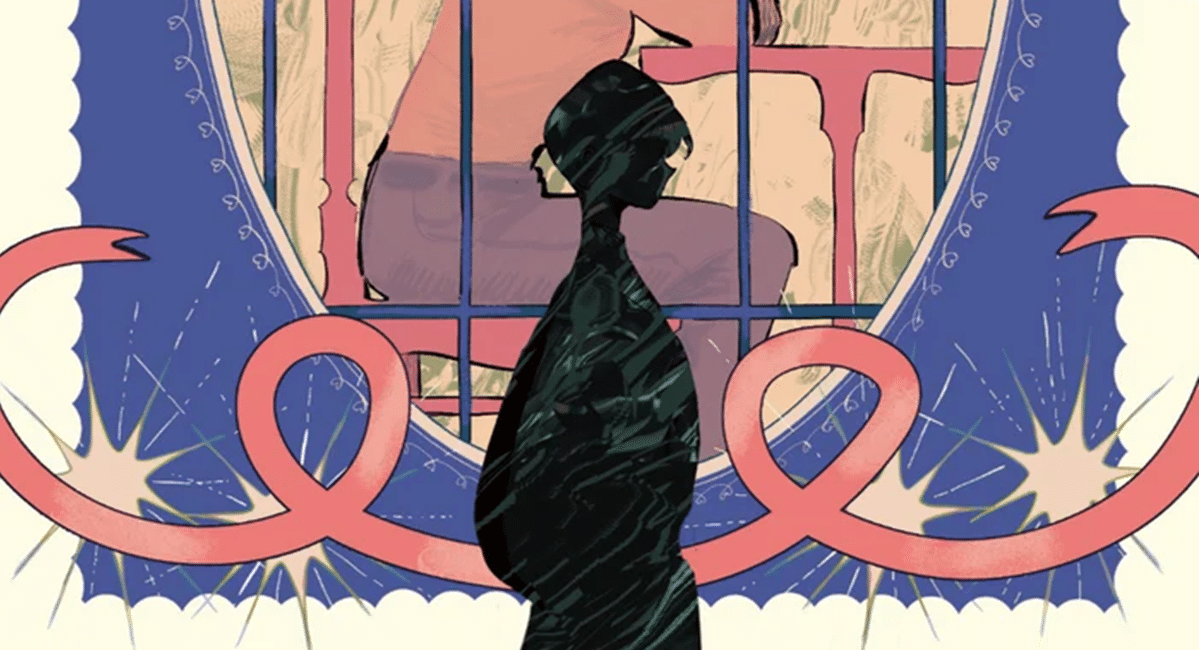
A fool, an absolutely insane woman.
Author: Vivian Nguyen
Publisher: Self-published
Publication date: August 2025
About “The Fool, Absolutely Mad Woman.” Is it a work of occult literature? This is clear to some extent from the basic premise that women find lovers through mystical means. In fact, the book goes even further with mysticism, with author Vivian Nguyen doing tarot readings early on in the story of Sapphic longing to guide the path the story ultimately takes.
But when I use the word “occult” in the context of The Fool, The Absolute Mad Woman, I don’t just mean its mystical connotations. Rather, I am referring to the origin of the word meaning “hidden.” The heart of Nguyen’s comics is actively hidden from the reader for much of it. This is common in literature, and the fun of reading a story is trying to figure out what kind of story it is.
The title certainly gives the reader some expectations. In Tarot, the Fool represents the beginning of something, but also recklessness and foolishness. To quote Rachel Pollack: “Sometimes we all want to be fools. Sometimes we act spontaneously, without doubt or fear. We don’t care what anyone thinks of us. We don’t worry about what happens next. But do we always want to act so freely? What about work, relationships, family?”
Combine the Emperor (Nguyen overlays the past with the Fool’s future, saying, “I have a clear goal in mind, and I will listen to the advice of others, but at the end of the day I will follow what my heart says”) and the Six of Wands (in the present, which means slowing down plans), and we see a character who collides with fate.
Our heroine, Alea, is not framed as a malicious or suspicious figure in the story, even though she engages in some pretty questionable and definitely insane behavior. Still, there’s an ominous air to The Fool. This is primarily seen in Nguyen’s use of shadows and framing. For example, consider how long it takes the reader to see Caitlin, Alea’s love interest. Before publication, over 60 pages (about a third of the book) show faces obfuscated by panel borders, text boxes, and props.
Still, it turns out that the face we’re seeing is not Caitlin’s, but Kate the homunculus. Still, the build-up to the reveal is an astonishing 11 pages, with each page becoming extravagant as the tension builds, concealing the full nature of what has been created and reminding the reader, in his mind, of a monster rather than a man. The first page is a full spread (only two pre-release pages contain multiple panels), with Kate’s fashionable heels poking out of the darkness, as if created by the darkness. There is no solid black on this page. All have connotative cross-hatching. Alea is small in contrast to her work legs. There’s even more emphasis on the “BAM” in large bold letters centered at the top of the page.
The next page cuts to a close-up medium shot of Alea with her back to the reader. Everything is pure white, with very little black on the pages. The fear of creation has finally awakened in our young geniuses. This is further accentuated on the next page, where we get even closer to Aleah’s face, making it even whiter than white. Her creations are still unnamed (until revealed, like Alea) and exist only in the shadows.
The next page is a pure white blank page. In contrast to the original short box version of the comics, which immediately advances to the next page and depicts Kate’s feet approaching Aleah’s. Another change between the original publication and its physical release was that the star on the next page was removed and pure black was chosen instead. The impact of these small choices is subtle, but still memorable. We are cut off from the typical experience of reading sequence art, ejected from the story for occult reasons, leaving the reader uncertain of what will happen.
Gwen adds another page. This is the exterior of the mansion where Alea lives. It seems normal at first. A house surrounded by trees during the day. But if you look closely. You can see that the trees are not trees at all, but the spirals are repeated over and over to give the illusion of leaves. You can see that there are no clouds in the sky, not even the slightest shadow. If you look more closely, you’ll notice that the nature of the shadows has changed from crosshatching to dots. And all the lights in the house go out. Oh, what’s going on in that house?
This will cause the panel to appear on the first of two pages in this sequence. The page has a total of six panels, each equally sized and vertical. The panel consists of 3 x 2 columns. They demonstrate the preparation of meals. There are only three panels with people on the page, and the rest are just food, steam, and plates. Obviously, the whole body is not depicted in any of the panels, only the hands.
This is further emphasized by the next page, the final new page. This page depicts a person wearing gloves cleaning a counter. There is a black substance on the counter, but the reader has no idea what it is. This is the last page before the reader turns. This means that the revelation is upon us. Something creepy and scary. Was Aleah killed by her own creation, which mocks humanity? Or was it Alea, who rejected her and killed her creation because it didn’t match the crazy dreams she had in the first place?
Then we turn the page and see that both Kate and Aleah are alive and well. Still, that anxiety does not leave the reader’s sensibilities. The shot Nguyen used is a distance shot, and is the furthest shot in this sequence. You can’t see either character’s face, and they’re both too far away to see any details. And Kate, like Lynn in the original, turns her face away from the reader. Something disturbing is happening.
This gets even worse on the next page, where it cuts to the bottom of the table. This is the second page with multiple panels. This time the four panels are divided into four evenly sized rows. And this is just the first page of this series of conversations. The speech bubble in the first panel is spoken by Kate and aligns with her desire to bond with Aleah’s body and connect with her creator. “What should I do after this?” Meanwhile, Alea’s words separate the two, emphasizing their separate nature. Balloon placement similarly works to separate the two rather than connect them.
Additionally, you need to be careful about how you shade the panels. Nguyen shadows the table, floor, and much of the area with tiny dots. This creates a common reality between these aspects. In contrast, Kait is shaded with crosshatching, similar to the introduction page. It pushes her outside the shared reality of the table, the floor, and the area. Yet both characters offer hints of the other’s materiality, such as a few dots peeking through Kate’s cross-hatching, or Alea’s shoes being shaded in the same way as Kate’s. They are together even when they are apart.
This exposes Kate’s face across the page. This is depicted over two pages and is revealed to us by turning the pages. Interestingly, the first page of the reveal depicts one reader two at a time, minimizing our sense of intimacy with Kate, choosing instead to place us in Alea’s point of view. Therefore, when you look at Kate’s appearance, there is a certain amount of smallness. She is obviously very beautiful, but she is also small. The reveal itself is usually larger than this image shows. This is highlighted on the next page, where we get the huge image of Kate we’ve come to expect. Despite all that is shown to the reader, the reader is always at a disadvantage.
There are many other mysteries hidden in this book. There were many moments of heartbreak, fear, and anxiety. And yes, this book is very, very gay. After all, it’s romance. Until that goes away and we are faced with the uncertainty of what we are reading. The only thing for sure is that this is a highly engaging, heart-stopping comic that’s worth reading over and over again.
A fool, an absolutely insane woman. currently available
Read more great reviews of The Beat!
Something like this:
Like loading…
