


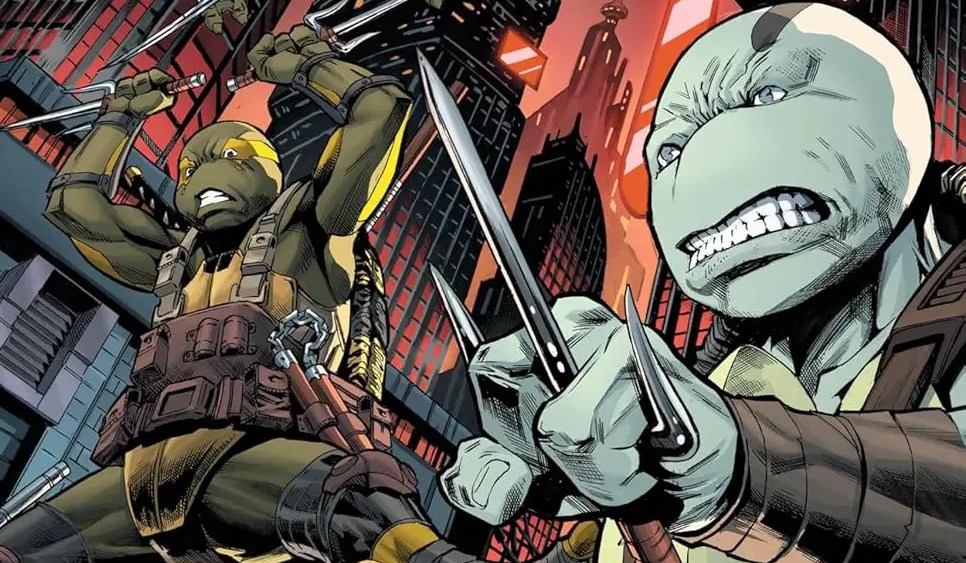
Teenage Mutant Ninja Turtles stories tend to focus on one of the four keywords in the title. “Mutants”, “Ninjas”, and/or “Turtles” do most of the heavy lifting, especially when it comes to Turtles’ regular renewals and various crossovers. It’s only in recent years that the “teenage” part has started to attract attention. Most notable is Teenage Mutant Ninja Turtles: The Last Ronin II – Revolution #3.
Re-Evolution #3 continues to explore the new abilities a new group of Teenage Mutant Ninja Turtles have acquired, but there’s also a healthy dose of teenage angst mixed in, especially when it comes to Yi. Tom Waltz and Kevin Eastman’s screenplay jumps between past and present, revealing how Yi first discovers his powers and how he struggles with them. It’s one thing to be Teenage Mutant Turtles, it’s another thing to be Teenage Mutant Turtles with superpowers, and it’s another thing for the new Turtles to stand out from their predecessors. The Turtles’ fight to maintain peace also takes a surprising turn, and it’s a little frustrating that things end on a huge cliffhanger.
Changes in time also mean changes in art, with a trio of different artists dealing with different eras. The Escorza brothers are responsible for the contemporary art, still retaining the post-apocalyptic era elements they developed during the original Last Ronin miniseries. They also draw an impressive series of pages dedicated to Yi’s new powers, literally lighting up the pages. Ben Bishop handles flashbacks that turn into trippy nightmares, reminiscent of his reality-shaking work Drawing Blood. Eastman depicts sequences that take place in the early days of the TMNT, but the height of it feels quite mythical.
Luis Antonio Delgado’s color work also helps define the three different eras. In Escorza’s case, he uses more muted colors, centered around midnight blue, which represents the New York night sky. For Bishop, it’s a warmer, more eye-catching color. Eastman’s work is drawn in black and white, both to capture the feel of the original Mirage comics he created in collaboration with Peter Laird, and to reflect the mythical status of the original TMNT. It is.
Teenage Mutant Ninja Turtles: The Last Ronin II – Re-Evolution #3 ends on a cliffhanger, but introduces elements that could keep this version of the Turtles going for a long time. Teenage angst, superpowers, fighting for the future you want to live in as well as a legacy you may not be fully aware of – it’s the building blocks of many books I love, and these Embracing the elements makes the TMNT series even more powerful.
“Teenage Mutant Ninja Turtles: The Last Ronin II – Revolution” #3 combines teenage angst with superpowers
Teenage Mutant Ninja Turtles: The Last Ronin II – Re-Evolution #3
Although Teenage Mutant Ninja Turtles: The Last Ronin II – Re-Evolution #3 ended on a cliffhanger, it introduced elements that could keep this version of the Turtles going for a long time.
It leans into the “teenage” part of “Teenage Mutant Ninja Turtles,” introducing elements such as actual superpowers that differentiate the new Turtles from previous ones.
Various artworks from different periods that allow the Escorza brothers, Ben Bishop, and Kevin Eastman to showcase their talents.
A late twist that raises the stakes.
The wait for the next issue will be tough, but hopefully it will pay off.
