


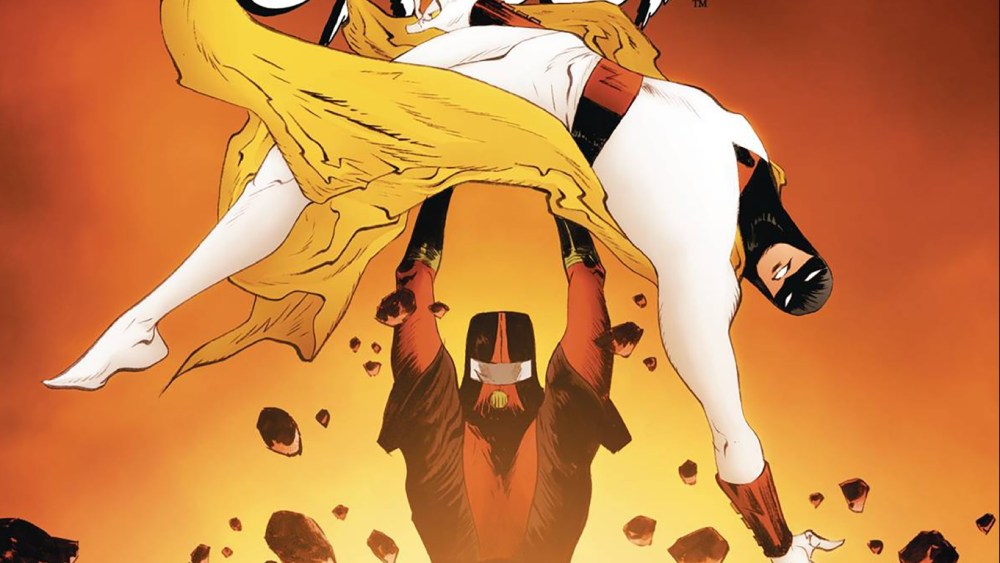
Dynamite Entertainment’s Space Ghost #6 – on sale this week – features a side development from issue #5. Jace is dealing with the emotional trauma of killing Zorak. And no matter how justified Jace was in protecting others and pulling the trigger to save the universe, killing someone must be a truly traumatic experience, especially for a child. Jonathan Lau continues to remind us how young Jace and Jean are, portraying them as skinny with big heads. How does a child so young deal with the knowledge that he has taken the life of another?
Pepose delves deep into Jace’s emotional state, narrating his issues through diary entries. And Pepose handles this event and Jace’s guilt with admirable authenticity considering this is still a comic based on a classic children’s comic. I’m not sure if Space Ghost #6 is better than other issues in this series because of its realistic treatment of this very heavy theme, but more on that later.
Provided by Dynamite Entertainment
Space Ghost #6 begins with the introduction of another Space Ghost villain, Crazy Moltor. And Moltor is portrayed as a kind of anti-space ghost, and his origin promises a lot of dramatic possibilities. He is also a talented scientist, but in contrast to Space Ghost, he is obsessed with his research. He also tragically lost his family, which was also his own fault, as opposed to Space Ghost. And he also has a found family. But the family Moltor finds is not an orphan or a monkey, but his monster.
And the Mortar Monster, Molten Man (a creature of living molten magma), is incredibly well drawn by Jonathan Rau and brightly colored by Andrew Dalhouse. What sticks in my mind from this issue is the image of a mortar and a giant molten man surrounded by orange flames.
But after an interesting two-page origin, Pepose shifts its focus to Jace’s mind, which unfortunately leaves no room for further use of Mortar. For the rest of the issue, he could be a run-of-the-mill, maniacal comic book villain, or just a henchman working for the main antagonists of the Robo Corporation. Besides the great visuals and the interesting potential of his origins, all that matters. Mortar is something that is sadly often forgotten.
Provided by Dynamite Entertainment
So I return to the main theme of this issue. Jace’s sins, or Jace and Space Ghost’s sins. Pepose really writes the characters and this theme with a great understanding of emotional trauma. He also does a good job of showing how Jace and Space Ghost deal with guilt in different ways, depending on their different personalities. And that leads to ample relational rewards, reinforcing Space Ghost’s role as surrogate father.
But emotional trauma is not an easy subject to write about or read about, especially in comics based on classic children’s comics. Don’t get me wrong, much of the plot and much of the dialogue fits squarely into the Saturday morning cartoon mold. However, this issue is heavy due to its focus on diary entries and Jace’s mental trauma, and I’m not sure how well it fits into the series. My favorite thing about the series so far is that I’ve had so much fun reading each issue. Almost every issue is fast-paced, self-contained, action-packed, and fun sci-fi. Well, Space Ghost #6 has a lot of praiseworthy, well-written, and well-executed content, but it’s just not as fun as the other issues.
Provided by Dynamite Entertainment
In conclusion, Space Ghost #6 offers a lot of good things that keep me interested in the series. Jonathan Lau’s art continues to be excellent. Andrew Dalhouse’s colors are fantastic, especially the villain Moltor and his melted henchmen. And Pepose’s handling of Jace and Space Ghost’s emotional trauma is authentic and well-done. But the heavy theme means Space Ghost #6 doesn’t share the same feeling that made previous issues so enjoyable to read.
“Space Ghost” #6 delves deep into Jace’s emotional state
Space Ghost #6
“Space Ghost” #6 offers a lot of good things to keep you interested in the series. Jonathan Lau’s art continues to be excellent. Andrew Dalhouse’s colors are fantastic, especially the villain Moltor and his melted henchmen. And Pepose’s handling of Jace and Space Ghost’s emotional trauma is authentic and well-done. But thematically heavy, “Space Ghost” #6 doesn’t have the feel that I so enjoyed reading in previous issues.
Great art and colors – especially for the villain Moltor.
Deals with emotional trauma in a brilliantly authentic way.
All emotions.
With an interesting origin, mortar becomes unforgettable.
The weight of the main theme takes away the fun of science fiction.
Some of the dialogue contrasts too much with the heavy themes.
