


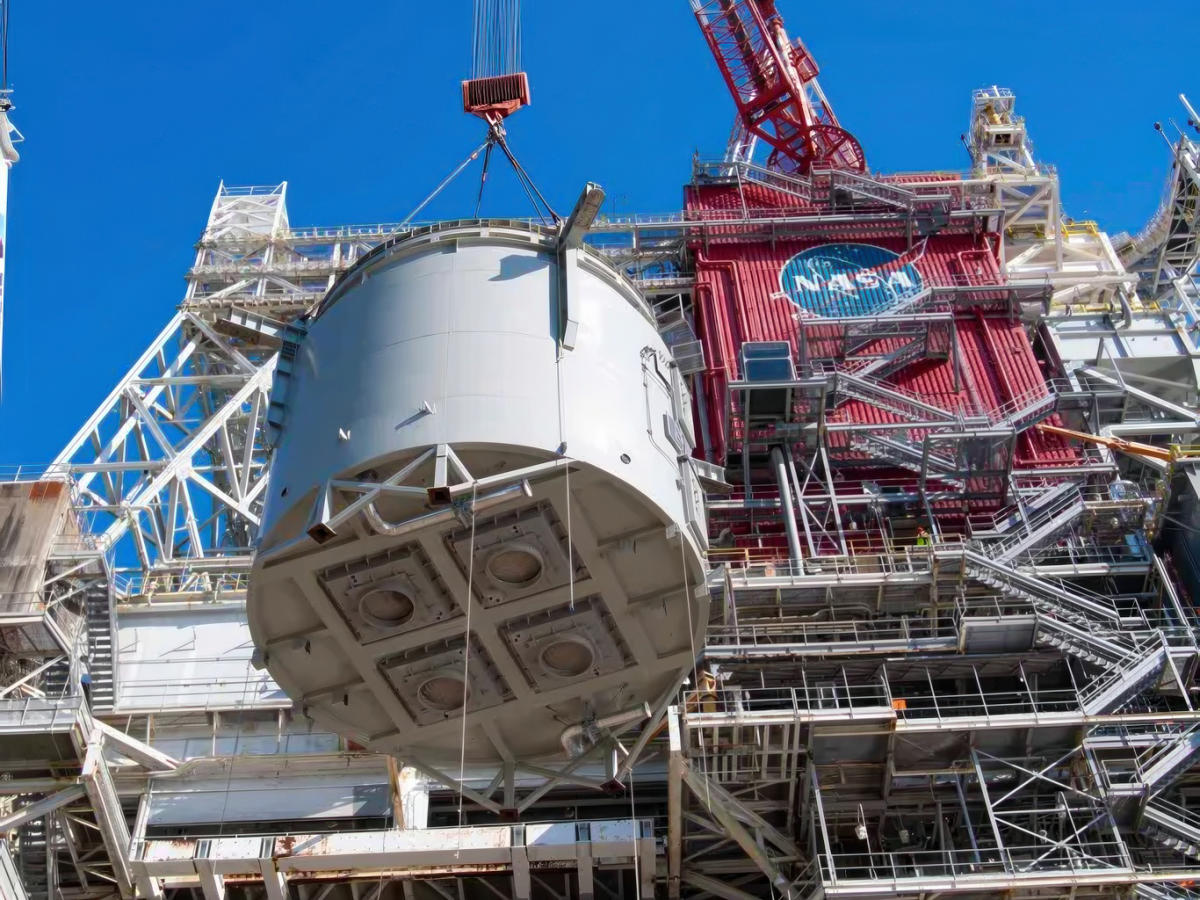
NASA has spent the past two weeks hoisting and installing 103 tons of components into a simulator to help prepare for the next moon mission. The crew installed components of the interstage simulator on the Thad-Cochran Test Stand at Stennis Space Center near Bay St. Louis, Mississippi. The connecting section mimics the same SLS (Space Launch System) parts that will help protect the upper stage of the rocket that will propel the Orion spacecraft on the planned Artemis launch.
The Thad Cochran Test Stand is where NASA sets up SLS components and conducts thorough testing to ensure they are safe and will work as intended in the space-bound versions. The new section has been installed in the B-2 location of the test center and has been fitted with all plumbing, tubing and electrical systems needed for future test runs.
NASA
The middle section protects the electrical and propulsion systems and supports the EUS (Exploration Upper Stage) of the Block 1B SLS, the latest design iteration of the rocket. It replaces the current Block 1 version and increases the payload by 40%. The EUS supports 38 tonnes of cargo with crew and 42 tonnes without crew, compared to 27 tonnes of crew and cargo in Block 1. (Progress!) Four RL10 engines built by contractor L3Harris will power the new EUS.
The interstage simulator section, installed by NASA in mid-October, weighs 103 tons, is 31 feet in diameter and 33 feet tall. The top of this section absorbs the hot fire thrust of the EUS and returns it to the test stand, ensuring that the test stand does not collapse under the more than 97,000 pounds of thrust of the four engines.
1/14
NASA sets up interstage simulator section
Various photos taken of NASA lifting and installing the SLS interstage simulator section at Stennis Space Center.
The tests at NASA’s Stennis Space Center will prepare the SLS for the Artemis IV mission, in which four astronauts will be sent aboard the Orion spacecraft to the Moon’s Gateway space station and a new module is planned to be installed. They will then descend to the lunar surface using the lunar lander Starship HLS (Human Landing System).
You can get a glimpse of some of the hard work at NASA in the video below.
