


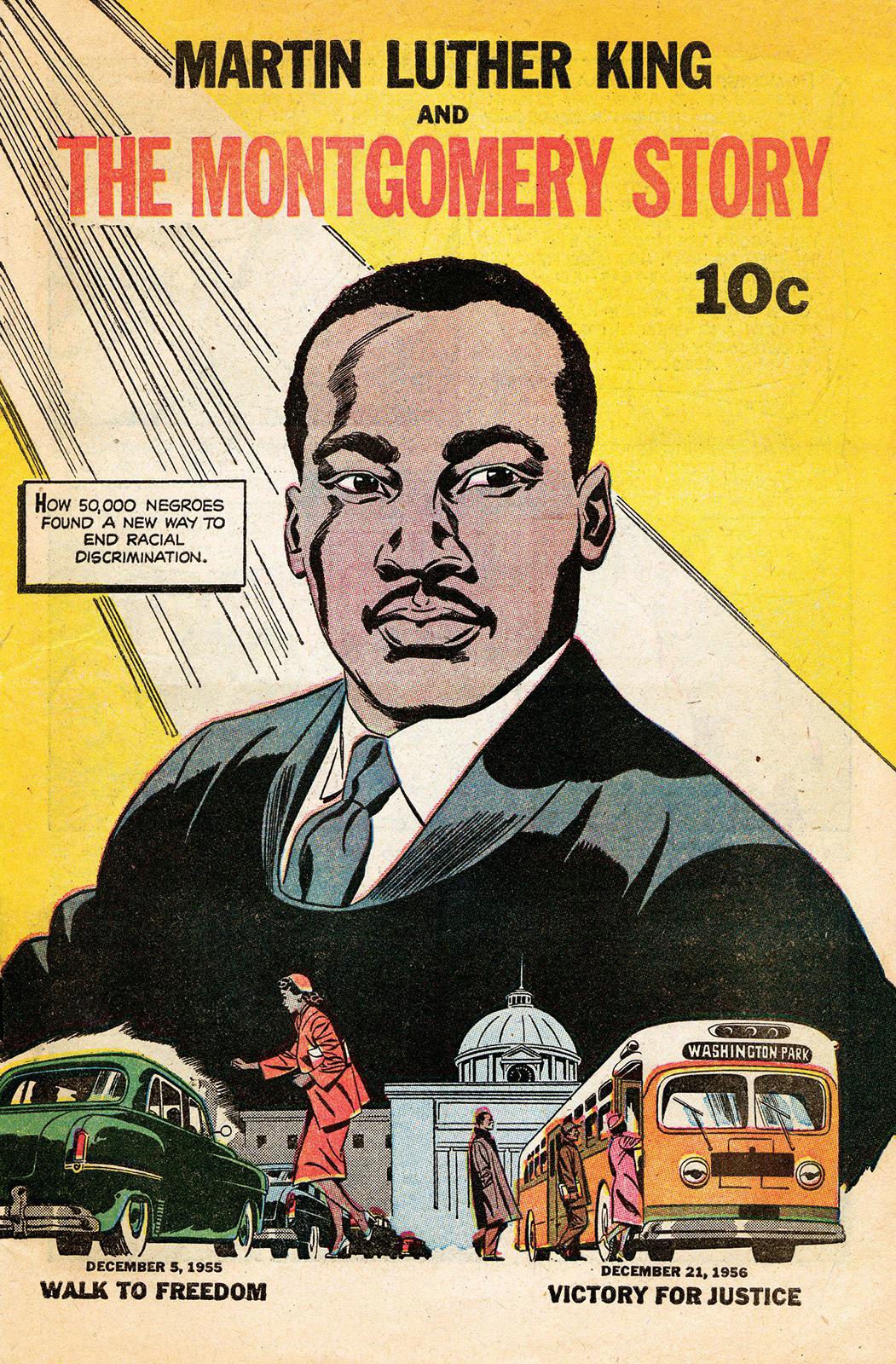
Click to access Comic-Book-1957.pdf
(Editor’s note: We post this every year on Martin Luther King Day.)
This slim 1957 cartoon, The Story of Martin Luther King and Montgomery, tells the story of the Montgomery bus boycott, inspiring many to take up nonviolent protest as a means to achieve civil rights for all. It is said to have been an inspiration. Most famously, a young John Lewis read the book and remembered its power, which inspired him to adapt his life story into the March trilogy.
This comic, published by Fellowship for Reconciliation, was written by pacifist Alfred Hassler and illustrated by an unknown artist at Al Capp Studio***. It has been translated into several other languages and was used as a tool in Egyptian protests in 2011. The first edition had a circulation of 250,000 copies, demonstrating the power of the manga medium at the time.
March co-author Andrew Aydin wrote his master’s thesis on the history of comics, which was featured in this article in Creative Loafing.
It was in the spring of 2008 that I first heard about the civil rights-era comic book “Martin Luther King and the Montgomery Story” from Congressman John Lewis. I had been working for him for less than a year, and I was driving him to an event when we decided to do this. Manga story. I remember Luis, who was sitting in the passenger seat, gently teasing me about attending Dragon Con, a comic convention in Atlanta. But then he said: “There was a comic book during the movement. It was very influential.” I was fascinated. Could comic books have played a role in the civil rights movement? If so, how? Can I try again?
That message is still strong.
***Update: Since last year, James Romberger has made a major discovery in comics studies by identifying Cy Barry as the artist for the Martin Luther King and Montgomery stories.
Cy Barry has a comic that changed the world.
Something like this:
Like loading…
