


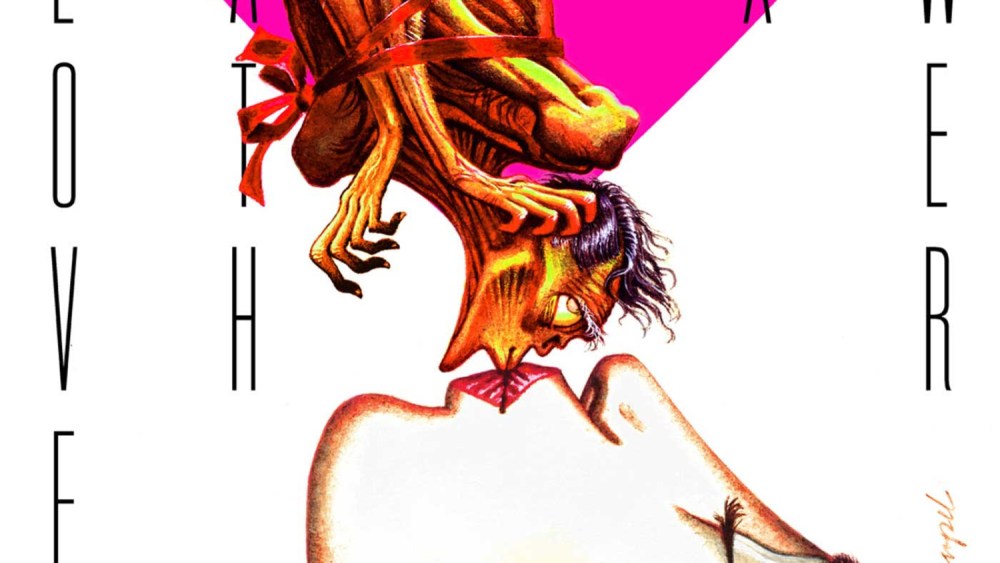
I get it: you’re jaded.
You’ve been a comic fan for ages, and you’ve been subject to dozens and dozens of re-releases and anniversary celebrations. Some of these are your long-time faves, and others you’ve just discovered after 20 or 30 years. Either way, enough of these books end up landing somewhat flat — mere cash grabs without much significance or value beyond that inherent capitalistic ploy. Even the “good ones” often make you wonder why some new book wasn’t slated instead,
But for a moment, open your hearts (and possible your wallets…) to the wonder of the forthcoming remastered Breathtaker Collection.
The Story Begins
Written by Mark Wheatley, and drawn by Marc Hempel, the four-issue Breathtaker was released in 1990 by DC Comics (and then collected in 1994 via Vertigo). In it, we follow the gorgeous Chase Darrow, whose journey to find true love is complicated by ::checks notes:: her lovers’ premature aging and subsequent death. So as Chase deals with her endlessly broken heart, and her status as a succubus, she’s chased by the world’s first-ever superhero, The Man (who works for the NSA, making his nom de guerre quite convenient).
On the surface, Breathtaker involves a rather obvious bit of social commentary
“Chase Darrow is a succubus and you can’t help but fall in love with her,” Wheatley said. “But if you engage with her, you know, she’s going to suck the life out of you. That’s why they send The Man out to track her down and bring her in. Not because they’re afraid she’s going to keep doing it; they want her to work for the government.”
At the same time, Breathtaker is very much a response to a rather specific, quite annoying development across comics in the early ’90s.
“One of the things Marc and I were responding to during…I call it the ‘Lobo Age of Comics,’ this increasing ramp-up of testosterone-poisoned characters in comics,” Wheatley said. “And I love my superheroes with the rest of them, but it was just getting absurd. And so we were very much aiming to create a real woman who was a real character. The Man absolutely was created as a parody of that ramped-up super character.”
So while The Man is stomping around in hot pursuit of Chase, the reader is forced to reconcile with what this figure really represents.
“He deals with bureaucracy every single day,” Wheatley said. “And the problem is that he does not do it that well. He has a guy who is a handler who deals with all the paperwork and all that. And so he wants to look good, but he’s losing his hair. He’s not a subtle guy. When somebody runs into his Lamborghini and puts a scratch on it, he loses it and jumps out and starts pounding on the guy in public and all the paparazzi are taking pictures. Now he’s got PR problems he’s got to deal with and he’s got to go say sorry in public.”
But Breathtaker isn’t just about lampooning this rather obvious buffoon. It’s also about giving that same man a chance to be a real person.
“So he does finally have a brief moment with Chase, and she’s the one person who sees what he’s going through,” Wheatley said. “And he can’t help but fall in love with her. She sees something in him, and so for us to believe that we had to believe it, too. The character has to be real.”
And the same goes for Chase, who is so much more than the succubus label she’s been burdened with throughput her life.
“Chase is a classic character in that…her reason for existence, her entire genetic make-up, is in conflict with her personality,” Wheatley said. “She really wants to connect with people. She really wants love, but to get it means destroying the people who are giving it to her. So, I mean, it’s that internal conflict. I think there’s a line in Shakespeare that essentially says that the only characters worth anything are the ones who are in conflict with themselves because that’s what interests us about people.”
The creators weren’t afraid to get extra real with their characters. And they did so in seemingly simple ways that offered heaps of insights into the characters, the book’s specific moment in time, and even readers’ expectations of the genres involved.
“There’s a sequence in here where The Man is getting ready for his dinner with Chase,” Wheatley said. “And he’s clipping his fingernails and his toenails and combing his hair into perfect shape. Everything is on display. In many ways, The Man ends up being as much a victim as Chase is because he’s being abused by his government handlers as much as he’s being forced to abuse Chase.”
It’s a focus on making real, relatable character that Wheatley learned from a rather unlikely source.
“I always liked sitcoms, for example, that portrayed real people, and the humor comes out of the characterizations,” Wheatley said. “I remember years ago, people saying, ‘Hey, there’s this new show called Cheers. You should check it out.’ And I caught an episode and I thought, ‘What was funny?’ And my wife was like, ‘Well, I don’t know. It was kind of funny.’ So the next week we were sitting there at the same time and it came on again, and that time, it was a little funny. By the third week, we were laughing our asses off.
“And I’ve never written a character I didn’t like, including the bad guys.”
Wheatley added, “And I realized what happened was we got to knew the characters. We hadn’t watched the first show that introduced everybody, right? And once we had a feel for who the characters were, it really was funny. You have friends and they’ll start to say something and you immediately start laughing because, coming from them, this is funny, right? You have to make your characters believable and sympathetic. And I’ve never written a character I didn’t like, including the bad guys.”
But the magic of Breathtaker isn’t just the deep emotionality and honest character development. As it turns out, the story about how Breathtaker came to be is equally thrilling, poignant, and unwaveringly human.
The Saga Behind The Story
It’s 1974, and Wheatley is studying at Virginia Commonwealth University while working as an art director at the Department of Agriculture and Commerce. One day, while sorting through submissions to his personal fanzine, he opened an unsolicited letter from a young kid out of Chicago.
“Marc just blew me away,” Wheatley said. “The samples were just so far beyond what a high school kid should have been doing. But they were weird. The dialogue balloons…had been very carefully razor-bladed so that all the words ‘fuck’ and ‘shit’ had been removed. You could tell what was supposed to have been there, but they weren’t there anymore. I was like, ‘Well, this guy’s kind of schizophrenic.’”
Kooky tendencies aside, that was the start of a rather meaningful and accomplished partnership between Wheatley and Hempel.
“So we started talking on the phone and getting to know each other and I published his stuff,” Wheatley said. “And I went off to New York and I acted as his agent and started getting him published before he even graduated. But eventually I ended up down in Baltimore and he came out and we started a studio. We had done Mars. We had done Blood of the Innocent. We did Blood of Dracula. We were doing Jonny Quest.”
It’s around that time, however, that Wheatley says the pair were “on the verge of killing each other,” which wasn’t helped by the pair sharing office space right across the hall from one another.
“And so I decided we wouldn’t collaborate,” Wheatley said. “I went off and started editing and packaging the Tarzan comic and a few other projects on the side. I worked as a printer and I knew all this technological stuff. I invented a color separation system that started bringing money into the studio. And we were working with a film house and we were in the early stages of developing computerized color. And Marc’s in his room, just drawing.”
Courtesy of Mark Wheatley.
Eventually, though, the two were forced back together, sort of.
“I started realizing, wait a minute, in about 18 months, I don’t think he’s had any income,” Wheatley said. “He was doing these beautiful paintings; they’re very sexy science fiction paintings, with women in very avant-garde settings and barely clothed and just very voyeuristic. I decided I would try to come up with a project I could just write and hand off to him and I would just stay out of his hair. It wouldn’t be a true collaboration.”
And while Hempel hadn’t done much to keep money flowing in, Wheatley couldn’t deny the magic of those paintings he’d whipped up in near-isolation.
“I was thinking about his paintings and they were breathtaking,” Wheatley said. “And I thought, breathtaking, that would be a cool name. What can I do with that? And I was hiking up the side of a ravine in a park, and by the time I got to the top, I had the whole thing worked out in my head. I climbed down, went back, and called Marc.”
From there, Wheatley said he pitched DC’s Mike Gold on a Monday night and got the thumbs up by the next Tuesday morning. There was just one teeny, tiny issue.
“They didn’t really have a contract for (creator-owned books) at DC Comics,” Wheatley said. “So my lawyer and a vice president at DC spent the next 14 months writing a creator-owned contract while Marc and I went off and did other things.”
“We couldn’t find an editor who didn’t think they knew more about Breathtaker than we did.”
Once that legal snafu was address, Breathtaker went on to become a massive hit.
“I think the first book went through three printings and the second there were two printings,” Wheatley said. “And then it was collected as the very first Vertigo graphic novel, and that went through seven printings.”
A sequel series was heavily discussed, with DC’s Paul Levitz leading the charge. However, as Wheatley explained, the pair “couldn’t find an editor who didn’t think they knew more about Breathtaker than we did.” And so the pair moved on with their respective careers.
Oh, but you have to know this story clearly isn’t done. Let’s look at Breathtaker‘s equally exciting second act.
Breathtaker‘s Post-Release-Palooza
Circa 2014, Wheatley and Hempel decided to hit up Indiegogo to crowdfund some new release for Breathtaker. But when the campaign proved to be “so-so” financially, according to Wheatley, they eventually came into contact with Nick Landau at Titan for the release.
“We worked out a deal, and it was full steam ahead until there was some sort of hiccup in the distribution system,” Wheatley said. “And we decided, ‘Let’s wait a minute; let’s do this next year.’ Then there was another industry-wide disaster the following year, and we thought we should wait another year.”
And just when they were finally ready to go, something else popped up — albeit a generally positive development for Breathtaker.
“Then, the following year, the Norman Rockwell Museum came to us…and we decided to do a show dedicated just to Breathtaker,” Wheatley said. “Nick was ready to publish, but we thought let’s do it conjunction with the (touring) show. It took two-and-a-half years to get the touring show set up.”
And then they toured the book and everything was amazing. Right?
“And then there was that little thing called COVID,” Wheatley said. “The book was literally at the printer; it was next in line to go on press. I talked with Nick and I said, ‘Is this the best idea to be doing this right now?’ He called back an hour later said, ‘No, it looks like we’re not going to even have a distribution system.’ So that fell apart. Then the Rockwell show got delayed because of COVID.”
Luckily, the world was a little less on fire a year or so later, and the pair toured the Rockwell show to great success. While Wheatley is a touch disappointed the printing process “didn’t sync” with the show, he takes it all with a grain of salt. Breathtaker‘s re-release may have taken ample time, but it’s just the way of this weird, fickle industry.
“I’ve been in this business since 1978, and I don’t know that I’ve ever done a project yet that went from point A to point B,” Wheatley said. “It’s always point A to point G, H, and Z and then back to H.”
Still, wrinkles like that may sting more than others. Case in point: After the sequel fell apart, the duo eventually got back the rights to Breathtaker. The comic was nearly adapted into a movie by Kate Hudson’s production company — until fate intervened, of course.
“That was on a Wednesday, and on Friday, the studio was taken over by a different company and all projects were put into turnaround,” Wheatley said.
Courtesy of Titan.
Same thing for a TV deal that got even closer to getting off the ground.
“We were approached several years ago about a TV series and then we had a greenlit and was ready to go with a streamer,” Wheatley said. “Marc and I were producers. Then there was this writer’s strike and an actor’s strike and the production company…lost something like $8 billion.”
But all of that’s mostly ancient history, and now Breathtaker at least gets a chance for new life via the re-release. Sure, it ain’t a Kate Hudson-starring Hollywood adaptation, but there’s more magic to be found in this collection.
A New Way of Creating Comics
For one, Wheatley, Hempel, and their collaborators had an easy enough time in starting the painstaking task of remastering a 35-year-old comic.
“Because of the Rockwell show, we still had 80-something percent of the original art,” Wheatley said. “We were in connection with lots of collectors, so we were able to get scans sent to us of another 20%. So there’s really only a tiny number of pages that we had to work from other source materials.”
“We did something very unusual. I painted those pages at the same size that he drew them. They’re not done down to print size.”
Here’s where things get truly interesting. Because as Wheatley explained it further, Breathtaker is a special book if only from a logistical standpoint.
“In our studio, we were producing blue lines for the industry, and we were doing color separations for the industry,” Wheatley said. “So we took his pages while they were still moist off of (Hempel’s) drawing board, brushed them, and took them downstairs to shoot film. I would be working the next day on that page painting; I painted it on blue line. We did something very unusual. I painted those pages at the same size that he drew them. They’re not done down to print size, which everybody else was doing. We had full size.”
It’s here that Wheatley humbly bragged that they were using so much watercolor board that Crescent would “send one of their trucks to our studio once a month.” Even still, the whole approach did have some noticeable downsides. They’re a wee bit technical, so I’ll let Wheatley explain it all.
“I painted in watercolor and wash on a very thick…an eighth of an inch thick sheet of crescent watercolor board with a film overlay of film positive,” Wheatley said. “So when that was color separated…it was back in the days of drum scanners that would spin it high. And the little scanner would just scan across it back and forth as the thing spun. Which meant that those thick, stiff boards, they had to peel the watercolor layer off of the hard board and wrap it around the drum to scan it.”
Still with us? OK, here’s all you really need to know about the process that makes it meaningful but tricky to effectively manage.
“Heat in the air causes paper to expand, and cold will also cause plastic film to shrink,” Wheatley said. “So when we got all the separations made, the line artwork no longer lined up with the color artwork. It was close, and it was in the ballpark, but it never really lined up.”
And now? Brother, you bet it all lines up!
“Now the colors are actually what we wanted them to be in every single spot,” Wheatley said. “The sound effects…they’re not just all black over the top of black artwork. They’re all in color.”
Wheatley added, “I like the fact that I can see the lines that Marc actually drew. They’re not fuzzy because they’re not laying on the line that I painted. It’s sharp and it’s clean. You can see the texture of all of the gouache and watercolor I was laying down on the page. And it’s on really nice paper; the printing is top notch. Titan spared no expense whatsoever on this.”
But if you aren’t exactly doing cartwheels about printing techniques, don’t fret.
Still More Stories to Tell
Because there’s actually one truly great element of the Breathtaker Collection to get genuinely worked up about like some kid on Xmas.
“Mark and I decided to do a new The Man comic book that would extend things,” Wheatley said. “And a lot of other extras were added to the book as well.” That includes a great introductory essay from the legendary Walter Simonson.
Courtesy of Titan.
So, what’s the new story about? Maybe The Man’s life as 60-something superhero? Not exactly. (Wheatley did say that the first sequel they’d planned would’ve “taken place 20 years later with Chase’s daughter.”) Instead, “Make Way for the Man” is actually a bit more meta.
“It’s actually set in the universe of Breathtaker,” Wheatley said. “In the story, The Man has his own TV show and his own comic book series and video games and toys and a clothing line. So we did the story like it was an issue of his comic book. It’s the comic book version of The Man.”
And, yes, they even made sure the numbering was spot on.
“At one point in the actual graphic novel, a little boy comes up and wants The Man to sign his comic book,” Wheatley said. “And so he hands the comic book to The Man and we can see the cover, and it’s Make Way for The Man #137. So we did issue #138. Issue #138 is numbered #1 in here because Titan said, but it’s #138.”
“It’s The Man battling a mega-villain, traveling the globe, to stop him from releasing The Breathtaker Device.”
And like with any great comic, metafictional or not, “Make Way for The Man” offers a rather thrilling story in which to sink your teeth.
“It’s the final chapter of a 12-issue epic storyline,” Wheatley said. “We were able to compress 12 issues because you’re coming in for the final chapter and we bring you up to speed and then we pay it off. It’s much more true life, and much more James Bond. It’s The Man battling a mega-villain, traveling the globe, to stop him from releasing The Breathtaker Device. None of us know what the device is until we get to the end of the story.”
And, of course, there’s a little something sweet on top. Consider it comics dessert, really.
“We even included a hostess Twinkies ad with The Man,” Wheatley said. “We were poking fun at that toxic stuff back in the ‘90s, but now all the time has passed.”
Now Twinkies may be a (mostly) harmless treat, but they’re also our way into something important about the birth and development of Breathtaker. A topic that adds to the humanity of this rich, deep book.
An Interlude on Comics Collaboration
There’s no denying the satirical heft of Breathtaker. But even as the writer, Wheatley said he isn’t the leading source of all this intellectual strength.
“The guy who’s really, really good at that is Marc,” Wheatley said. “When we decided to do the fake Twinkies ad, I had Mark write that.”
And not only is that Twinkies ad generally great, but Wheatley said that Hempel delivered it “in a day or two.” It’s something of a record for the otherwise slow-working Hempel, and that’s always been something of a concern between the two collaborators.
“That is the tension between us that you may pick up on,” Wheatley said. “There’s nothing to do with personalities and everything to do with the fact that I have been known to turn out a book over a weekend. And Mark has been known to turn out a book over a few years.”
Wheatley added, “I penciled The Man comic book, and Marc was supposed to have penciled it, but he couldn’t get it together to do it. So then he had to ink it, and it took over a year for him to ink the standard comic book. Our working speeds are just not that compatible. And when we started, it wasn’t that different.”
That may further explain the duo’s disagreement that led them part just before Breathtaker‘s debut. But it all turned out well enough, and it almost seems pointless to bring up. Except the collaboration between Wheatley and Hempel really is at the heart of Breathtaker. It’s not only what makes the magic of the story but likely kept it going across the long, strange journey for the book’s various releases/iterations.
I even made an observation that Chase and The Man may be representative of the Wheatley-Hempel relationship/partnership. While Wheatley said the dynamic isn’t quite the same, you still can’t deny how their bond facilitated this book.
“Well, Mark and I are really good friends,” Wheatley said. “You put us in a room together, and if we’re not working, we’re laughing our asses. Our sense of humor is sophomoric at best. I have certainly learned a lot from Marc over the years. There’s all sorts of aspects of what I can do now that I picked up directly from him. But I think, to some extent, the same is true for him, although I’m more of a sponge than he is.”
Courtesy of Titan.
Wheatley added, “Marc is just funny. He’s a guy who just sits back and observes life. And he’s constantly putting it together in his head and tearing it apart and putting it back a different way. He did a series of comic books that I published back in the day called Naked Brain, which were just page after page after page of gag cartoon. His ability to be concise and funny is unmatched.”
Plus, regardless of what happened with this re-release, there’s no Breathtaker without Wheatley and Hempel.
“But Marc has gotten to the point now where just turning out any volume of work is so difficult for him,” Wheatley said. “He’s just not focused on doing art anymore. He’s far more likely to want to go perform with his band. But if were go back and do any more Breathtaker, I certainly wouldn’t want to do it without Marc.”
“It seems weird that time has passed because it doesn’t feel like the time has passed,”
And, no, the duo wouldn’t even think to pass Breathtaker on to some young, hungry creative team.
“I did my time writing the Black Hood, writing the Flash,” Wheatley said. “There’s nothing more painful in the world than to invest everything you have in a character and have an editor say, ‘Oh, we’re completely changing the direction of the storyline because there’s a whole label-wide event.”
Obviously, there’s lot of big ideas and bigger emotions attached to Breathtaker. And so it’s re-release isn’t just a cash grab because this story is perhaps more alive and relevant than ever before.
Breathtaker‘s Story Continues
Because even after some three-plus decades, the messages and themes of Breathtaker are nearly one-to-one with life in 2025.
“It seems weird that time has passed because it doesn’t feel like the time has passed,” Wheatley said. “When we wrote it, we were dealing with Reagan, I think. But I don’t know that I can claim any sort of prescience on our part in writing the story. It’s more the fact that the world really hasn’t moved ahead.”
In fact, not only is the story exactly the same, but it didn’t demand some massive update.
“I had to reread it — really, deeply reread it — to do ‘Make Way for the Man,’” Wheatley said. “Because I really needed to know where we were coming from. I had to get back into that mindset. And I was really struck by the fact that, except for there only being one guy with a cell phone, it could have been published today and would have been a contemporary story. We’re even still dealing with the same issues. The struggle between various aspects of politics and government and whether or not people have control over your lives or not.”
There’s also a similar level of value from an artistic level. Breathtaker really changed the game (and not just in novel ways of printing, either).
“First of all, I don’t think you’re going to find anybody better at telling a visual story than Marc Hempel,” Wheatley added. “I would put him ranked with Harvey Kurtzman and Will Eisner and Mœbius.”
Wheatley added, “A couple years after this came out, Genndy Tartakovsky calls Marc and says, ‘I’m starting this new show called Samurai Jack, and I’d love you to design it for me. In a sense, everything you see today in many places, not comics necessarily, but everywhere, has already been transformed by this.”
However, the book’s true value isn’t just political or creative in nature. No, for Wheatley, it’s a deeply personal; he called it his “favorite book I’ve ever done.” So much so, he revisited it in the recent Nucleus X, a kind of spiritual successor and wrap-up to his fanzine, Nucleus.
Courtesy of Titan.
“I published the last issue when I was in college, like, 40 years ago,” Wheatley said. “This new issue is the secret to all of the comics I’ve done, which is that they’re all one story. It’s all part and parcel. I did a 48-page graphic novel, if you want to call it, in Nucleus, that finally shows how it’s all connected. And it’s pretty much a Mars story with Radical Dreamer wandering through it and a very brief mention of Breathtaker and The Man. But it does show how it all stitches together. So in a sense, they’re all my favorites because it’s all one story.”
Breathtaker may be just one component of that Wheatley’s grand narrative, but it’s also very much a story entirely of its own merit. It’s a story about overbearing governments; man’s endless grapple for relevance; the struggle of maintaining social connections; and even where we find our heroes. Mostly, though, Breathtaker is a story about being alive in the simple and most effective way. And that’s got to be worth at least $29.99, right?
“It’s a fun story in many ways, but it’s also a very serious story about loving and giving and relationships and the real implications of having powers far beyond the people around you,” Wheatley said. “I just think it touches people in their hearts and it entertains them while it’s doing it.”
