


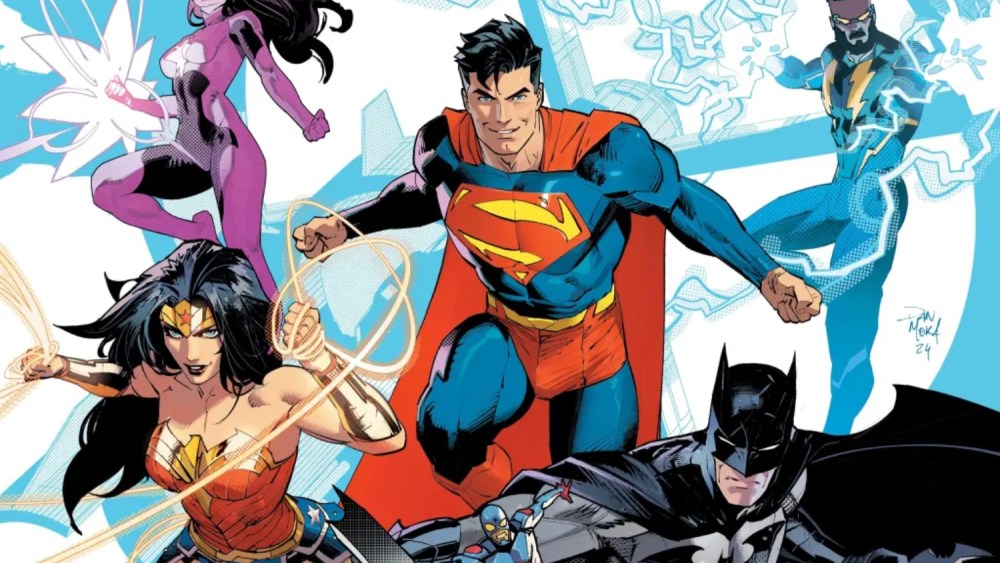
Mark Waid is having something of a renaissance at DC Comics. After doing a brief story during Dark Knights: Death Metal, Waid has quickly risen to once again being the writer at the famed publisher. (Among a crop of extra talented creators, of course.)
Now only has he expertly revived the World’s Finest title, but Waid has written a few major events for DC continuity, with the most recent being Absolute Power. In that harrowing event, Amanda Waller attempted to take all of the hero’s powers and assume a new, self-asserted leadership role in the world. Spoiler: it didn’t work out. But what did come of all that is the reformation of the Justice League. It’s not that the Titans were doing a bad job as earth’s protectors, but this latest iteration of of the Justice League is all new and all different (can I say that? I’m rolling with it) because it’s an Unlimited roster. Moving forward, this seems to mean if you’re a hero, you’re on the Justice League. Pretty cool, right?
Justice League Unlimited #1 is due out this week (November 27). Ahead of that packed debut, AIPT had a moment to chat with Waid about this new title, what goes into each roster, and what readers can expect from the series. It’s an insightful chat not only into Waid’s latest magic with DC, but what he brings to this singular universe in general.
AIPT: Mark, I just wanted to thank you really quick. You’re one of my comic book heroes and I’m sure you hear that all the time. Your 52 #25 with Nightwing that you did with George Pérez was my first showing of any of your work, and it’s still maybe one of my favorites. It’s a two-page thing that I always use to talk about how to describe the character to anybody.
Mark Waid: That’s really nice, thank you so much, my pleasure.
AIPT: Well, thanks so much for being here today. I’m super excited for Justice League Unlimited. What drew you in to writing this form of the league?
MW: It was a natural progression from World’s Finest. I mean, World’s Finest continues, and it continues to be this sort of silo where I can write stuff that’s in-continuity and features a bunch of DC Characters as I want to pull them in or out. But, it’s still set in the past. This is set in the present. This is current continuity. But, it still allows me to use any and all characters from the DC Universe and pull them in as needed.
Courtesy of DC Comics.
AIPT: I think that’s been such a strength of both titles. You’ve now got three kind of separate time points, with Batman & Robin Year One with Chris Samnee, World’s Finest, and Justice League Unlimited. How has it been writing these different time points for the DC Universe and some of their big characters?
MW: ::Laughs:: It’s been great. Every once in a while, with World’s Finest in particular, I have to think to myself, “Oh, wait, Cyborg isn’t around yet.” Or that sort of thing. But, by in large, I keep track pretty well.
AIPT: That’s awesome. With the title, I just have to ask too, with it called Justice League Unlimited, should readers expect some sort of similarity with the TV show that’s named similarly?
MW: I think in the sense that it tends to be mission specific. There’s always several things going on. There’s always several plates spinning and several different subplots (bubbling) under the surface. But on a story by story basis, it really is Red Tornado, who is the sort of the dispatch and monitor of the group who will be keeping an eye on the world’s situation, and send in the specifically perfect heroes to deal with any specific crisis based on its nature. You know, sometimes you’ll need Superman and Wonder Woman. Sometimes you’ll only need Fire and Ice for a smaller thing, or what have you. But, in that sense, it does remind me of the cartoon show. Mission-specific.
AIPT: That’s awesome. I mean, getting a brief look at that first issue, I could totally see the thing that you were going for there, and I think (it) was a slam dunk.
MW: Thank you.
AIPT: And Dan (Mora)’s art was spectacular. It was really incredible how what you kind of just said, you get that vibe right away.
MW: Cool. Dan and I make a really good team. And Dan is terrific. And Tamra Bonvillain, who does the coloring, is sensational. The two of them have been a team for a long time, even before DC Comics work. And, they work so well together.
AIPT: I think it seems to be such a good working relationship too, when you have that kind of trust back-and-forth with one another and kind of giving a little more free reign, or just “Oh, they know what I’m talking about.”
AIPT: How has that work dynamic with you, Dan, and Tamra allowed the series as a whole to evolve and take shape?
MW: It has a different flow to it because Dan and I have such a working history now together, having worked for two and a half years together on World’s Finest. We sort of have a short hand between us, and he and I just play off each other really well. I know his strengths, he knows my strengths, and we work together to compliment each other purposefully, by design.
AIPT: I think that, at least from the issues in World’s Finest in particular, there’s been such a great development in how the environment as a whole takes shape. And with things like The Watchtower, seems to be points where it looks like that readers can appreciate that.
MW: I think so.
Courtesy of DC Comics.
AIPT: The Justice League has also changed a lot since they last existed. All those characters are in very different places than they were before. How, if at all, is that going to be a thing for readers to kind of see? Like, Aquaman and Wonder Woman haven’t worked together on a team in a good few years, in our world, at least. Does that have any impact on how they are able to read each other? Like how you mentioned you and Dan can read each other?
MW: It really does. Part of the joy of working on a book like this is putting characters together that either haven’t been together for a long time, or have never been together, and building individual relationships between those people. That’s the kind of stuff that you can only get in a book like Justice League Unlimited.
AIPT: That’s such a good point because, especially as you said, it’s going to be very rotating as far as who’s taking what mission. I feel like that will offer good interactions that haven’t happened in a while or never have.
Has there been a character that you found to be the heart of the Justice League so far?
MW: Not so far. Part of that’s cause I’ve been playing through with a bunch of a different heroes. But, I would look to Superman and Wonder Woman as a good team. Superman as the heavy hitter, but, in the field, Wonder Woman is the general. Wonder Woman is the one calling the shots. Not that Superman is under her in any sense, you know, on a power level or on a stature level, but she’s just the military mind you need in the field.
AIPT: That makes a lot of sense. You mentioned recently that you’re still getting used to writing Diana.
Has the series helped shape that for you a little more?
MW: Yes it has, yes it has.
AIPT: That’s awesome. I think that’s such a really good aspect of her that people don’t often think about. Like the general mindset that you just said, versus just being a straight-out warrior. Does that strategic mind make her a de facto leader of the team then, or just the person that people look to?
MW: Certainly in the field. If she’s on the mission, she’s the leader. I mean, people tend to look at Superman, and in the past Superman has a history of being the one calling the shots. But it makes more sense to me, if Wonder Woman is around, then she is the one they would defer to. And then, in terms of other characters, it really is a discovery for me geting to do a deep dive on someone like Black Lightning, or Star Sapphire, or characters that I haven’t worked extensively with, and thinking about not only what kind of character they are and how they operate in the DC Universe. But also how they operate in a team like this, and what they can bring to these unique, like I said, it’s mission-specific based on powers and abilities, but that means I have to give a great deal of thought with every story as to who is best for this job and it may not necessarily be the same Leaguers over and over again.
AIPT: Do you have a character that you’ve found to be a favorite that you haven’t gotten to write as much recently that you’ve grown close to writing?
MW: I’ve gotten super fond of Air Wave. I have been (fond of the character), and hopefully by the end of the first issue, you will be too.
Courtesy of DC Comics.
AIPT: I think that’s a safe bet. ::Laughs::
MW: ::Laughs:: I mean, he’s a great point of view character. He’s new to the team. he’s new to the readers pretty much. He’s pretty much new to the DC Universe. At least, we haven’t seen that character for 40/50 years. And so, he’s a really good person to see the Justice League through their eyes.
AIPT: It’s almost like he’s representative of the reader in a way then?
MW: Yeah, very much so.
AIPT: That’s awesome. Having that kind of character, especially on a team book, is sometimes so helpful to connecting with it as a story.
With it being a rotating cast, what factors come into play if a character’s on a team? I know a character like Air Wave that hasn’t been seen in so long, is that kind of how you weigh it: based on who’s best fit or who readers maybe should get acquainted with?
MW: When I put the teams together, I basically have three tiers. I want to have two or three of the big heavy hitters. Batman, Superman, Wonder Woman, Aquaman, Flash — the standard -bearers of the Justice League. Then, on the second tier, I want to have the characters who are sort of B-listers in the sense that they’re not the holy trinity of Superman, Batman, or Wonder Woman. But, you get characters like The Captain, or Mary Marvel, or characters like that. Robin. And then, on the third level, I want to bring in at least one character that hopefully is pretty new to newer readers. Whether that be Air Wave, or Doctor Occult, or Xanthe from Spirit World. Some of those, I try in every issue to bring in at least one character that is functionally new to the DC Universe in the sense that we haven’t seen them for a long long time
AIPT: I think that that’s a very smart way to use the team. This book seems very different than many past iterations that are typically the big seven, or anything like that.
MW: Thanks. I mean, and that’s by design. I could do a book that’s just the big seven. But, it’s better to just mix it up. It makes the team more inclusive, it makes the team more diverse, it makes the team just more interesting from my point of view, because you can play with power levels. If you’ve got the same seven core seven Justice Leaguers in every issue, then the threat has to be gigantic every single time. And this gives me the ability to sort of play with the level of threat as long, as there’s urgency to it, as long as there is danger to it, but it doesn’t always have to be Starro, you know.
AIPT: That’s very smart, too, because you’re right otherwise it is always the giant level Darkseid.
MW: Yeah, exactly.
AIPT: And I think also, as a reader, that’s helpful I’d imagine, to the whole All In initiative to spotlight characters that maybe readers aren’t super familiar with as well.
Waid: Exactly, yeah.
AIPT: I’ve been kind of curious, when you mentioned Robin, it popped in my head. I was so curious with the Robin’s Nest, does that correlate to Robin, or is that a metaphorical nest?
MW: It’s more of a metaphor. It’s not specifically a Robin-centric room, it is more that is The Monitor Room. And that just seemed like a more interesting name than The Monitor Room.
Variant cover by Jim Lee. Courtesy of DC Comics.
AIPT: That makes sense. When I saw Dan’s incredible art delineating the whole Watchtower, I pictured Tim and Damian in there fighting over space for how to coordinate.
MW: And you will see them. But you’ll also see other characters in there as well. Mister Terrific spends a lot of time in there.
AIPT: That’s awesome. It’s very clever, too, because you’re right, otherwise it would just be The Monitor Room.
With that, what made you pick The Watchtower? I love it. I love the Hall of Justice, I love the Watchtower, and it’s always nice and refreshing when it’s flip-flopped back and forth. What made you decide on taking the Watchtower as the League’s main base?
MW: That was actually the idea of editor Paul Kaminski. But I was all in, because I don’t look at the watchtower, especially because it’s not in geosynchronous orbit with the United States like it used to be in the past, so I don’t look at it as God’s looking down upon humanity. What I look at it as is a way to be at trouble points all across the globe and help keep on everything that’s going on, not just what’s going on in the U.S. or what’s going on in the western hemisphere.
AIPT: Definitely to your point earlier how it might parallel with the show, the ability of the team to go wherever seems the most logistial for a Justice League that’s meant for the world.
MW: Right, and again, that’s why I took it out of geosynchronous orbit and give it its own orbital path, so it doesn’t feel like God’s looking down their nose at tiny men on Earth, you know.
AIPT: How do you pick then where, not so much the threat, but where the threat’s going to be? Do you try to make a connection between the two as far as like weather or anything, or is it completely off the dome?
MW: No, I always give thought to what time of day it is in the world. So, if you’re doing a story in the United States but you’re also cutting back and forth to, you know, Europe, it’s going to be night and day. If you’re going to be in Costa Rica, I want to get a specific place. If you’re going to be in South America, I want a specific place. And I am working hard to make sure that we’re hitting all across the globe and not just every single adventure happening in Arizona, or what have you.
AIPT: Going back to Dan Mora’s incredible art. I’m sure, especially as far as with what we’ve seen in World’s Finest and what people can look forward to in the first issue, is his ability to create such a life like environment I think is so baffling at how well he does that.
MW: He really does. I mean, he does his research clearly. It doesn’t matter where I ask him to place a scene, he always makes it feel very much of that place and not at all generic.
AIPT: That’s so incredible, I can’t even imagine the kind of research that he must take to go into that as well. Is that where your creative process with him is just- do you give him like a place or is it not as specific and he decides?
MW: Often I give him a place. So, I mean, there are times where I’m like, “Whatever you feel like drawing here, Dan, it doesn’t really matter where this is happening because this is what’s happening.” But, by in large, there’s specific places because they’re mission dependant as well. For instance, in that first issue, we have the big bad going after iridium mines, specifically because that gives you a chance to control the world’s electronics. So, where are the biggest iridium mines in the world? Where they’re in this specific place. So, let’s go there.
Variant cover by Andy Kubert. Courtesy of DC Comics.
AIPT: That’s really interesting and very thoughtful how I think they end up connecting to one another.
MW: Thank you.
AIPT: When you mentioned electronics, I thought of this because I remember the World’s Finest arc that you did a little bit ago with the Tornado family, I think it was. It was very technology focused, and it seemed like it was a really cool thing to parallel everything with A.I. and stuff. Does the Justice League have similar a kind of, I don’t even know if that was intentional (in World’s Finest), but do you have a theme in mind for the first Justice League arc or so in a similar way then?
MW: It was, that was intentional, yes. And similar to that with the Justice League, as you’ll see, it is in terms of the big bad, it is less about giving them something to punch, and more about trying to manipulate the world in less traditional ways than having just a giant robot show up and start swinging fists.
AIPT: Definitely. I think it’s a really cool way too, with the Justice League having not been a thing, and then bringing them back. The threats are definitely different and more thoughtful.
MW: Thank you.
AIPT: I think that’ll be something, I know I’ll look forward to. Is that as far, I don’t know how far ahead you’ve mapped, a general skeleton of how readers should expect the stories to go for the first year or so?
MW: At least for the first year or so, yes.
AIPT: I think that’ll be really beneficial for the story to allow characters to move around and grow.
MW: There are, on a subplot level, there are certain random locals and random missions, but by in large there’s a pattern and a specific through-line for the big bad menaces.
AIPT: Will the big bad menaces, with the All In Special that just happened, is there a timeline for how they coincide, or is your book meant to be its own thing kind of separate from everything with Darkseid for now?
MW: We’re working together on that. We want to make sure that that’s all tied together and is part of what All In as an initiative does really well, which is, ties the DC Universe together in such a way where the characters get to be themselves and the books get to be what they need to be without a ton of crossovers, but at the same time, under the surface, we’re all working with the same basic subplots that are burbeling in the DC Universe.
AIPT: It sounds like then there’s a lot of connectivity between titles?
I always think that’s helpful. Is it helpful to check in with the Batman office or Green Lantern office: “What’s this character doing?”
MW: And constantly. And especially with Justice League, because I need to make sure I’m not trying to use a character that’s been in space for six months or a character who is extensively dead in their own book, or something like that. And there’s already been cases like that. And there’s already been cases where I’ve said, “I would like so and so on a mission” and I’ve been told “They’re busy doing this thing in their other book and they can’t be.” Which is fine; I like that give and take. And, again, that’s the level of communication that we’ve got with the other editorial offices to make sure that we are fairly consistent across the board. Same with Justice Society, in terms of which members can we use in the Justice League versus which ones are being used in Jeff Lemiere’s book specifically so there’s no overlap.
Variant cover by Simone Bianchi. Courtesy of DC Comics.
AIPT: Definitely, I always appreciate that because as a reader it can always be confusing; like “is this character alive right now?”
Or, they’re in a backsplash panel or something, so that’s very thoughtful I think to how connective this whole initiative is going to be. Is that one of the main goals?
MW: Oh yeah, absolutely. I mean there are going to be times when things slip through the cracks. We’re not beholden to on a monthly basis what’s happening in the other books. It’s more a general sort of, “Oh, this character’s going through something in their own book that takes several issues, we don’t want to tread on that.”
AIPT: Is there a character that you’re most looking forward to that maybe you haven’t gotten to write that you’d like to include in a team dynamic?
MW: I really found Doctor Occult to be pleasantly surprising. I mean I knew the character, but I hadn’t really done a deep dive on them. So much that they’re showing up more than once. There’s also just a giant laundry list. I mean, for Absolute Power, obviously I had to maintain a list of every single active superhero in the DC Universe. And that’s still a list I draw from. So, I’ve got it sort of segregated into three chunks. Again, the heavy hitters, the B-listers, and then the less known more obscure characters that I want to play off of. And so that list, the third part of that list, is very long and very interesting.
AIPT: That’s very exciting. I always love an introduction to a more obscure character, one that I’m just not familiar with so, I’m sure that’ll be an exciting part of the stories as well. I think one of the only other question I had was, if you were in the elevator with someone who’s not read comics in like five years, what would be your Justice League pitch to them for why they should check out the book?
MW: There’s something in here for everybody. There are the big heroes, there are the small heroes, but there are giant menaces, there are smaller menaces, but by in large there’s something for everybody in this book.
