


Most comic book fans have a solid idea about what they’re going to buy every week as they descend upon their local comic shop. With that said, there’s still a lot of fun to be had just glancing at the week’s new releases and taking a chance on a book that looks promising, funny, scary, etc. That’s where covers come in. A fantastic image can make the difference between trying something new or saying, “Nah, not this week.”
In that spirit, here are the covers that captured our attention this week, with entries from comics editor Chris Coplan. This is Judging by the Cover.
Absolute Batman #1
Variant cover by Ian Bertram
I don’t need to tell you anything about Absolute Batman. Everyone (us included) has spent weeks and weeks hyping it to the moon. But what I can offer is that when people have said that everyone’s bringing their A game to this title, they mean everyone. Because even the variant/incentive covers are absolute fire, and there’s something about this “new” Batman and the whole “giant brooding leviathan of a man” gimmick that’s set everyone’s creative brains a fire. And that proves doubly true for this Ian Bertram variant, which is among my faves on a rather competitive list. Sure, it’s weird to see Bertram not creating brain-melting madness a la Precious Metal, but he certainly brings the same kind of organic abstraction to this Dark Knight piece. If anyone would have oversized muscles shaped like footballs, marked with veins like steel cables, it’d be Absolute Batman. But even amid the overwhelming sense of presence, Bertram still captures Bats’ brooding intensity, litheness and agility, and dark undercurrents — in short, something deeply elemental and primal. It’s an updated Batman that’s just as familiar, and a powerful snapshot of why I think this Absolute “line” could be a really great shot in the arm for Batman and DC at-large. Also, this shade of blue-grey or whatever is killing it.
Transformers #13
Cover by Daniel Warren Johnson and Mike Spicer
Everyone has their first Fool. You know, that bad guy that isn’t quite a total mastermind, but rather some emotionally and morally bankrupt ninny who vexes you with their mere existence. That was Starscream for me, and I hated his scheming ways but loved every time he got put in his place by Megatron. But where did he come from, and what made Starscream the robot he is today? The ongoing Transformers book looks to delve into his “shocking past” after Starscream was basically left for dead at the end of the debut arc. So, what’s all that got to do with this cover from Daniel Warren Johnson and Mike Spicer? Sure, Starscream looks like he went about 10 rounds with Robo Mike Tyson, but there’s something also revealing and intimate about this. The way we can see down into his very core, with wires and tubes acting like bone and blood. The uncomfortable, awkward pose he’s struck as he has clearly been smashed like never before. Even that I can’t tell what’s blood/oil and just rain/debris. Amid all that, Starscream retains that same annoying, defiant look — this is a snapshot of him like we’ve never seen before and a moment that tells us who Starscream is when all the chips are down. It’s a great look into what should be an interesting arc, and the perfect way to tell a story at the perfect time. I hate you, Starscream, but maybe I also love you?
The Amazing Spider-Man #59
Cover by John Romita, Jr., Scott Hanna, and Marcio Menyz
I feel like this is the second time in recent weeks that a Spider-Man comic has made some extra lofty claims. In the case of The Amazing Spider-Man #59, after some pretty solid build, the solicitation promises “the most brutal fight in Spider-Man history” as Spidey and Tombstone square off. And if anyone could deliver the battle of a lifetime between a mutant spider dude and a dude formerly with the greatest haircut ever, it’d be the team of John Romita, Jr., Scott Hanna, and Marcio Menyz. I love the way the cracking/broken glass looks a lot like spider webs; it just adds a really novel layer to this scene. The way the combatants are intertwined is really interesting, too; it speaks to something about their larger dynamic and the scope of this latest battle. Meanwhile, I’m not totally sure what’s going on with Tombstone’s face/eyes, but it scares me and that’s a damn good thing. Even the light from that gorgeous skyline adds a kind of whimsy and romanticism without ever taking away from the intensity of this mano a mano confrontation. Will this be the ultimate fist fight as promised? Maybe. But it most certainly will be bold, expressive, and totally oversized, and that’s a win no matter how you cut it.
The Terminator #1
Variant cover by David Cousens
It’s not that Terminator #1 doesn’t have some great covers attached. Rather, I think the subject matter of this story effected things. Because, as writer Declan Shalvey made clear in our extended interview, this ain’t your grandpa’s Terminator. (Or, since time travel is involved, his grandson’s Terminator?) So, most creators gave us some really cool covers, posing the robot assassins in some slick settings and maximizing the menacing factor to the Nth degree. Yet despite all that coolness, I believe that it was David Cousens who truly nailed the assignment and then some with his own variant. For one, it asks the question, “Where is this Terminator and why did it/he end up underwater,” and that’s essential to this book’s approach to time travel and offering a new angle within the core storyline. I also really like that he may be looking squarely at the reader — that vaguely meta level of audience engagement/interaction seemed to be an element of what Shalvey and I discussed throughout our chat. Even the broken, slightly ramshackle appearance of our robot friend here says that we’re looking at this Terminator after -ish (that’d be Judgment Day) has come and gone and we’re in some scary, exciting new territory. If robot wars weren’t cool enough already, this one steps it up to daring new heights.
The Toxic Avenger #1
Variant cover by Matt Bors
Speaking of things that I’m very excited about (but also previews our twisted future?), we come to the debut of The Toxic Avenger. Like Shalvey and Terminator, writer Matt Bors made it rather clear that this is a Toxie like we haven’t seen before. A new, more up-to-date Toxic Avenger who is less a caricature of ’80s cheesy filmmaking and more of a representation for youth culture and environmental politics in our post-truth age. And nowhere is that better reflected than Bors’ own variant cover to issue #1. Yes, series artist Fred Harper totally kills it; he’s got such a sharp style and approach that perfectly balances the heart and body horror required to tell a truly great Toxie story. But with Bors’ own contribution, I feel like we’re getting a preview of the series proper. Like, how this is revealing a new/different Toxie, and the more “subtle” approach that grounds some of this tale. Or, the way the ’80s energy (via that sweet logo) is infused just enough to remind us of Toxie’s legacy and still keep this series fresh and modern. Even the humor here (dead rat and floating pizza slice) feel really sharp without impacting this book’s emotionality. And, yes, I mentioned emotionality in a Toxic Avenger story — this is a brave new world, and this book could smash down the doors with its mighty mop.
The Autumn Kingdom #2
Variant cover by Adam Gorham and Francesco Segala
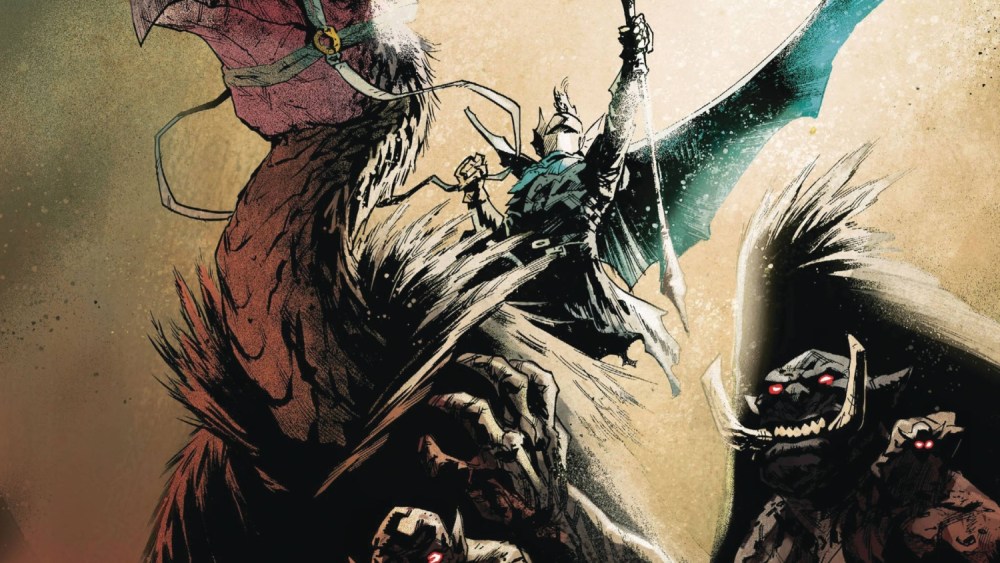
Before he, um, lost the plot, Meat Loaf released Bat Out of Hell, which is an amazing album with perhaps the greatest cover ever (done by the iconic Richard Corben). It’s the sort of powerful, vaguely erotic experience that awoke something in a few generations of folks, and made them view rock ‘n’ roll as this gateway into some deeply human, vaguely naughty realms of thought and emotion. Now, does this Adam Gorham-penned variant cover to The Autumn Kingdom #2 have the same level of power and influence? No, but it does kick at the same kinds of ideas and boundaries. It’s something where, even if you don’t know anything about the story, everything is pretty clear. Good is good, evil is evil, and you either want to watch this battle unfold while listening to Dio or, for the extra brave among us, somehow transport yourself into this conflict and unleash hell to your many fiendish foes. It’s a cover that scratches the same big fantasy itch, and it does so with epic line work, mighty coloring and shading, and the courage and strength to just go super bold with everything. Maybe this could be the Bat for a whole new, slightly nerdier generation of fans, folks who will see this and use that awesome strength to really celebrate life. Either way, I want to ride that chicken-dino pronto.
Fantastic Four #26
Cover by Joshua Cassara and Dean White
I don’t like seeing my own blood, but I certainly love the gratuitous spilling of others’ life juice across comics, TV, film, etc. And when my wife said, “That’s because you can’t relate to how you have blood like other people,” that gave me great pause. And this Joshua Cassara and Dean White cover to Fantastic Four #26 is equally effective. Not in a way that gets me to quietly pontificate on my own sustained emotional/developmental disconnect from the rest of mankind, but the power of blood and its ability to cut right to the heart of deeply human stories. Because in a tale that reads a little jokey — Reed and Johnny go digging up a hellmouth at Aunt Petunia’s farm — all that humor gets swallowed up by blood. (OK, Long-Neck Reed and Mustachioed Johnny will always be a touch funny.) What we get is that surge of intense anxiety and chaos, as if our brains are in that world and all we can do is drown under the weight of all that. It’s another perfect snapshot of what happens when gore/horror invades a moment. That, and the singular truths and insight it offers into (at least in this moment) why the unknown is so terrifying and tantalizing and why we fear and cling to blood as this larger trope. So, yeah, blood is weird and cool and everything , and this cover’s a vivid preview of how I mull it over all the time. Giving it a lot of my platelets, ya see.
DC vs. Vampires: World War V #3
Variant cover by Daniel Bayliss
And from a giant pool of blood to legions of blood-suckers, we come to DC vs. Vampires: World War V #3. A few weeks back, I commented somewhere (but likely in the hallowed confines of Judging by the Cover) that sometimes I have a hard time with the 1,200 vampire stories released every year. There’s only so much you can do with sexy and/or creepy creatures that consume blood, and a lot of books nail the same tropes (hissing, long nails, drooling blood, being hypnotic and/or scary, pale skin, etc.) As such, I appreciate this Daniel Bayliss variant cover to issue #3 for giving us a different perspective of vamps — literally. I don’t know if we’ve seen this angle before (perhaps), but it doesn’t change how viscerally effective it is overall. There’s something about seeing the wrinkly gums and craggily tongue of a vamp that drives home 1) how monstrous they truly are and 2) how they’re still deeply human. It also shifts our perspective on Green Arrow here — there’s this mix of fear and sligthly monstrous energies to the Emerald Archer that plays up some of the inherent morality to this larger story. It’s deep and intimate with something we often worship and fear, fostering a connection more robust and inventive than even some beloved franchises. V, it would seem, is for very cool perspective.
Minor Arcana #2
Variant cover by Mike Del Mundo
If you thought Minor Arcana #1 was a compelling start, writer-artist Jeff Lemire is only getting started. The solicitation for issue #2 makes mention of, among other things, Theresa “searching for peace for a desperate client of her late mother” and how being “trapped….is unfortunately exactly where she needs to be.” It’s a predicament marked by darkness and light, hope and nihilism, a dynamic that I think is best represented by Mike Del Mundo’s own variant cover. Because Theresa is very much trapped, in a town/place and predicament she can’t control. And it’s very much familiar and traceable (like a proper circle), and yet even that function doesn’t make her any less of a prisoner and/or victim. Yet amid all of that, Theresa appears to remain stoic and maybe even focused and committed as ever, a response that speaks to a deep well of strength (but also maybe just a touch of emotional disconnect). As if she knows the score and will persevere regardless (or there’s a comfort to knowing the game before you play it). It’s a piece that captures this book’s singular take on magic, existentialism, family, and even how we balance the light and dark of it all. I already expect big things from this title, and covers like this one are part of how it’s already delivering big, deeply potent things.
