


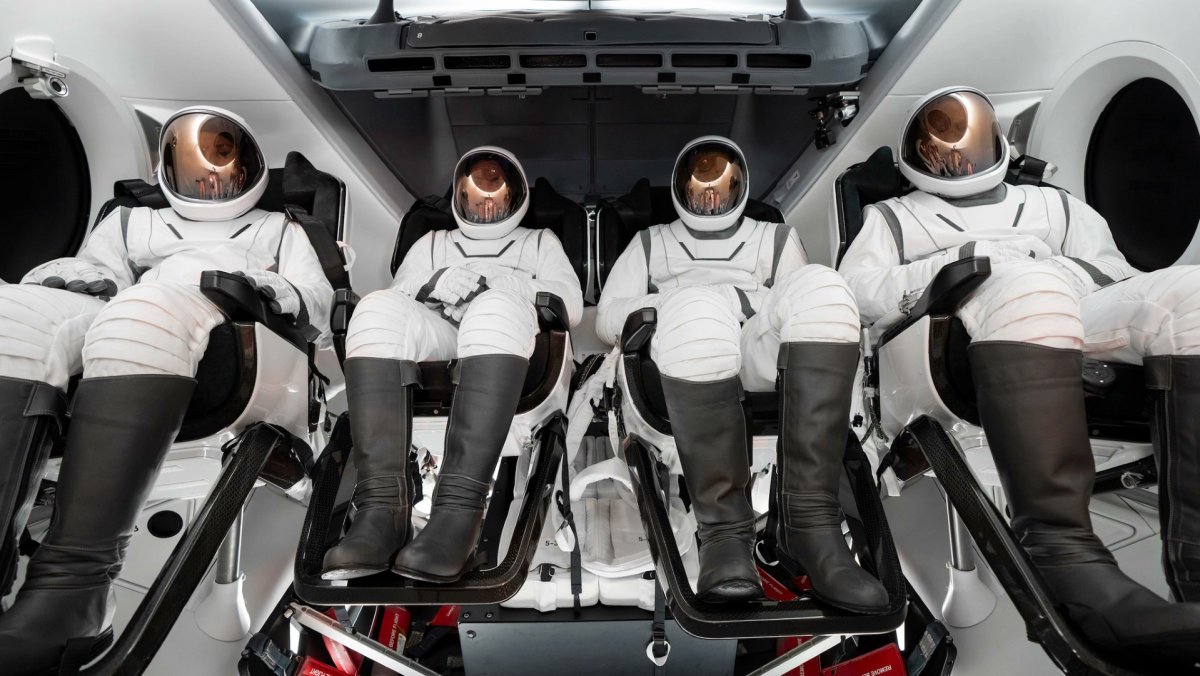
Two of the four Polaris Dawn astronauts could make history today by conducting the first-ever commercial spacewalk, about 700 kilometers above Earth. Mission leader and funder Jared Isaacman and SpaceX engineer Sarah Gillis will leave the safety of the Crew Dragon capsule for 15 and 20 minutes, respectively. The other two crew members, Scott Poteet and Anna Menon, will stay inside the spacecraft to monitor the spacewalkers and make sure everything is OK. SpaceX will livestream the event on its website and on X, starting at 4:50 a.m. Eastern time. If the spacewalk is canceled, the astronauts will have another chance at the same time on September 13.
As The New York Times explains, Crew Dragon doesn’t have an airlock like the International Space Station, so the astronauts have to deflate the cabin before opening the hatch. All four will need to wear NASA’s extravehicular activity (EVA) suits, which are improved and more rugged versions of the company’s internal vehicle activity (IVA) suits.
SpaceX’s spacewalker suit has new joints that can bend and rotate, improving maneuverability. The helmet is equipped with a head-up display (HUD) and cameras, and the entire suit has a Faraday layer that protects against electric fields. The Polaris Dawn crew’s spacewalk will test the suit’s performance by exposing it to the harsh environment of space while conducting maneuverability tests. “The development of this suit and the execution of the spacewalk will be a key step towards a scalable spacesuit design for future long-duration missions where life will be multi-planetary,” the Polaris Dawn website states. The entire operation, from start to finish, will last two hours until the astronauts close the hatch and repressurize the Crew Dragon.
After several postponements, the private mission launched in the early morning hours of September 10. In addition to completing the first commercial spacewalk, the mission has other objectives, including sending a crew further than any previous Dragon mission and further than anyone has traveled since the Apollo program, into part of the Van Allen radiation belts.
