

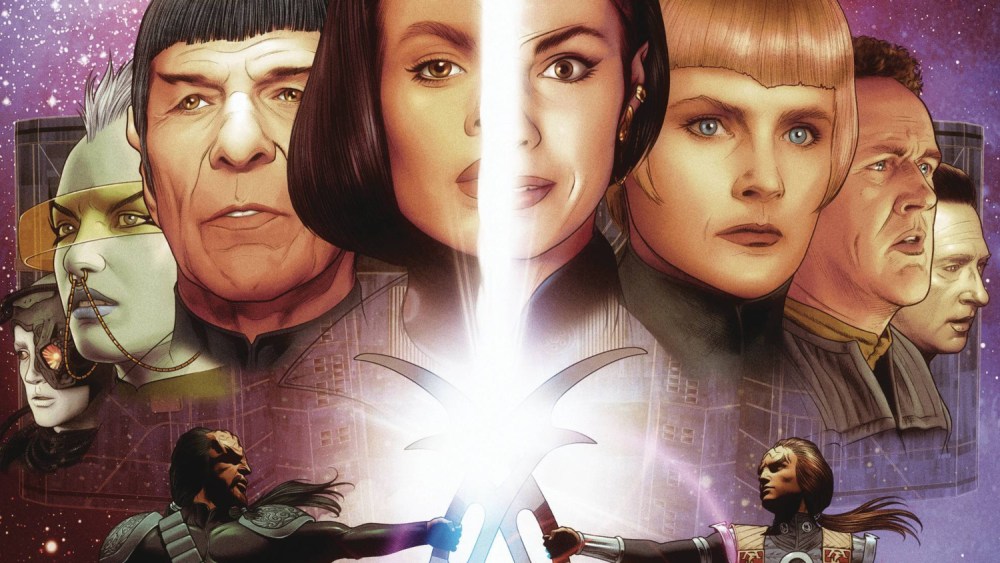
Unless you’ve been living on Rura Penthe, you’ve likely noticed the ongoing Star Trek comics resurgence at IDW.
While the main Star Trek book has been running strong since 2007, it’s really in the last two to three years that the entire line’s truly reached warp speed. The line’s practically starship-sized these days, and it includes:
Throw in huge events and spin-offs like Day of Blood and Lore War, and Star Trek comics are making good on the innovation and excitement that hum at the franchise’s core.
And there’s really one name that’s been in the captain’s seat this whole time: group editor Heather Antos.
“This whole line was my idea,” Antos said during a recent Zoom call. “This whole line happened because of me. When I came on board at IDW, it was originally for the Star Wars (line of licensed books). And when I moved on from that, I was given the opportunity to choose which IP.”
Antos certainly has all the right credentials to lead IDW’s Star Trek presence. Not only is she a true blue fan (her fave captain is Kathryn Janeway, FYI), but Antos formerly lead similarly robust groups/lines for Marvel-Star Wars. But Star Trek is a different beast entirely, and one that almost demands such a massive suite of titles and impactful stories.
“Star Trek is the one that interested me the most in part because without Star Trek, the comics industry would not be where it is today,” Antos said. “The pop culture industry would not be where it is today. The MCU would not exist. Star Wars would not exist. Star Trek was effectively the first multiverse – the first books to movies to comics. The first fan conventions.”
Cover by Ramón Rosanas. Courtesy of IDW.
Yet even a super-fan like Antos can recognize that despite Star Trek‘s sturdy presence in the robust canon of modern-day pop culture, the franchise is still regarded somewhat oddly.
“Yet the comics, and just the fandom in general, is still the niche of the niche of fans,” Antos said. “Within nerdism, it’s still seen as the nerdiest of things.”
Sure, there are standout Star Trek comics from yesteryear – Antos explained that the “old DC run has some really fun stuff. I love the Gold Key comics; there’s some weird stuff in there. There’s fun stuff in the Marvel run. Even IDW did some really great stuff when they were doing the Chris Pine tie-ins and even the Mirrorverse stuff.”
The issue, then, was that perhaps things always proved a wee bit insular.
“It always felt a bit inside baseball,” Antos said. “It always felt very like you had to have watched that one episode to understand the reference. It’s so cliche, but every comic should be able to be picked up by anyone and understood, especially a Star Trek sci-fi comic. My main goal was that I wanted to create a line of comics, not just for Star Trek fans, but for comic fans. I wanted to show comic book fans that Star Trek is cool and is for you, too.”
As such, Antos has worked with the various creators to tell Star Trek stories that are about one thing above all the references to the Horta and the salt vampire in the world.
“When working with (Lanzing, Kelly, and Cantwell), I adore them to pieces, but they are the biggest Star Trek nerds I have ever met,” Antos said. “Sometimes reading those scripts, I had to say to them, ‘Hey guys, you’re writing this for people other than yourselves.’ Not everyone knows who the Tal Shiar are. And so we have to make it about the stakes and the emotion of the characters.”
Sure, Antos receives ample feedback from more enthusiastic fans, and it’s not always a treat to deal with, either.
“They’re in my inbox,” Antos said. “Everyone is always going to project their own wants onto any fandom, right? ”
However, what’s made IDW’s Star Trek so effective is the actual people involved and not what they’re necessarily writing and/or geeking out about.
“I think in part why this line has worked so well, it’s that we trust in each other,” Antos said. “It’s just them as writers working together in two lines that have to talk to each other. And they trust me as their editor. I’ve worked with Jackson and Colin for close to 10 years now. Chris, going on four years.”
Incentive cover by Rahzzah. Courtesy of IDW.
While the creative team has always meshed well enough, Antos also has to work with Star Trek‘s licensor, Paramount. These days, she said, that relationship is tight as can be, and is one based off a mutual love for this weird, wonderful franchise. However, it took time and effort for it to truly flourish.
“I will say I wish that I had the opportunity to get access to scripts earlier in my relationship with Paramount,” Antos said. “It did take a little bit more coaxing when I first started.”
Antos added, “The first batch of scripts I got was Picard season three, and then I got Strange New Worlds season two. The first season of Strange New Worlds, I didn’t get the scripts and stuff like that. It made working on those tie-in comics just a little bit harder. And then I’m just going off of what Paramount is saying is happening versus what I know. And then when I do finally get to see the shows and the comics come out, it’s always like, ‘I wish I had known because then we would have done a different story or focused on a different character.’”
It’s not just a big company/studio being sticklers, either. Antos and company have really tried to push what’s possible with this grand universe, and tried to present ideas and images that aren’t always so readily digestible by long-time fans.
Take, for instance, the forthcoming Star Trek: Red Shirts. Here, creators Cantwell and Levens focus on the untold stories of “Starfleet’s most intrepid and doomed crewmembers.” They’re like Mr. Bill (if you get that reference), and death and dying are just a natural part of their collective tale.
“In a million years, I never would have gotten Red Shirts off the ground the first year I was doing,” Antos said. “Red Shirts was the very first idea I had for a comic when I took over Star Trek. But I knew I had to wait to pitch it because Paramount wasn’t ready for a book like that.”
Or, there’s a certain one-shot story that, while seemingly controversial at the moment, exemplifies a prime shift in context.
“The very first conversation I ever got in with Paramount was (around) the Klingon one-shot that Jackson and Colin wrote in 2021,” Antos said. “In it, Kahless decapitates his brother, and it’s a splash page. We had this 20-minute debate over whether or not that’s too gratuitous. Can we show it on a page? Can we show a decapitation on a page? And we had the artists do all these different versions of which version would be the most acceptable depiction of a decapitation and that would pass muster. Fast forward to one year later, we’re doing Day of Blood and we have a cover by Daniel Warren Johnson with a Klingon decapitation on it. That just shows the level of trust that we were able to build with the licensor.”
Like any meaningful relationship, the secret to happiness/success is to never let a conversation turn into a disagreement.
“We all want the same thing. We all want the brand in these books to be successful,” Antos said. “We just might have different visions of what the best path to get there will be. It’s IDW’s needs, it’s the line’s needs, and it’s this particular story’s needs. And how do we get that Venn diagram to line up as best as we can? And also align with whatever the TV shows are doing or the movies or the video games and all of that other stuff.”
Cover by Chris Shehan. Courtesy of IDW.
That holds true across all aspects of this “relationship.” Yes, even when other “arms” of this multifaceted franchise might torpedo your lofty story goals (even if said torpedoing is never actually intended).
“I get all the screenplays and teleplays that come in for all the different things,” Antos said. “And then I’ll get an episode of Strange New Worlds in my inbox that completely blows up everything that we’ve been working on. So then we all have to get together and figure out how to solve the problem. But you know, it is never a fight. They’re just as big a fans as we are.”
But don’t think for a second that it’s just about relying on some shared sense of fandom. Rather, the real alignment and effectiveness of this “comics Starfleet” lies elsewhere. More specifically, Antos tries to stoke everyone’s inner nerds with stories geared toward a certain kind of wish fulfillment.
“There’s always opportunities,” Antos said. “One of my favorite things is finding the gaps. We’re all fans of this stuff, and as fans, we all have questions that we want answered. We have the opportunities to answer those questions. That’s the job. When I took over, my goal was to create the very best Star Trek comics that have ever happened.”
And that means nailing it every single time, even if the work somehow proves especially daunting.
“Warp Your Own Way was the hardest thing I’ve ever done in my life,” Antos said. “A 200-page ‘interactive graphic novel.’ Building the book map took 16 hours. It was me making stacks of paper all over my office. And it nearly killed me.”
Luckily, all of that brain-melting organization has paid off.
“The last three years of Star Trek comics, we’ve seen the publishing line get back-to-back Eisner nominations,” Antos said. “So I think that speaks enough for itself how well we’ve been doing.”
Antos added, “Star Trek #400 was what we called, internally, the first of the ‘Antos-verse.’ And to have that (issue) itself be nominated for an Eisner was wild. And then this year when we found out Warp Your Own Way got nominated for a Hugo, I wanted to throw up. It’s just surreal to have a comic book acknowledged at that high of a level, let alone a licensed comic book.
But these titles are no mere collection of licensed releases. The line has also landed heavy praise from various media outlets, with each praising creators like Cantwell, Lanzing, and Kelly as the perfect scribes for a more robust era of Star Trek. The references here may be deeper than ever, but so is the heart, intent, and charm of these inventive slices of progressive sci-fi.
In terms of other, more concrete areas, however, it becomes harder to gauge Star Trek‘s true impact. Diamond stopped releasing monthly sales figures after April 2022 (via Comichron), and so more recent numbers are harder to access. However, the three issues of Star Trek: Mirror War released in January (#3), February (#4), and April (#5) 2022 sold 8,568, 8,256, and 8,105 copies, respectively, which places each issue near the top 120/130 for monthly units. (For some slightly helpful context, courtesy of Unreality SF, Star Trek comics averaged about 8,630 monthly copies back in 2010.)
If nothing else, given Star Trek‘s significant emphasis in the IDW lineup, you’d have to think these books contributed to the publisher ranking a rather surprising fourth in the industry (via ICv2), even out-performing Dynamite, Dark Horse, and BOOM!
Cover by Chris Fenoglio. Courtesy of IDW.
Numbers are numbers, though, and there’s a reason something like Warp Your Own Way landed with readers. It ultimately speaks to what these IDW books have done so well: Remain true to the shared emotional-narrative core of Star Trek while innovating and extending the universe whenever and wherever possible. Defiant is another solid example of this dynamic — it may feel like uber fan service at times, but it does that to tell stories that make Star Trek feel all the more textured and compelling. It’s not just that these creators and editor are devoted fans — they clearly see the larger potential of a universe that’s all about the seemingly magical journey of discovery and finding peace amid the frictions of social groups.
All of it’s the Star Trek you’ve always loved (or maybe instead never gave a chance?), and also a new kind of cutting, inventive sci-fi that speaks to our new weird moment while offering a certain kind of joy and hope. So, yeah, it’s a proper distillation of Star Trek, and we’re all better off for this franchise’s intriguing development arc.
For their part, Antos and company aren’t proud because of any awards or other honors. No, it’s that they’ve done all this as they’d collectively intended.
“I did the math at one point, and I think it’s 65 issues over three years…exactly the way we wanted to as we planned it,” Antos said.
More recently, the team has sought to extend their “streak,” if you will, as IDW is launching a new slate of fresh Star Trek titles. Just don’t call it a second phase, though; it’s more like a continuation of all the big, bold, and decidedly people-centric stories they’ve been telling over the last few years.
It begins with this week’s publication of Star Trek: Omega #1. Officially, it’s the “denouement of the critically acclaimed Star Trek and Star Trek: Defiant storylines, and the first glimpse at all that comes next.” But for Antos, Omega is so much more still.
“Omega is just perfect…such a bittersweet, perfect finale of what Star Trek is all about and what the last three years of this line have been,” Antos said. “All of the creators, the writers, the designers, the letters – everyone involved loves Star Trek just as much as the people reading it. And it shows. I think that’s why we’re getting the responses that we do. I wanted to bring back all the amazing artists we’ve got to work with and acknowledge their work, too, on these pages. And it was really great that everyone said yes and came back. It’s such an honor to be able to end it with a full period.”
To some extent, Omega isn’t as sad because the various contributors have seen this all coming.
“We always knew that Lore War was going to be the final huzzah of this,” Antos said. “This whole time with the series, there was a ticking clock. And for all intents and purposes, we know for the most part where most of these characters end up in Picard season three…or beyond. We were always told when we picked our cast out for Defiant and everything, we always had to put the toys back in the box. So this was us setting everything up, putting them in place where they needed to be.”
However, Antos also sees Omega as more than just a carefully-plotted finale to a veritable universe of rich storytelling. It’s also a chance to plug some more holes and fulfill fan wishes (especially those of the creators).
“But also it was our moment to, say, give Jake and Cisco the ending that they never got in Deep Space Nine,” Antos said. “To give Morrison and Alexander the ending they never got in Deep Space Nine. (Man, Star Trek has a way with bad dads.) To really let us say goodbye to these characters that have become family over all of these years.”
Cover by Travis Mercer and JP Jordan. Courtesy of IDW.
Following Omega, there will be three new limited series debuting this summer/fall:
The very first is the aforementioned Red Shirts, which Antos said begins with “a Mugato scratching someone’s eye out – this is not your father’s Star Trek book right from the go.”
Then there’s Star Trek: Strange New Worlds: The Seeds of Destruction (from season four writer Robbie Thompson and artist Travis Mercer), where Chapel, Una, La’An, and Spock (and a “new adorable robot sidekick,” D6) journey to “an ice-covered planet” to uncover “the scary secrets that lurk deep beneath…” in what’s been described as a “Lovecraftian” horror story.
And, finally, there’s Star Trek Voyager – Homecoming (from writers Tilly and Susan Bridges and artist Angel Hernandez) that “offers the final resolution” for that beloved series.
And that’s only the stuff that the team can actually talk about right now.
“Where we’re at right now, it’s a bit of building toward the 60th anniversary (in 2026),” Antos said. “So truly, I mean, we’re building for some fun, big stuff there. I have some fun The Next Generation stuff planned for folks, don’t you worry. I have a couple pretty big ideas I’m trying to get through over at Paramount if they’ll let us. So keep your fingers crossed.”
Alright, don’t get your Blue shirts in a tizzy: We can talk about one more, especially big new story in the Star Trek canon. Specifically, the recently-annnounced The Last Starship, where Kelly, Lanzing, and artist Adrián Bonilla resurrect Captain Kirk (who died in 1994’s Star Trek: Generations) – just in time for him to “watch the Starfleet he loved so dearly burn to the ground.” There’s endings as new beginnings, and then there’s the sheer promise of this massive story.
“Like I said, I love exploring the gaps and answering questions,” Antos said. “Truly what we’re getting to do with The Last Starship is explore one of the biggest gaps that has never been explored in Star Trek history, which is The Burn. (That’s when trillions died after the mass detonation of every warp drive, crippling the Federation.) It’s the period when there was no Federation and there was no Starfleet. And we watch it all burn down, truly, and have to pick itself back up again. Whether coincidence or not, it is kind of timely.”
Variant cover by Skyler Patridge. Courtesy of IDW.
But as with most Star Trek stories, Last Starship goes deeper still. As Antos explained, it almost contextualizes the franchise, both in terms of what’s happening as this universe’s story further develops but also in the arc of modern-day pop culture.
“It’s a nice juxtaposition, I think, getting to see Star Trek at its most Star Trek, when the Federation is at its most powerful and has all the support,” Antos said. “Like, whatever, go stop this god killer. But now (with Last Starship), it’s desperate. And how do you maintain that hope? How do you maintain the integrity of what makes Starfleet when all hope is lost? I think it really fits in this time when we’re getting shows like Andor. I’m really excited to see how it lands with people.”
It’s harrowing sentiments shared by Lanzing (in a statement released via The Hollywood Reporter).
“We’re bringing you into the Federation’s darkest hour through the brilliant, noir-soaked lens of (Bonilla) with zero homework required,” Lanzing said. “Longtime Trek fans will have a deep and fascinating reading experience, to be sure – this is a pivotal moment in Trek history that’s never been even glimpsed before – but above all, The Last Starship is a dark and complex sci-fi you can hand to anyone.”
Whatever happens in that book or any other titles, Star Trek will sojourn onward. This next “leg” of the larger journey remains mostly unwritten, but Antos is a good captain interested in maintaining the only objective that truly matters.
“It’s very rare for me to look backwards because I’m always like, ‘What’s next?,’” Antos said. “Star Trek has always been about exploring strange new worlds and emboldening your horizons, and we’re doing the same thing in the comics.”
