


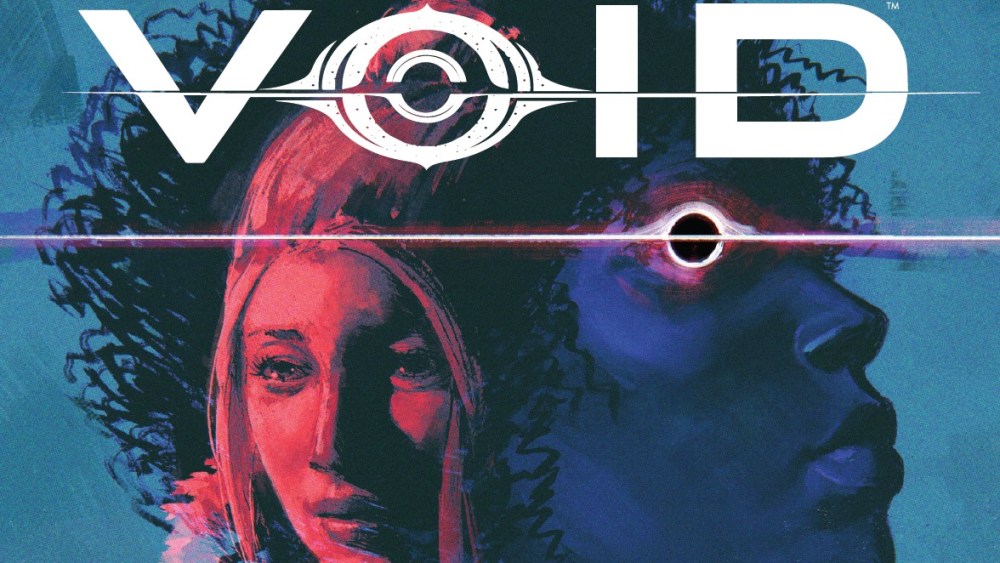
After a long two-month wait, Mad Cave Studios finally released the second issue of their sci-fi horror miniseries Dark Empty Void this week. Created by writer Zach Kaplan and artist Chris Shehan, with colors by Francesco Segarra, flats by Agnese Pozza, and text by Andworld’s Justin Birch. There are also some wonderful design pieces. The logos by Tim Daniel and book designer Diana Bermudez both make good use of the black hole theme. All compiled by editor James B. Emmett.
In the first issue, scientists created and contained a tiny black hole on Earth. But when they lose control, a strange teenage girl emerges from the singularity. The scientists call in the main character, Joy Frank, a psychology professor, to try to understand this girl called Artemis. Her conclusion was that Artemis must be brought back to Earth to stop the black hole from swallowing it.
I loved the first issue’s great character work, interesting setting, and great art, but I realized it might be too late for some people. Well, Dark Empty Void #2 is even slower. The slow burn doesn’t bother me as much. Because the rest has a lot of room to rise, and there’s enough interest in the mystery to stick around until the end. But even I couldn’t ignore how slowly this problem was progressing.
Provided by Mad Cave Studio
I know the slow pace is not without reason. The horror elements of this series arise from the overall atmosphere of eerie anxiety of facing something hostile and being unable to stop its slow and inevitable approach. Chris Shehan creates this feeling through his excellent illustrations. This is the real highlight of the book. He has a great sense of cinematography, and some panels look like stills from blockbuster movies.
Sheehan creates the desired atmosphere by filling the page with large splash images and placing small plot-driven panels above the images. On the other hand, large, beautiful images create a sense of wonder. On the other hand, the page layout also feels strange. Even people and stories are small compared to this vast, cosmic, unknown and unfathomable threat. What do we do when faced with something so overwhelming?
As the team of characters approaches the black hole, Sheehan uses this technique on four successive pages, initially placing an essentially hostile area just off the page, but then drawing other areas in the brightness. Gradually move closer and closer until almost everything is washed away. And once inside, a similar layout enhances the twilight atmosphere of a strange and alien environment.
From there, Sheehan’s cinematic style and Segarra’s excellent lighting sense work together perfectly to maintain an unusual sense of unease as the team encounters bizarre alien creatures in this bizarre environment. .
Provided by Mad Cave Studio
The characterization in this issue is once again great, with the focus definitely being on Joy and her estranged husband Colson. The supporting characters are better developed than in most comics, but they’re not all that great. Among them are two former military guards who fit squarely into the “shoot first, never ask questions” stereotype. Still, they have their own unique voices and distinctive character designs. The third guard is a friendly Asian man who quotes poetry. He’s a nice contrast to the stereotype, but all three may end up being just redshirts.
Nasim Ruia, a leading black hole scientist, is also on the team, but has done little on the issue. And unfortunately, the creative team doesn’t take full advantage of this strange Artemis. The mystery surrounding her is slow to develop. When she says something, it always mysteriously returns the focus to Joy. Writer Zach Kaplan clearly does this on purpose, but it sadly traps Artemis in the background.
The actual character development in Dark Empty Void #2 centers around Joy and Colson’s relationship. Joy again shows a wide range of emotions and complexity. Colson often gives the impression of being a kind man, but at times he is insecure about his feelings for Joy, and at other times he is filled with childlike awe at the new discoveries made inside the black hole. Sometimes it’s just being there.
Kaplan and Sheehan do a great job of portraying the chemistry that Joy and Colson have with each other, but at least some bitterness on Joy’s part keeps them apart. Perhaps the only good thing about the pacing of this issue is how each new situation works to slowly bring Joy and Colson closer to each other.
Provided by Mad Cave Studio
In the end, this miniseries is still about the black hole that symbolizes depression. Whatever Zach Kaplan has to say about it is done almost entirely figuratively in this issue. Fortunately, he does this much more subtly than in the first issue, but also clear enough to get the message across. If the black hole symbolizes depression, especially Joy’s depression, then Dark Empty Void #2 teaches us not to fight depression in aggressive ways or try to avoid it out of fear. . Rather, Kaplan suggests that real solutions can only be found by going deeper into the darkness and facing it with patience and hope.
In conclusion, as you can see, I enjoyed a lot of what Dark Empty Void #2 had to offer – the complex relationships between the main characters, the subtle symbolism, and most especially the wonderful atmospheric artwork. But at the same time, I couldn’t help but think about how slow this issue was while reading. Not enough excitement. The creative team is ready and we look forward to more exciting things happening in the next issue. But before that we have to wait another two months.
Despite its many strengths, “Dark Empty Void” #2 isn’t exciting enough
Dark Empty Void #2
I enjoyed a lot of what “Dark Empty Void” #2 had to offer – the complex relationships between the main characters, the subtle symbolism, and most especially the wonderful atmospheric artwork. But at the same time, I couldn’t help but think about how slow this issue was while reading. Not enough excitement.
Artwork with a movie-like atmosphere.
Complex and diverse characters and their relationships.
Great use of symbolism.
Very slow pace.
Artemis’ character is not fully utilized.
