


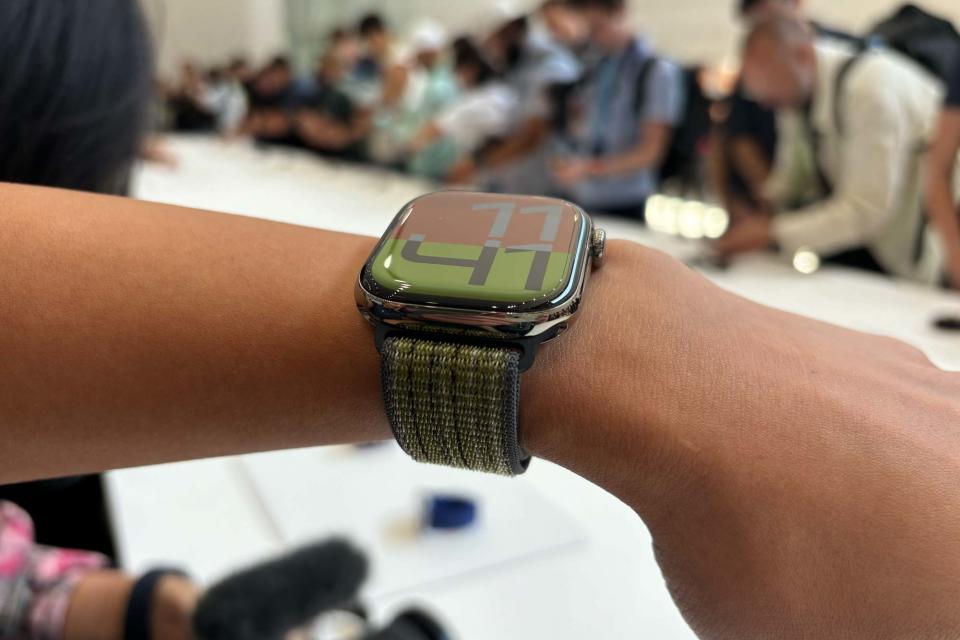
Early impressions of the Apple Watch Series 10 have been mostly pretty positive. Not only does it have the largest display of any Apple Watch to date (despite the case size being smaller than the 49mm Ultra 2), it’s also lighter and thinner than before. The display isn’t just larger, it’s also brighter when viewed at an angle, and the always-on screen now updates every second when stationary (instead of once every minute as before).
Aside from the updated display and some nifty new case options (the new polished titanium and jet black aluminum look pretty amazing), the Apple Watch also gets a new health feature called sleep apnea detection. While this isn’t an exclusive feature for the Apple Watch Series 10 – it was also present on last year’s Series 9 – it was still a major highlight of Apple’s presentation and another example of how Apple wants users to wear their Watch throughout the day and night.
The only problem is that the battery life is still listed as 18 hours; 36 hours in battery saver mode (half of what Apple claims for the Watch Ultra 2). That means if you wake up at 7am and put the watch on, you’ll be dead overnight. Of course, this isn’t as extreme as I’m making it out to be. Apple has been touting 18 hours of battery life since 2015, when the Apple Watch first came out, and recent models have easily surpassed that, despite changes like the always-on display. It’s not unreasonable to wear it all day and all night to track your sleep, then charge it in the morning and be ready for the next day. Apple has been pushing fast charging to make that more feasible over the last few models, and the Series 10 can charge to 80% in just 30 minutes.
At least in my experience, the problem occurs after a year or so of using the Apple Watch. I had a Series 7, and the battery health was below 90% in less than a year, and below 85% after about 14 months. This was a noticeable difference. If I wanted to wear the watch overnight to track my sleep, I had to charge it at noon. If I was using LTE while running and left my phone at home, it was even worse, and streaming music and tracking my workouts could eat up 25% or more of the battery. However, my Series 9, purchased last December, still has 100% battery health and seems to be in pretty good shape. Maybe my Series 7 was a bad one, but I think Apple did some solid charging optimization here to keep the battery fresh.
A little over a day on the Apple Watch puts it on par with the Pixel Watch 3 we reviewed earlier, but not as good as Samsung’s Galaxy smartwatch. But the comparison gets even worse when you look at Garmin’s lineup of fitness-focused watches. Essentially, all of these watches can go a week or more without charging. Sure, they’re not like Apple or Google wearables, which are tightly integrated with every aspect of your phone’s OS, but that’s not the point. If you want to get the most out of your watch and wear it all night to track your sleep and not have to think about it the next day, the Apple Watch is far from the best choice.
So, back to the Series 10. How excited would we be if Apple said this thing had a 3-day battery life? Even matching the Apple Watch Ultra’s 36-hour rating would be a win, since it would likely last closer to 2 days in real-world use. But instead, Apple made the Series 10 thinner, as they always do. Of course, comfort is important when talking about wearables, but personally, I would have traded a 1mm reduction in thickness (about a 9 percent change) for a bigger, longer-lasting battery.
Instead, I’ll have to make do with fast charging. Don’t get me wrong, it certainly makes a difference. It’s easy to imagine a world where you wake up, put your Apple Watch on the charger for 45 minutes while you get ready for your day, and don’t think about it until the next morning. But that just means more time having to think about this device that’s supposed to be on your wrist. While charging overnight isn’t necessarily the best option anymore, it’s still a shame to have to charge it every day. I wish there was an Apple Watch I could forget about and put on the charger every few days and have it charge. Maybe next year.
Catch up on all the latest news from Apple’s iPhone 16 event!
