


It’s previously gone by at least two different names (Oculus Connect, then Facebook Connect), but whatever the name, Meta’s fall event is a big showcase for the company’s latest and greatest achievements in the realm of virtual reality and mixed reality. Just like last year, the biggest news to come out of Meta Connect 2024 can be predicted by just two acronyms: AI and AR.
Like other big tech companies this year, Meta will be eager to show how it will remain relevant in an AI-driven future. And seven months after the launch of Apple’s Vision Pro, which coincided with a brief surge in interest in augmented reality (AR), Meta CEO Mark Zuckerberg is likely eager to show off his plans for making AR a reality.
Zuckerberg isn’t as enthusiastic about the metaverse as he was when he changed the company’s name, but the marriage of AI and AR is one way to make the dream of a persistent virtual world a reality. It might not be on the scale of Ready Player One, but if AR glasses actually take off, the meta might be able to control another part of the digital world. And offering updated, cheaper VR headsets to help us get there wouldn’t be a bad idea.
With all that in mind, here’s some of what we expect to see at Meta Connect 2024, which kicks off virtually on September 25th and runs for two days.
Meta
Orion AR Glasses
After reportedly abandoning development of its pricey, next-generation mixed reality headset that was meant to rival Apple Vision Pro, Meta is now focusing on its next innovation: a pair of augmented reality glasses, code-named Orion. As can be seen in the background of Mark Zuckerberg’s photo (above), and later confirmed to some extent by the man himself, Orion resembles a chunky pair of hipster frames.
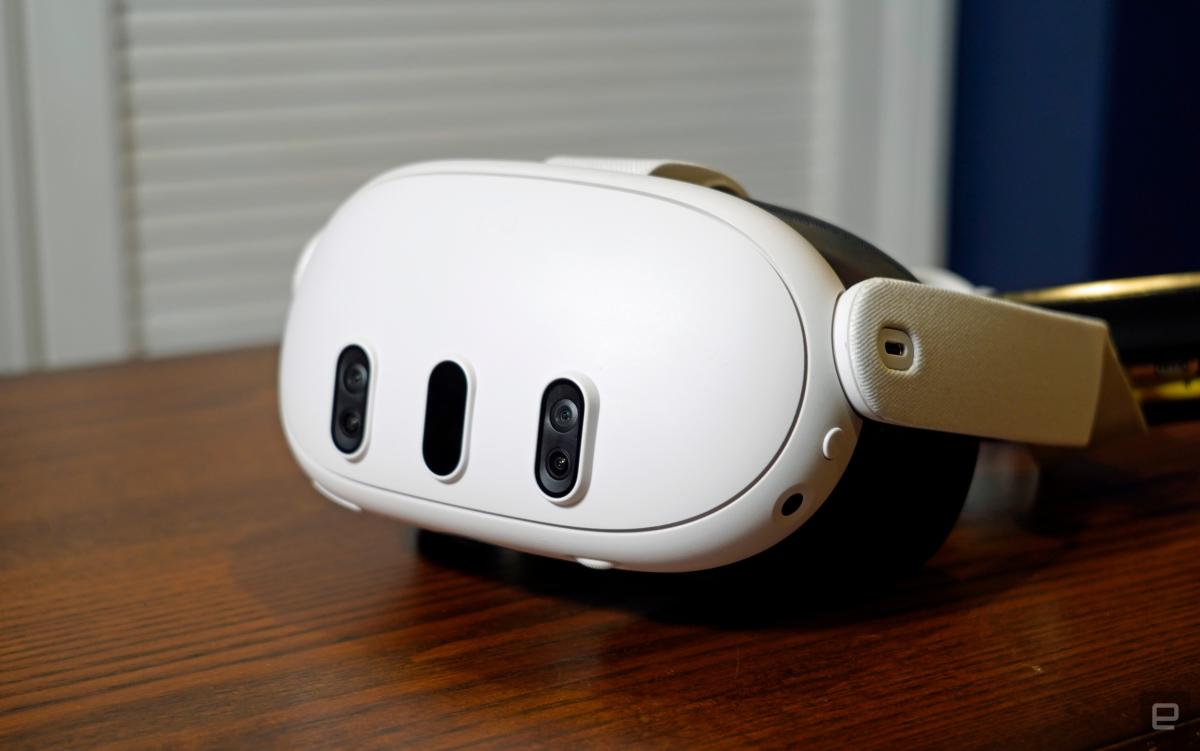
Unlike the Quest 3, which takes over your vision entirely and uses cameras to display a lower-quality view of the world, Orion lets you see the real world like a normal pair of glasses. But like Magic Leap and Microsoft’s HoloLens before it, Meta’s glasses can overlay holographic images on top of reality. The main difference, of course, is that they seem a lot easier to use than those devices.
“We think these glasses are going to be a big hit,” Zuckerberg said in an interview on the Blueprint podcast (via RoadtoVR ). “We’re almost ready to show a prototype of a full set of holographic glasses. We don’t intend to sell them broadly. We’re focused on building a full consumer version, rather than selling prototypes.”
At MetaConnect 2022, Zuckerberg showed off what the company envisions as AR glasses and a fancy wrist controller.
“This is probably our most exciting prototype yet,” Meta CTO Andrew Bosworth told The Verge last year. “And I know this might be problematic to say, but in this space, it might be the most advanced technology on the planet. In the consumer electronics space, it might be the most advanced product that humanity has ever produced.”
According to a leaked Meta roadmap, the company plans to release new Ray-Ban smart glasses next year that add a small built-in screen to the existing cameras, speakers, and microphones. Meta’s first consumer AR glasses will follow in 2027. It makes sense to see some kind of concept device this year. Just as Apple’s Vision Pro was essentially the company’s version of an AR/VR concept car to introduce developers to the concept of “spatial computing,” Meta needs to give developers a way to use its platform to build their own AR experiences. Rival Snap just announced its fifth-generation AR Spectacles, a version aimed at developers (for a $99 monthly subscription fee).
Meta from Gary_the_mememachine/Reddit
A cheaper version of the Quest 3
Instead of an upgraded headset, Meta will likely release a stripped-down version of the Quest 3, called the Quest 3S, Bloomberg’s Mark Gurman reports. Recently leaked images from Meta’s Quest Link application confirmed the existence of the headset. According to Gurman, the company is aiming for it to be significantly cheaper than the current version, reportedly looking at a price point of $300 or $400, but still offer a closer experience to the Quest 3.
According to the latest leak, pricing will start at just $299. A Reddit user shared a clip of an Amazon ad that reportedly aired on Peacock, which features the Quest 3S along with its price and storage (h/t UploadVR). According to the ad, the 128GB Quest 3S will cost $299, but there may be other storage options available. It could potentially replace the Quest 2, which remains in the line priced at $299 long after its 2020 launch.
So why is Meta doing this? There’s a big performance gap between the Quest 3 and Quest 2, which makes things difficult for developers. A cheaper device similar to the Quest 3, perhaps using the same processor, would make it easier to develop games that span the two price points. According to Bloomberg’s Gurman, Meta is also considering releasing some models of the new headset without a bundled controller, which would bring the price down even further.
Of course, AI will also
Meta will show how it’s further leveraging AI in its Quest headsets and Ray-Ban smart glasses. The company introduced multimodal AI search to those glasses in January, letting you ask the Meta AI questions about objects or landmarks you’re looking at, or request simple translations. But in our testing, those features were surprisingly unfinished.
Meta will discuss how it improves on existing features with its implementation of the Llama 3.1 Large Language Model (LLM), which it positions as an open-source competitor to Google and OpenAI’s LLM. In particular, the company notes that Llama 3.1 dramatically improves translation, math, and general knowledge capabilities. There’s certainly room for Meta to introduce new AI features to Ray-Ban’s smart glasses with Llama 3.1, but given limited processing power and battery life, it will likely have to wait for an updated model for any truly groundbreaking features.
Carisa Bell contributed to this report.
