


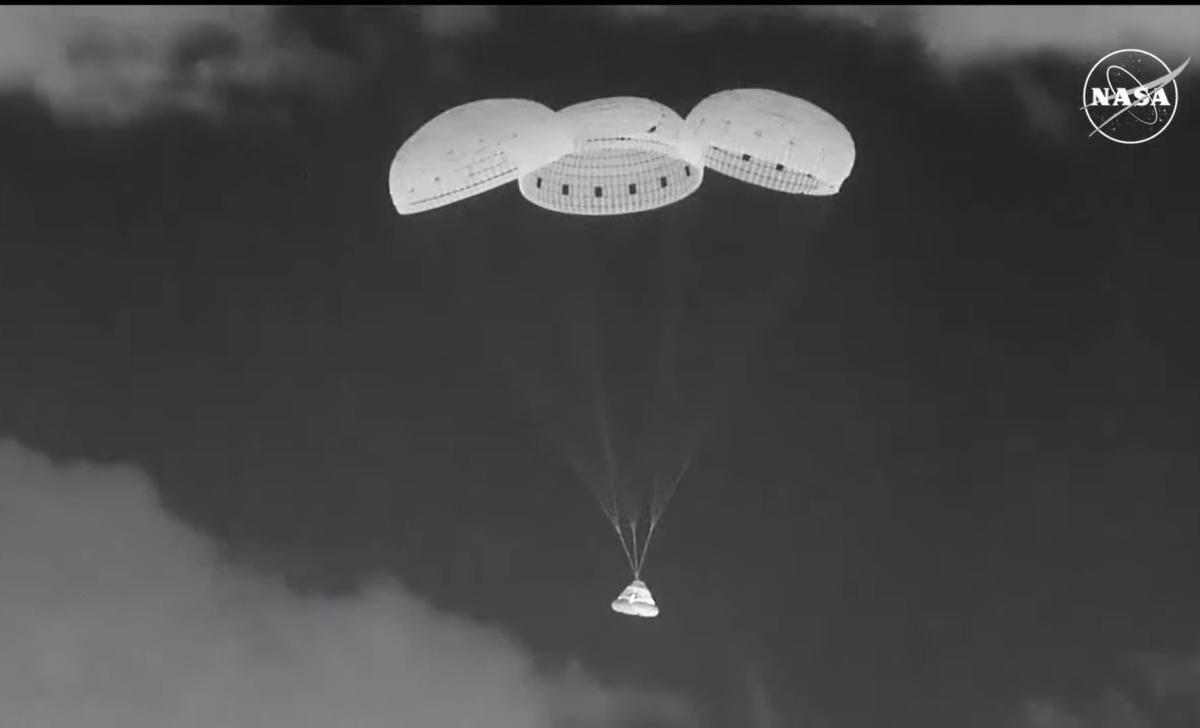
Boeing’s Starliner spacecraft detached from the ISS at 6:04 pm Eastern Time on September 6 and landed safely and gently at White Sands Spaceport in New Mexico at 12:01 am on September 7. The spacecraft, called Calypso, had no crew on board, even though astronauts Suni Williams and Butch Wilmore were on board and headed to the ISS. NASA decided in late August that for safety reasons, the astronauts would return in February on SpaceX’s Crew Dragon spacecraft. Wilmore and Williams only supported the spacecraft’s return and watched the coverage of the re-entry and landing. “You guys are OK. We’ve got your back. You guys are OK. Get her back to Earth,” Williams told ground controllers.
The astronauts boarded the Starliner as part of its first manned flight to prove the spacecraft’s readiness to regularly transport humans to the ISS alongside SpaceX’s Crew Dragon. They were only scheduled to stay in the orbital laboratory for eight days, but midway through, helium began leaking from the spacecraft’s service module. Some of the module’s thrusters also failed. Starliner uses helium to pressurize fuel tanks, which pump propellant into the thrusters that move the spacecraft. For the past three months, engineers on the ground have been testing the Starliner with the help of astronauts, but NASA ultimately decided to return the Starliner unmanned because it was not confident in the thrusters’ performance.
Boeing was not prominent at the press conference following the Starliner landing, and three NASA officials spoke about the landing. Asked why Boeing was absent and whether the company’s relationship with NASA had been affected by the Starliner issues, the representative said Boeing had deferred to NASA as its representative for the mission. All three said they had spoken with Boeing managers and that the company was committed to working with NASA. Steve Stich, commercial crew program manager at NASA’s Kennedy Space Center, also said everyone was pleased with the landing, but added that there was still a feeling that they would have liked the astronauts to return aboard Calypso as planned.
Stich, Joel Montalbano (Associate Administrator for NASA’s Space Operations Mission Directorate), and Dana Weigel (NASA’s International Space Station Administrator) praised the successful docking and “bullseye landing” of Starliner. They said they learned a lot from the mission, which apparently accomplished 85-90% of its objectives, and stressed that it’s important to remember that when it comes to test flights, things don’t always go according to plan.
It will take about two weeks to return Calypso to NASA’s base, and about another week after that to get all the data from the capsule. NASA and Boeing plan to analyze the data collected throughout the system while the spacecraft is in orbit, through undocking, re-entry and landing. They will then use that information to help design improvements to the spacecraft.
Unfortunately, we won’t be able to inspect the thrusters that failed during the flight to the ISS, nor the “doghouse” that housed the spacecraft’s propellant system, where helium leaked. NASA had always planned to discard the service module containing these elements upon atmospheric re-entry, but it now lies on the floor of the Pacific Ocean. NASA has previously said the problem arose when the thrusters heated up more than expected during the flight, loosening a seal on the container and allowing helium to leak. In the case of the thrusters, it appears that the heat caused the seal to bulge, restricting the flow of propellant and leading to the shutdown.
Stich said these problems are not insurmountable, but they will take time to resolve. It is also not known at this time whether the next Starliner flight will have a crew on board. Currently, NASA is preparing for other missions. By the end of September, SpaceX’s Crew 8 mission vehicle is scheduled to undock and return to Earth, and SpaceX’s Crew 9 mission is also scheduled to launch. Crew 9 will fly with two astronauts instead of four, with Wilmore and Williams making the return flight in February.
