


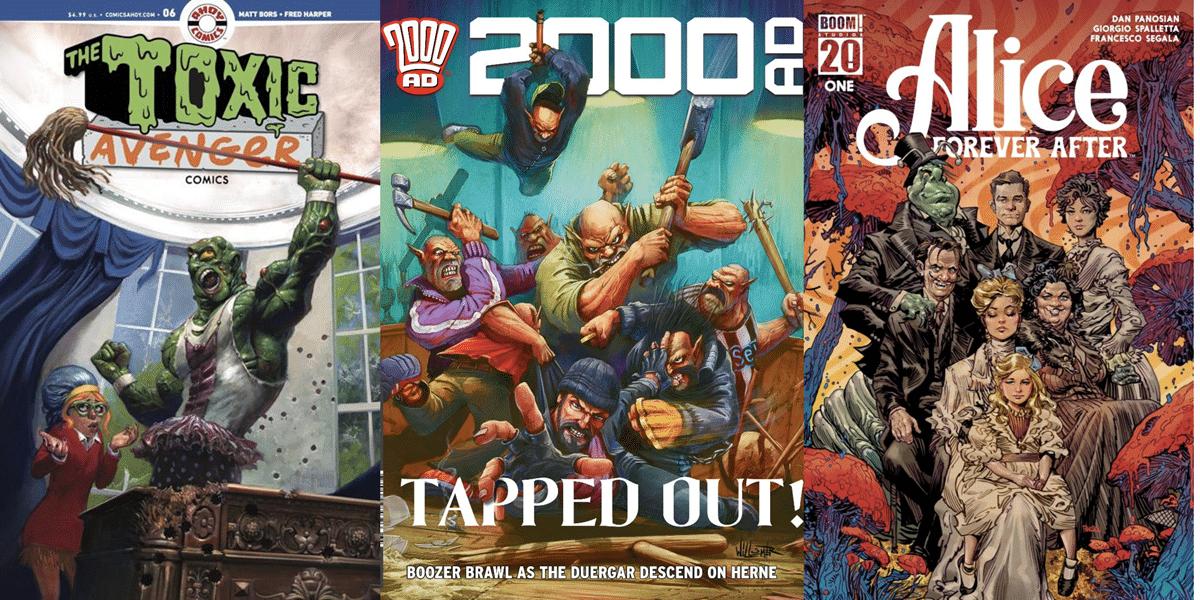
In this week’s Wednesday Comics column, the team goes down the rabbit hole with Alice Forever After #1, checks-in on a big twist in the Energon Universe with G.I. Joe #17, searches for brighter days with Where Does the Rainbow End? #1, and more! Plus, Ensign’s Log and The Prog Report!
Alice Forever After #1
Writer: Dan Panosian
London Illustrated By: Dan Panosian
Wonderland Illustrated By: Giorgio Spalletta
Colorist: Francesco Segala
Letterer: Jeff Eckleberry
Publisher: BOOM! Studios
Review by Sean Dillon
There are two questions one must ask before taking on the prospect of doing a follow up to Alice’s Adventures in Wonderland: Why? and Is there literally anything else you could be doing instead? In the long, sordid history of Alice’s Adventures in Wonderland sequels, there tends to be several recurring elements. Drug use, child abuse, a sense of climactic horror coming to Wonderland as a different blend of logic takes root — one more akin to the world of adulthood with its tax dodgers and mad dictators, and an ill-advised romance between Alice and the Mad Hatter.
Thankfully, Alice Forever After does not appear to be playing that card. Indeed, for all that it very much falls in line with the vast majority of Alice follow ups from The Looking Glass Wars to Lost Girls, there is nevertheless a charm to be found within the pages. This largely comes in the form of the art from both Dan Panosian and Giorgio Spalletta. Spalletta’s vision of Wonderland has the air of a mad cartoon slowly decaying.
Indeed, one gets the sense that things are in the late stages of decay and ruin is soon to follow. The characters are at once mad in the sense of how we knew them in the previous Alice After books as well as in the sense that their desperation is heightened to a point of mania. Panosian’s London, meanwhile, rejects the realistic format one might assume the approach to Wonderland might provide them ample oppertunity to embrace. Instead, the world feels more akin to a refined version of the Walt Disney cartoon Alice in Wonderland, with characters full of expressive eyes and exaggerated features.
Where the book falters is in the writing. This is the case with literally every single attempt to follow up Alice’s Adventures in Wonderland for the simple fact that the book is caulk full of gags, puns, references, satires, parodies, and bits. Literally every single page of the book is littered with jokes to the point where the annotated edition of the books itself has to have annotations to fully dive in to the complex history being engaged with. True, Panosian does an admirable job with his work. But he’s playing serious with what is one of the funniest books ever published.
That said, the bit where the Caterpillar is walking the streets of London and everyone compliments his double canes was delightful.
G.I. Joe #17
Writer: Joshua Williamson
Artist: Tom Reilly
Colorist: Jordie Bellaire
Letterer: Rus Wooton
Publisher: Image Comics
Review by Jordan Jennings
The Dreadnok War comes to its thrilling conclusion this week with GI Joe #17. The Joes go on the offensive to extract Cobra Commander from the Dreadnoks and secrets are revealed that change the direction of the simmering GI Joe/ Cobra/ Cybertronian conflict.
Back when I covered the first part of the storyline in GI Joe #14, I commented on the frantic pacing of the issue. As apparent in the subsequent issues, including #17, the pacing was a feature and not a bug. The whiplash of changing allegiances, espionage, and general warfare made for a deeply enjoyable comic. Writer Joshua Williamson is at his best here in this issue. The dialog is snappy and captures the characters’ voices perfectly. This is best exemplified in the scene where Cobra Commander basically recruits the Dreadnoks into his employ. In this scene, Williamson writes a deeply megalomaniacal Cobra Commander with such lines as “Few have ever come close to killing me. But that is as far as you will ever get. CLOSE.” Perfection.
The pacing of the issue maintains the breakneck speed and frenzy of the arc. Williamson is constantly moving the plot forward while affording time to character moments like Duke’s run-in with the Autobot Hound, who has been secretly with the Joes for a few issues now. Williamson begins to pay off plot threads he first established in the Duke mini-series from 2023 as we finally get to see Duke confront the Cybertronians that have been plaguing him. This is on top of the big reveal at the end of the issue I won’t spoil, but long time GI Joe fans will be ecstatic to see.
Tom Reilly’s art is fantastic as always. His panel layouts are equally important to driving the plot and making the action really sing. Oftentimes issue-long fights tend to come across dull in comics as artists don’t spice up the panel composition, but not Reilly. The diversity in the composition and strategic use of double page spreads keeps the book visually compelling. Striking action is not all that’s on display in the issue, either. Reilly’s ability to convey emotion is criminally underappreciated. The body language he is able to imbue into his art is impressive. The visual humor of Road Hogg trying to ride the helicopter paired alongside the crazed determination in Duke confronting the Autobot “menace” showcases Reilly’s range.
The colors by Jordie Bellaire are equally phenomenal and capture the late-80’s day glow, mad max chic of the Dreadnoks perfectly. Belliare’s use of color in the opening 9-panel grid page makes that page one of the best uses of the formalist layout I’ve seen in ages. I am admittedly a sucker for a well-executed 9-panel grid, but when they work, they really work.
I had a blast reading the Dreadnok War and GI Joes #17 sticks the landing. I highly recommend everyone to check this storyline out. Even if you are only sort of familiar with GI Joe as a concept, you will find a lot to love here.
Babs – The Black Road South #1
Writer: Garth Ennis
Artist: Jacen Burrows
Colorist: Andy Troy
Letterer: Rob Steen
Publisher: AHOY Comics
Review by Zack Quaintance
Look, I am likely one of the friendliest reviewers of Garth Ennis comics within the online comics reviewing space. I heaped all kinds of praise on the first volume of Babs, which saw Ennis rejoining past-collaborator Jacen Burrows for a manosphere-satirizing romp through a generic fantasy realm, with talking-weapon fantasy catching some of the jokes as well. I went so far as to call it “one of the funniest comics in years.”
But the first issue of this second volume was rough for me, almost entirely because a bit where the main characters do a fantasy rap for three pages. Three. Full. Pages. Of written out rapping without a beat. Plus, a fourth page where the crowd chants back at them. It’s a Lord of the Rings meets Eight Mile mash-up with a layer of Weird Al on top. And I found it, as the kids say, very cringe.
Humor comics are precarious business, and even a clunker one-liner can derail the mood in a book that’s otherwise a good time. Three full pages of a joke not working is a tough thing to get past, and it soured the whole affair for me. Obviously, you might get a bigger kick out of bringing hip hop to a fantasy pub. It just didn’t work for me.
That said, the rest of the issue nicely set up an interesting premise for the second arc — while drunk after the aforementioned hip hop, Babs and friend accidentally commission an adventuring party deep into Mordynn. I also dug what feels like a new, deeper focus on Babs as a character, rather than the dynamics of the world around her. And I liked the first arc so much, that I’m willing to forgive this one for a bit of hubris.
Where Does the Rainbow End? #1
Writer: Francesca Perillo
Artist: Stefano Cardoselli
Colorist: Lorenzo Scaramella
Letterer: Buddy Beaudoin
Publisher: Mad Cave Studios
Review by Khalid Johnson
One of the most charming things about reading Where Does the Rainbow End? #1 is the art of Stefano Cardoselli and how well it communicates the sweetness in the interactions of the characters written by Francesca Perillo, with gorgeous warm colors by Lorenzo Scaramella. The letters of Buddy Beaudoin really build out the distinct voices of robots and humans and give such a strong sense of character that only punches up the strengths of the visuals. The setup feels almost saccharine as robots take care of a human infant, and though the details of their second-class living are ever-present in environmental detail, as they take care of Gilda their world is bright and vibrant. The sweetness then is met with a foreboding presence to end the book as the world reacts to the knowledge of Glinda.
There is a lot of humanity extended to the robots in anthropomorphizing them and the conflict set up leaves a lot of questions. With two robot factions relegated to different degrees of disenfranchisement, one of my immediate questions is then, what are the consequences of this world on Black and brown people especially in a futuristic America (considering past and present America)? Seeing the Statue of Liberty as set dressing I think about histories of oppression here and then with the wall dividing the sectors of landfill that the robots call home, and the apartheid of America, South Africa, Palestine. I’ve been thinking a lot about nonviolence and “peace” in the context of human rights struggle and the explicit framing of discarded military robots as old and hostile scratched something in my mind. The state apparatus is hostile, violent, when discarding people and casting them into squalor with no care or access to care, that hostility is not met with the same judgement and accepted as matter-of-fact, immutable.
Where Does the Rainbow End #1 is a charming and very sweet first issue with vibrant art and characters that left me with a lot of questions about the broader world and the brush that will be used to paint the factions. Simply put, I was left with a lot to ponder.
Toxic Avenger Comics #6
Writer: Matt Bors
Artist: Fred Harper
Colorist: Lee Loughridge
Letterer: Rob Steen
Publisher: AHOY Comics
Review by Zack Quaintance
This comic opens with a full page splash of the Toxic Avenger pulling up his leotard tutu thing while his girlfriend rests pantsless across the resolute desk in the oval office, the pair of them just having had sex there, with a caption noting that it’s four days after a coup. This is deeply funny, and also a real tone-setter for the new multi-part story that starts in this issue, in which Toxie goes to Washington.
I’m a big fan of these new Toxic Avenger comics, having read them all, and politics have been baked in from the start. The book is at its core a deep satire of American values and life and what it costs all of us, which, of course, is all deeply political. In this new arc, however, the politics of all gets put right up front, and it makes for arguably the best single issue since the title came to AHOY back in late 2024.
What really works well about this comic to me is that instead of making sly, winking political jokes, or searching for analogs, it makes its points almost as obviously as possible. There’s a real feeling of let’s stop messing around here and call it as it is. Again, I will remind you, this is a comic that opens with a mutant superhero just having sex in the Oval Office.
The issue reading this well could also speak to the value of maintaining continuity within a creative team, with writer Matt Bors, artist Fred Harper, colorist Lee Loughridge, and letterer Rob Steen all having been aboard from the start. There’s a smooth coherency to the collaboration here, one that feels key to nailing the pristine timing needed to tell jokes in comics (and this comic has plenty of jokes…just wait until you meet the Planet Teens).
It’s also not above having silly fun. Not every joke in it has to be one at the expense of crooked lobbyist or vain senators. In fact, I think the moment that got me the hardest was — and spoilers for one minor joke here, so turn back if you like, you’ve been warned — when Toxie continues to hold his right hand up after being sworn in through the full length of a senate testimony, until someone says “put your gaddamn hand down.” That got me good.
Finally, I’ll just say that for those of you who have not been reading Toxic Avenger comics, you can absolutely jump in here with Toxic Avenger Comics #6, and get everything you need to join the rest of us for this new arc. You can and should do that, in fact.
Ensign’s Log — Stardate 11426
As IDW’s Star Trek comics continue to expand, Ensign Avery Kaplan has enlisted here to keep a careful log!
Star Trek: Lower Decks #15
Written by: Tim Sheridan
Art by: Vernon Smith
Colors by: Charlie Kirchoff
Letters by: Clayton Cowles
Design & Production by: Johanna Nattalie
Publisher: IDW Publishing
First of all, the running gag of the recap page that also includes random scenes and characters from other Star Trek shows continues to be hilarious. This issue continues the ongoing six-issue-long storyline that sends the U.S.S Cerritos on an especially intriguing second contact mission.
This issue is a solid continuation of the ongoing storyline, but one that focuses more on Bradward Boimler’s subplot than advancing the narrative of the six-part story. Both Beckett Mariner and Samanthan Rutherford appear in this issue, so all five of our main Lower Deckers do appear this time around, which I always appreciate. Meanwhile, Boimler, D’Vana Tendi and T’Lyn have bigger parts, and Freeman gets a not-insignificant role as well.
While this issue was entertaining enough, I don’t know if it was as funny as some of the previous few issues. I did have a few reservations about the running gag regarding Boimler having one eye that was bigger than the other; I’m not sure jokes about one’s physical appearance should have a place in the Franchise.
Not only does this issue continue the same creative team from the previous few issues, but it also maintains the same level of quality. Smith’s art remains well-rendered and faithful to the show. In this issue, I particularly enjoyed the pose he gave Boimler when Boimler assumed his position on the bridge of the non-Starfleet ship. And the Cerritos bridge looked excellent after being battle-damaged. Kirchoff’s are accurate to the show, and do an excellent job of highlighting some of the art’s details. And of course, Cowles’ lettering remains well done.
Middle chapters can be tough, and while this may not be my favorite issue of the story arc, it is nevertheless yet another worthy addition to the Cali class canon.
The Prog Report
2000AD 2465 (Rebellion Publishing): In this week’s Prog, my two favorite stories remain those that I wrote about in this space last week: Death of a Judge and The Discarded. Both move along nicely in this issue, furthering their respective plots in compelling ways. The former continues to be interesting given the combination of its title and the fact that John Wagner is writing it. I’m sure we’ll revisit it again at least once here. Elsewhere in this issue, writer Kew-W is joined by artist Tom Foster and letterer Simon Bowland on another stand-alone story about the Judge who would become Judge Death, kind of an ongoing exploration of Judge Death in the before times. These stories have been good, even if I tend to prefer my truly scary villains without a concrete origin, although that’s a Joker thing, and we don’t always have to let our preferences be indebted to Batman. So that’s where I’m at with this week’s magazine, a bit of a comedown after last week we got the start of the most-anticipated new Judge Dredd story in some time. This week’s cover (above) is by Toby Willsmer. As always, you can pick up a digital copy of The Prog here. —Zack Quaintance
Column edited by Zack Quaintance.
Read past entries in the weekly Wednesday Comics reviews series or check-out our other reviews here!
Like this:
Like Loading…
