


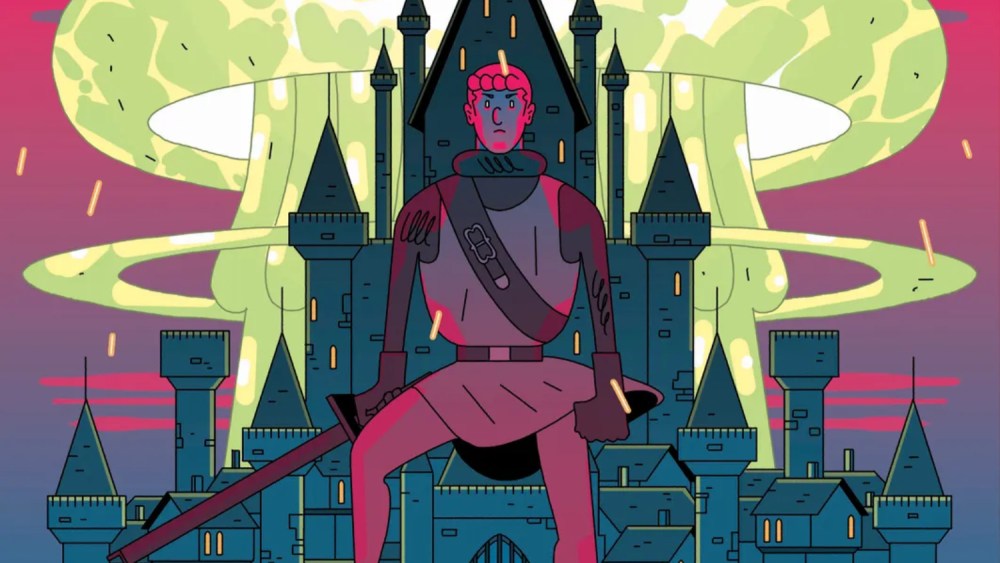
Ionheart is everything great about American-flavored sci-fantasy epics: a brave knight, a magical kingdom, anachronistic tech, epic sword fights, etc. It’s the exact perfect fare for Lukas Kummer to make his English-language debut.
“My brain works in English because I’m socialized with American TV shows and science fiction movies and fantasy movies,” Kummer said during a recent Zoom call. “Sometimes I can think of the English phrase before I can think of the German phrase.”
That is, as you might have already guessed, quite the intriguing revelation from an Austrian-born writer-artist now residing in Germany. His other works (including Die Ursache and Die Verwerfung) have a similar sheen of adventure and intensity, albeit positioned in a decidedly different cultural framework. Americanized stories, it seems, just speak Kummer’s language when it comes to sharing these fantastical tales.
“Actually, I’m trying to think of…is there European science fiction?,” Kummer said. “There’s Stanislaw Lem. There’s Metropolis. But other than that, I really can’t think of a lot. With Ionheart, all my influences in there are basically American.”
Now, obviously there’s great comics talent from that side of the world; Kummer himself specifically mentioned the great and powerful Mœbius (from France). But in working in Germany over the last decade or so, Kummer has felt disconnected from that local comics industry/community.
“In Germany, there isn’t really a tradition,” Kummer said. “And the thing is, especially the comic book market in Germany, you have underground, avant-garde and then you have mainstream, but you have nothing in between. I like the avant-garde stuff that comes out right now of Germany. It’s really interesting. But I never saw myself in either of those two camps.”
At least the geography itself has something to offer Kummer’s storytelling.
“When it comes to fantasy, especially Middle Age fantasy, I can go outside and look at castles,” Kummer said.
A Culture Clash
That’s not to say that Ionheart is fully and completely American (like a red, white, and blue steampunk robot). Rather, some 15-ish years ago, Kummer came up with the earliest ideas and concepts for the now 312-page OGN.
“I know that back then I was reading a lot about Aztec culture, especially when the Spanish came, when Cortez and his conquistadores arrived,” Kummer said. “This is the moment in time that I really would have liked to witness, when Cortez meets the first Native Americans in South America and the Aztecs and how this whole thing developed. I was really into Aztec mythology and lore. The way they sacrificed, even in comparison to other civilizations, it was off the charts.”
Still, it took more time for the idea to actually spark a larger story.
“I didn’t go any further because it didn’t lead me anywhere,” Kummer said. “Then I thought, what if it wasn’t Aztec? I wanted to have two very different cultures clash. So you take the two most obvious stereotypical settings: a very stereotypical science fiction setting and a very stereotypical medieval/fantasy setting. And then you let those two collide.”
The act of collision is perhaps the best way to describe Ionheart. It’s a sensibility that’s even emphasized in the publisher’s description:
“Pursued by a terrifying demon, a young knight (Billy) flees across the radioactive ruins of a fairytale land. His only weapon is the same cursed power that once destroyed this world — what some would call magic, and others would call technology. As his relentless enemy draws closer, the knight’s terrible secrets begin to unfold.”
From there, we’re faced with questions galore. Just who is Billy, and where’d he get all those neat-o gadgets? What’s behind the magic-technology kerfuffle in this kingdom? Why is he helping the Princess, and what’s her deal? What year does all of this take place in, and does that matter? And what happened first and do I need to really concern myself with that order? In short, Ionheart is a medley of sci-fi and fantasy that’s like great barbecue: Seemingly simple ingredients that, upon consumption, reveal themselves to be rich and flavorful.
You can thank Tom Cruise for all of that, FYI.
“By any chance, do you remember the movie Oblivion with Tom Cruise? I saw it on an airplane once,” Kummer said. “And what I found fascinating with that movie is, bit by bit, you learn more about the story and it takes a U-turn, like, every 15 minutes and it’s something completely different.”
Kummer added, “It’s not like in Lost, where it doesn’t make sense anymore. Everything that happens in Oblivion is…OK, it makes sense in that kind of setting. And that was my blueprint. I wanted to tell a story that has those U-turns every couple of chapters or pages. But it makes sense in the world that I created and with those laws that I established.”
Courtesy of Top Shelf Productions.
Sign Posts and Dead Ends
That’s really the dynamic or dichotomy that keeps Ionheart churning ever onward. Kummer is constantly moving and shifting across the book, and you wander around this dueling world of sci-fi and fantasy in a way that’s meant to disarm you and strip you of your senses so you can feel the power of a simple story of a stranger in a strange land. But Kummer also wants you to be able to track the story, and to keep pace with shifting timelines and varied locales so you can feel the full thrilling surge of this experience. It’s an easy book but it’s not, and in that space is all of the magic.
“I want people to understand it,” Kummer said. “And I want people to know what’s going on and where they are. I want it to be as clear as possible.”
Kummer added, “Tintin has a very plain face – so you can project yourself. All of my characters have plain faces; it’s very much in that tradition. I tried to work by a strict color concept so people always know where they are. You can make it understandable when there’s the common language that we speak, pop culture.”
If it seems like either of us are being overly vague, that’s sort of the point. To truly engage with and enjoy Ionheart, you really should go in a little blind. Yes, there’s three chapters/books, and each one bobs and weaves in its own way to tell the story. And, yes, there’s “heroes” in each book, as Kummer said that the “first two books are Billy’s books. And then the Princess takes over.” There’s also a murderous robot, equally murderous trolls/barbarians, sweet glider cars, talking alien tech, and so much more still. Ionheart is very much a secret I wish I could scream directly into your face, but then I’d spoil something truly, utterly special.
But it’s also one that is purposefully, deliberately meant to be quite direct.
“I wouldn’t consider myself an expert in either sci-fi or fantasy,” Kummer said. “I just know the tips of the respective icebergs. But that’s what I wanted to represent in Ionheart because, like I said, both the fantasy and the science fiction world are very stereotypical. If you saw a reel from the Jetsons, that’s the science fiction world they live. If you watched a 30-minute clip of Snow White, you know the fantasy world.”
Courtesy of Top Shelf Productions.
Sauntering Into The Unknown
The way in, then, is very much through this kind of lingua franca that often accompanies genre storytelling (which now includes this book).
“I’m playing with a common vision,” Kummer said. “The first thing you go to when you think about sci-fi or fantasy…that’s what is represented. I think that’s also the only way to make it work because if you take a more nuanced or layered approach, then you would have to explain those. You have to have a certain pop cultural upbringing to understand it. My grandparents aren’t alive, but if they were, there’s no chance they’d understand it. I think the common denominator of our generation is that we grew up with the same things.”
At the end of the day, Ionheart can be described in one succinct message. The real work, then, comes from the journey brought on by this simple but undeniable urge.
“It’s very much a book about escapism, and (Billy) can’t escape,” Kummer said.
Given the archetype-heavy approach to Ionheart, Kummer found writing advice from some masters. He referenced “But…Therefore…” from South Park creators Trey Parker and Matt Stone — if your story beats work with “But…Therefore…,” you’ve got a gem; however, if “And Then…” fits instead, it’s back to the drawing board.
Then, of course, there’s Story by Robert Mckee, which is practically the bible for effective screenwriting. That one especially seemed utterly perfect for Kummer’s creative approach.
“It’s very dogmatic, his approach,” Kummer said. “There’s rules, and you don’t have to follow it. But if you do, you’ll have a great screenplay.”
Courtesy of Top Shelf Productions.
In Good Company
Just as he leaned into other writers for help, so too did Kummer lean heavily into some tentpole influences. These were road signs for an attitude needed to make the story truly flourish.
“I don’t like things that take themselves too seriously,” Kummer said. “My favorite directors are John Carpenter or Paul Verhoeven. It’s very much in the vein of RoboCop, which is one of the most ingenious, stupid movies ever made.”
Not every influence, however, was quite as boldly, amazingly dumb-and-wonderful. There’s one comic especially that encapsulates something essential about Ionheart.
“Maybe it’s not the best example because it’s very smart, but League of Extraordinary Gentlemen by Alan Moore,” Kummer said. “It’s my favorite comic book series. I think the first two volumes (work), then when it goes off into Black Dossier, I’m out. But those first two books, there’s so much knowledge and smartness in there. But at the same time, he takes a Victorian novel figure and puts them into a superhero setting. And that’s a really stupid idea, but it’s so stupid smart.”
Other influences have been lobbed toward Ionheart, including Adventure Time. (Especially with the dual worlds, general tone/aesthetic, and mix of heart and humor, that one feels spot on.) But whatever you use to filter or explain this book, Kummer doesn’t really mind one iota.
“We all grew up with influences. I quote them pretty obviously, I think,” Kummer said. “It’s only when something comes completely out of left field, that’s when I get irritated. If it reminds you of Blade Runner, it’s fine. If it’s Dark Tower, yeah, sure; it’s one of my favorite comic books.”
Courtesy of Top Shelf Productions.
It’s Not Eraserhead, K?
Still, that’s not to say that Ionheart just works because it’s a simple but genuinely thrilling experience. Rather, there are aspects of it that are meant to be less obvious for a reason.
“There are a few moments where I try to be ambiguous,” Kummer said. “At the end of the second book, I really wanted to be ambiguous. There’s a few hints, like the insanity of the mad bot. You can do your own research to understand or you get the reference. But if you don’t get the reference, it doesn’t matter. I’m not David Lynch.”
Speaking of the second book — where a lot of the truth of Billy’s journey leading up to this story starts to unfurl in earnest — it’s Kummer’s favorite chapter.
“I think that’s the most personal story in there,” Kummer said. “That’s the heart of it.” Complicating that experience, though, is that it’s the third book where Kummer is “really happy with how all of that came out, stylistically.”
That’s not just the case of some unsatisfied artist, though. It’s Kummer knowing the story that he’s told, and being OK with a journey that’s wild and exciting but also personal and mysterious in parts. He wants to have fun with this story, and to give readers something to chew on that’s approachable but layered if you want to be; direct but never boring; multifaceted but resonant with universal ideas and values. Basically, he’s having his cake and you’re the one who get to eat it.
Case in point, the book’s biggest question is a prime example of its creators entire “passionate but not all-consuming” approach.
“I wanted to do mystery, and then the solution to that mystery, or what’s behind that mystery, is way more banal,” Kummer said.
Courtesy of Top Shelf Productions.
The Path Nearly Taken
If anything, Ionheart had to be this way to actually make it out into the world. That if it weren’t this multifaceted experience, where things are as easy or as hard as you want them to be, and where genre is everything and nothing, Ionheart may not have ever been published.
“I had two more books (after the first 100 pages), and I sent them to Chris Staros at Top Shelf. He said they were shit,” Kummer said. “I was pretty sad at the time, but he was right. I read them recently. It’s not like they are shit, but it was too experimental. At that point, it was COVID and we were all isolated.”
Before settling on Ionheart‘s last two books/chapters, Kummer said he’d “used this universe as a kind of platform to try out narrative experiments. That’s why the third and the fourth book fell off.”
Kummer added, “I tapped into the whole multiverse. The charm of Ionheart is that it’s just two worlds and that’s enough.”
There were other issues with the third book, too, like how he “threw in a whole bunch of new characters” that just overcomplicated everything. Or, the story structure “where the scenes…it sped up all the time. So it started out really slow, and then every 16 pages, it doubled in speed.” And don’t even get him started on the fourth book.
“First, it started as a superhero comic, and then it went into horror and then it was superheroes again,” Kummer said. “I think the horror part is still very good. One day, I’m going to publish it like a small spin-off.”
There’s even more ways in which the book could have developed. A scene from the first book, which features a character “entering a certain establishment,” was nearly the crux of the book entirely. This instance might confuse you even further, but just know that it’s an anecdote that’ll further help us understand what Kummer is trying to do with the many layers of Ionheart.
“That’s something I had in mind for a very long time. I don’t know why, but…I tried to build a whole book around that scene in a certain way,” Kummer said. “And then I thought then the thing was, ‘OK, you have different robots, and why does one look like this and one look like this? Is there a logical explanation?’ OK, one is a surgeon.”
Courtesy of Top Shelf Productions.
Shimmery Expectations
Admittedly, discovering what Ionheart could have been at the same time as what it sort of is, existentially and contextually speaking, super-mega-confusing. But if nothing I’ve mentioned so far has helped you come to a purchasing decision or not, there’s one final sales pitch from its creator. For Kummer, it’s all about leaning into and bucking expectations as an exercise in creative expression. It’s also about wanting something for what it is and accepting when it’s so much more (or maybe even less?) Mostly, though, it’s just about being open for a really great story.
“I think you’re going to pick it up expecting a lighthearted adventure story, which it is,” Kummer said. “But I’m pretty sure in the end it will move you.”
