


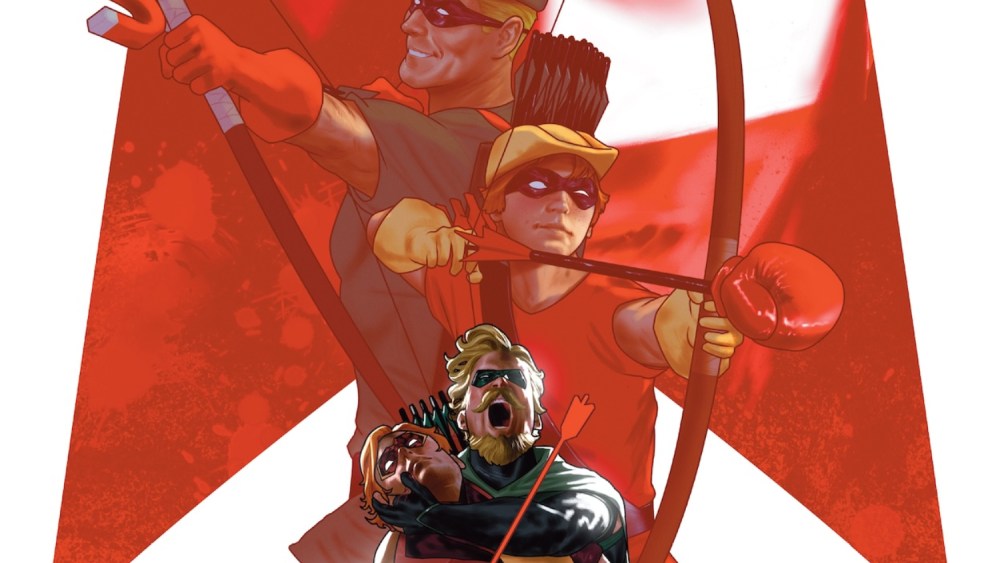
Beginning with last year’s issue #18, Chris Condon and Montos officially took over on Green Arrow. And in that time, the pair have developed a grounded, noir-leaning take on the Emerald Archer, with the bulk of the story so far focused on the saga of Freshwater. Now, with the bombastic first arc over, the pair are looking toward the future with this week’s issue #25. And what better future than one featuring Roy Harper, his daughter Lian Harper, and a story reminiscent of a seminal Green Arrow storyline?
More specifically, this latest arc references and re-explores “Snowbirds Don’t Fly.” A two-parter originally published in 1971’s Green Lantern/Green Arrow issues #85 and #86, “Snowbirds” is considered one of the seminal Green Arrow stories ever, as we find out that Oliver Queen’s ward, Roy Harper, has been using heroin. In it, creators Dennis O’Neil and Neal Adams deliver one of the most controversial stories at the time: one where a “good guy” does a “bad thing.” It not only facilitated a much-needed national conversation around addiction, but it also demonstrated how important comics was in telling these vital stories.
To get a better idea of this new arc and it’s relationship to essential Green Arrow history, I caught up recently with Condon. During our chat, we talked about what made “Snowbirds” so vital, connecting the story with real-world events/happenings, the development of the Roy-Oliver relationship, using comics as communal aid/support and, yes, even chili recipes, among many other topics.
This interview has been edited for clarity and length.
Courtesy of DC Comics.
AIPT: I do want to first off mention: The first arc you did, it was incredible. After talking to you beforehand and seeing it come to its conclusion, the attention to detail that you did to making it less of a superhero story and more of a social story was a really great way to use a comic to deliver a more powerful message.
Chris Condon: Thank you. I mean, that was kind of the goal from the start. I’m glad it worked for you and it seems to have worked for other people as well.
AIPT: Definitely. And I think Green Arrow is the perfect character for that given his role is not that of Flash or Nightwing or Superman. It’s not as much about stopping a “big villain” versus acknowledging whatever greater issues are impacting a community, and his inability to let that continue with his own stubbornness for seemingly just stopping injustice however he can. It’s like a Spider-Man sense of responsibility he has.
CC: I think with a character like Green Arrow, you could do your typical superhero story if you really wanted to. But for me. I think that he has such a interesting character. He’s got this…not every superhero is as curmudgeonly and opinionated as Ollie, and I think that it’s really fun to get to play with that and get to see him in the way that I think the character was really defined, which was as a social justice warrior in the early ’70s under the guidance of Neal Adams and Denny O’Neil And so to bring it back was pretty important to me in terms of how I want to approach the character — and same thing how with what we’re doing for the new arc. It was pretty important to keep that in mind and how we are approaching this new story, which is in dialogue with a very classic Neal Adams-Denny O’Neil story.
AIPT: Definitely. I did get a chance to read it (the next issue) and I can definitely see the threads that you’re trying to pick up on from what O’Neil and Adams did and carry that on. What do you think has been your goal to separate this from that while delivering the same kind of tonal message of a political story without having it be line-for-line the same message?
CC: For me, it was what Josh Williamson had done previously in the previous issues to my taking over the title — it was a family book. And I know it certainly has it fans. But in where we picked up from it after Absolute Power, it made sense to separate Ollie off a little bit, and give him time to sort of decompress and figure himself out. And in that way, we got to bring him back down to basics a little bit.
Going into the next arc, I wanted to not fully bring the whole Arrow family in again just like nothing had happened, but I wanted to start peppering in more characters again. For myself as a writer, I like to see characters interact with other characters. I like to see those moments play out — I really love character moments. Those are more important to me than plot, frankly. And so, I wanted to explore the characters Roy Harper and Lian. And how better for me to do that than to look back at possibly the most famous Green Arrow story of all time, “Snowbirds Don’t Fly.” I love playing with that kind of history. And one of the things that I really like to do in doing Big Two work is look back at the history of these characters and explore that. That’s something I did in the Daredevil one-shot that I did, (and) it’s something I’m doing in Ultimate Wolverine and it’s something that I’m doing in Green Arrow.
It was more a thematic reference in the first arc. But this arc, I really wanted to play with something that was consequential in that run, and to look back at that and see how that affects the character today — outside of an odd reference or an editorial note at the bottom of the page. I really wanted to explore what that means to people, because those moments in our real lives do matter to us, (and) they do affect us for the rest of our lives.
I’m someone who lives with constant regret over nothing, because I’m just a guilty person. I just have that guilt built into me from my youth. My parents, unfortunately, instilled that into me. And I wanted to play with that a little bit — how do these people, these superheroes who live these great (lives), they get to leap off of rooftops and get to hangout in a Watchtower in space…how do these very human frailties (and) foibles affect them as people? And that was what I wanted to do with this next arc. In doing so, I feel like its setting us up for an interesting brother/sister story with our first story. We’re still dealing with social issues, (and) we’re still dealing with a more grounded story, but we are also looking back at one of the greatest stories of the character.
Montos is just getting better and better, which is like another thing.
AIPT: To talk about Montos, I would need another whole half hour to talk about how incredible the collaboration is with Adriano Lucas.
CC: Laughs. Yeah.
AIPT: It’s so funny seeing the color from Nightwing during Tom Taylor’s run with Adriano Lucas being very bright, and here they’re just so thick and dark and very intricate and they play so well with Montos’ art style. I can totally see what theme you’re going for as a result.
But I think you make a great point saying this is a brother/sister arc in the sense there is definitely some reflection to not only one of the greatest Green Arrow stories, but I think one of the most seminal comic book stories. It’s decades later and that (addiction) is still a very prevalent issue in society. And, just as much then as they are now, Roy and Oliver are quite different people.
How did you view their main differences while keeping in mind they have the same calling to do good for those who are struggling? How did you try to acknowledge their drive being relatively along the same lines?
Courtesy of DC Comics.
CC: They’re two different people, so they’re going to be different to some extent. They spent time together — both in their early days as superheroes, but also for Speedy, for Roy when he was Speedy, those were his formative years. So, he’s definitely going to have a perspective on Ollie that’s different than Ollie’s perspective on him.
For me, it was important to get to play with that, and to see these two characters interacting and sort of reminiscing on those earlier times. That’s going to play through the whole arc. For me, even going back to That Texas Blood and The Enfield Gang Massacre and my earlier stuff, it’s always been a part of my interest to explore characters and their past. Because I do think that your past does set up who you are and who you will become. And that was all I was trying to do with these characters was to see them as they were and see them as they are now. And, you know, what the choices that they made led them to this particular moment, and how they will go from here after the climactic thing that happens at the end of the issue happens.
I do think that the second issue, it’s pretty emotional. But I think that it all feels true to what the characters are, and what they do. And that the biggest thing for me (is) to explore the characters, but have it feel true as well to the characters because obviously if it’s not true to the characters, then we’re doing something wrong.
AIPT. Definitely. I mean, outside of Tony Stark, Roy is kind of the poster for addiction in comics. A character who has struggled with it and has overcome it. And there’s such a rich history there. Sure, it changed a little bit in The New 52, but then it seemed to revert back to how the story was originally intended by O’Neil and Adams.
How did you try to honor the overarching theme of addiction that Roy has experienced while keeping the focus on Oliver?
CC: I mean, I think not only his addiction issues, (but) I think the role that recovery has played in his life is an important part of his story. And that’s something that people in our daily lives deal with. I mean, this is something a good friend of mine deals with — (he) has been to jail, has gone through the whole thing, and is on the other end. I think that in our society, a lot people think that people who abuse drugs that they’re down some dead end, but the truth is…they haven’t seen that there’s another path. I think that was an important thing to explore. It gives me the runway to be able to tell a story about opioid addiction (and) about pharmaceuticals companies abuse. That’s really the story we’re going to be telling.
AIPT: I think the last (arc) did an incredible job showing how big corporations have the ability to, whether intentionally or not, push some people in society under the blanket. What do you feel like is the core message of the story?
CC: I want people to acknowledge again…it’s very much a similar sort of takeaway from the first arc — people in power abuse their power. I think that that’s an important theme throughout, and that’s what I hope people pick up on the story.
Obviously, there’s villains and heroes and all that, but I really wanted to talk about something that is important to this country, to this world, and to myself as well. Companies will get you addicted to a product, and they do it for the profit. I think that is something that is truly, frankly evil, and it’s something that I feel like it is a little “taboo,” maybe, to talk about in comics.
Because we have a character like Green Arrow, who is a social justice warrior, and because we have a character like Roy/Arsenal, who previously was Speedy had an addiction problem. It gives us the doorway in which to explore this topic that…is taboo, (and) it probably would be less taboo to even talk about what’s happening in the country politically versus what’s happening in terms of of a smaller level. How these things are affecting people, and one of those ways is through prescription drugs.
Once people are addicted, they go to something stronger. That’s the story that we’re telling — this new grade of a heroin-like substance called Crimson Sand.
Courtesy of DC Comics.
AIPT: To your point, the first one was Ollie a bit on his own getting back to basics, but a story like this has to expand. What’s the feedback been like as you pitched this arc? What’s been your process with DC to be able to deliver the story in a meaningful way that’s more than just a quick little blurb to get a little bit attention?
CC: The best thing that DC has done is they just let us do what we want to do. I mean there’s not much in the way that they get in our way or tell us we can’t do something or tell us we have to do something this way. There are some things that I guess people will see what they are, but because of the rating of the comic, we can’t show certain thing.
At a certain point, you just have to throw our hands up as a creator, because you see one thing and think, ‘How is that OK but this isn’t OK?’ At the end of the day, they’re letting us tell a story that I didn’t ever think that I’d be able to tell with a Big Two character. And to end the first issue of the arc the way that we ended it (which is in itself a reference to “Snowbirds”).
It’s kind of amazing that they’re letting us do this. Especially following what Josh (Williamson) was doing, which was, again, great, but was very much a superhero family book. Everyone had a moment of action, (and) it was very fun and felt very bright. It felt Silver Age-y in a way, which I love that. One of my favorite writers is Bob Haney.
But I think that in how we’ve approached it, and how they wanted us to approach it, they let us run. And we approached it with a very strong voice as an artist and writer. So their notes on our work is very much just, ‘This line might be a little bit much’ or ‘We can’t show this one.’ For example, for as much as this arc is about drugs and drug abuse, there is a limit to what we can show because it is a teen-rated book. Which is obviously disappointing for me, because I think that it’s something that everybody encounters in their life anyway. But you have to deal with doing a book that is, at the end of the day, linked back to Warner Bros. Discovery. They don’t want you to be doing certain things, so you have to be careful about that.
They wanted more from us, and so then that gets you thinking about, ‘What more can I say?’ I started thinking about the opioid epidemic. I started thinking about opioid abuse in the country in this country, in particular (around) my area in New Jersey where I live. I’ve had, not to get too personal, but a friend of mine that I was working with that I was trying to help get help, he overdosed. It’s never an easy thing — going to the funeral. Then having his parents say, ‘Thank you,’ and it’s, like, ‘Well, I didn’t really do anything.’ Just being there for somebody like that is enough for a family that’s dealing with that wrenching experience. I hope it happens less and less because it’s an awful thing.
But just looking at that and having a character like Green Arrow that is this social justice warrior — again, he gives us that space to be able to talk about these very serious things. Because that’s who he is as a character, and those are the kind of stories that he thrives in, I think. A lot of people will call him a Bat-Clone, and I think that this is what sets him apart. It’s his voice, it’s his character, it’s having interactions with his community. I think that’s all that we’re trying to do.
AIPT: I’m sorry about your friend.
But you’re so right, it is such a prevalent issue, and I think the tragedy is that it’s been a decades-long issue that is an epidemic that evolves with society and is truly a disease that impacts people in very tragic ways.
I think there’s always a little bit of fear that maybe they just can’t be (published) anymore, to the same leeway that they used to be able to tackle heavy issues. I think of Iron Man #182, where he goes to the hospital after getting really sick right around Christmas. It’s his big turning point with his addiction as well.
CC: Like, the Denny O’Neil stuff, too?
AIPT: Yeah! It is!
CC: Yeah. That’s good stuff.
AIPT: Those stories don’t happen as much anymore, and I think writers who see that deficit and tackle it like the way that you do, they make heads turn.
Courtesy of DC Comics.
CC: I think you’re hitting an interesting point. Even though we’re living through a rough time, and I don’t really care what political stripe you’re from, it seems that both sides are saying it’s a tough time. But, specifically, I am more of a liberal-minded person, so I very much jive with what Green Arrow says and what he does. From my perspective right now, these are really intense times, and you do want to have a fun escape. At the same time, you also need things that are going to provide fuel and inspiration and tell you that, ‘I see you, I hear you, I know things are bad, but we can work on these things, we can change these things. We can combat these things.’ And that’s what these stories are great for.
Especially a character like Green Arrow. The first arc of Green Arrow didn’t end on a happy-ish note; it certainly had its moment, but it was a positive step forward. And that’s what I was striving to do with that story, and I think that that’s something I will be striving to do with every story that I tell. Especially with a superhero. I think that it’s important to, yeah, have the fun stuff and have the escapism, but I do think that it’s also important to have the things that are going to speak to the moment. I think that those things exist for a reason.
Going back to the 1930s and 1940s, what was going on in film in particular, this was definitely prevalent in comics as well. On the covers, they’d have Superman and Captain America beating Hitler up. But, in film, it was dark times, but there was a way to handle these things where you’re both talking about something and you’re also delivering entertainment. And something like Casablanca came out of that, you know? So, I do think that it’s important to talk about the real issues of the day, and I think if you can do it in an entertaining way…that’s even better because then people can’t necessarily look away as easily.
I hope people enjoy the book. I hope they get something out of it. But, at the end of the day, all that I can really strive for and want to do is tell just a Green Arrow story that’s going to stand up on its own and not feel like its forgettable, (and) like it’s a throwaway story. I want this to feel like it could be a part of the pantheon of great Green Arrow stories.
AIPT: I think that it’s safe to say, at least in my very biased opinion…it’s one of the comics that I recommend to everybody who’s never read a comic or wants to get back into comics.
There’s something so meaningful about that first arc. It’s not supposed to feel good, and you’re not supposed feel like everything has a bow tied on it. It’s supposed to make you think, ‘Oh, there’s so much more to do.’ That’s constantly done with the character, and that’s what I think makes him such a long-lasting imprint of a superhero — not everything that you see him do is done on the page. It’s that you know he’s constantly doing (more work). He’s going to always feel a little unsatisfied with what he’s done cause there’s always more that he could do.
CC: Yeah, and I think that it’s in the core of his character. I mean, this even goes back before the Denny O’Neil-Neal Adams stuff, which again cemented the character for me in terms of making him a unique voice. But I mean he was a screw up, you know? Fell off of a boat. Laughs
Also, ‘How can we do something interesting with this character who’s very much one-dimensional in a very classical way.’ I mean, who are Green Arrow’s villains? They’re all tend to be archers, you know? How do you do that in an interesting way that has an effect on the character? Instead of just affecting bystanders, have this effect somebody who’s close to Ollie. And who better than his first ward? So, it’s an interesting story to get to tell, and I’m really fortunate to be able to tell it in the way that we’re telling it.
Courtesy of DC Comics.
AIPT: Oh, absolutely.
I know we’re running out of time, so I’ll try to wrap it up. When you mentioned ‘ward,’ I couldn’t help but think of the similarities and the differences between a character like Roy and Nightwing/Dick Grayson and their relationship with their mentors.
Both Dick and Roy, in some ways, were emotionally neglected for their fundamental years, and so their support systems are very key for those characters. I think it’s really nice to see this arc shown that now that Roy is grown, how his relationship might or might not look with Oliver. Compared to how other characters of that time connecting with their mentors might look.
CC: Laughs. I think that the biggest thing that we could do is give these two characters their time together in a way that I don’t think I’ve seen in a long time. And I want to see these characters interact and think about the things that they did before that affected their relationship.
I mean, that’s very prevalent in issue #2. It’s even in issue #1 to an extent. There’s a line that Roy has where he’s sort of like, ‘You know, I don’t look back on those days and think well about them that often’ or something like that. I want these characters to have a moment to shine, and really spend time with the characters and not just worry about what villains are around the corner. At the end of the day, I think that’s probably the most special thing that DC is letting us do with these characters. It was really good to explore them as characters.
AIPT: Definitely.
The last thing that I’ll ask, and it’s kind of a goofy question — are we going to get an updated chili recipe for Oliver? When I saw Connor trying to cook during the last issue, I loved it. I don’t remember which JLA back issue or Green Arrow issue has his actual chili recipe, but do you have one in mind?
(Editor’s Note: That’d be Green Arrow Secret Files and Origins #1 from 2002. Excelsior!)
Courtesy of DC Comics.
CC: Laughs. I think it’s pretty funny, but I feel like if you add lemon to anything, it’s pretty good. So, I may add some lemon to it and see how it works. I might want to try to make the recipe myself before I say this.
AIPT: I have done it; it is very good.
CC Laughs. It’s funny, ’cause also in That Texas Blood, there was a green bean casserole. I put the recipe in the back of the book, (but) never made it myself. I sort of guessed at what a green bean casserole would be. And somebody out there made it. They said it was delicious, and I was like, ‘Well, thank God, (that) could’ve gone wrong.’
But there’s only so much you want to mess with Ollie’s recipe. But, whether Connor has his own, that’s something that’s up to interpretation, I guess we’ll see.
My real goal in (Green Arrow) going forward, because the way that this is built…we haven’t 100% decided if we’re going to do another arc or not. But, if we do, what I’d really like to do is, I’d like to do Roy on this arc, and I would like to do Connor on the next one. So, I want to explore the characters and their interactions. So, the next arc is going to be chili focused, I think.
AIPT: Well, I’ll be there!
