


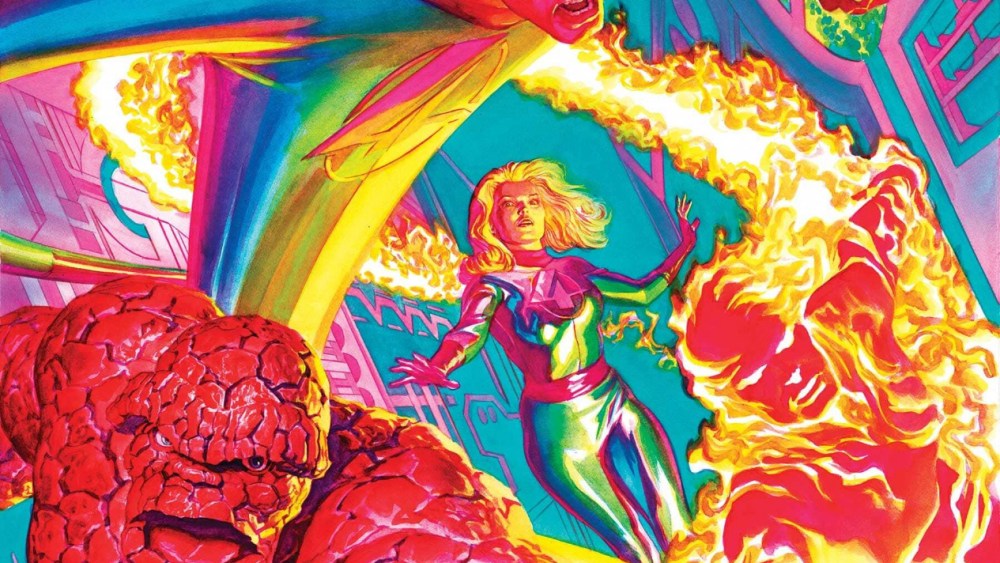
In the 9-issue Marvel series, One World Under Doom, the eponymous dictator assumes control of Earth’s governments, and everyone goes along with it because they feel powerless to make a difference. The not-at-all based on real-world events and feelings we’re all having right now story is the brainchild of Ryan North, who’s also been in charge of the Fantastic Four for the last two years. North, who did his postgraduate work in computational linguistics, has also woven an educational science element into the stories that would make any junior high teacher swoon.
I spoke with North about the unusual approach he’s taken, merging science with very contemporary conversations about labor rights and economics, as well as Fantastic Four’s long-term focus on family.
Corey Mintz: The Fantastic Four have been relatively out of vogue since the early 1980s, when the ascension of the X-Men to Marvel’s flagship title relegated the FF to a sort of professor emeritus status. You didn’t grow up reading comics. What attracted you to these characters?
Ryan North: I think you’re right that there’s this idea of their being your grandparents’ superheroes. But if you look at them, there’s a guy who lights himself on fire (Johnny), a rock guy (Ben), a stretchy guy (Reed) and an invisible woman (Sue). Nothing in that, to me, says 1960s. That sounds awesome to me. So I never thought there was anything wrong with the Fantastic Four. I thought they had a series of bad movies, which was most people’s exposure to them.
CM: The hook you used to launch the series was that the Fantastic Four’s home, with their children inside, is sent one year into the future. The kids won’t age or be harmed, but the FF will have a year without them. Everyone in New York is angry at Reed Richards and the team becomes pariahs. But as a parent to a small child, I’d love a year off. Which came first, that story idea, or the desire to separate the leads from their sprawling family ensemble cast in order to tell smaller stories?
RN: Part of the reason for that was that if you’re writing the Fantastic Four, a book with four main characters — Reed, Sue, Ben, and Johnny — then you have Alicia, who in my mind is equal to all of those. Plus Franklin and Valeria, plus another two kids, Joe and Nicky. That’s nine characters in a 20-page comic. And I didn’t think it was possible for me to do a good job of getting you to care about all nine characters in a 20-page comic.
So splitting them up, where we get to spend a month with Ben and Alicia, and a month with Reed and Sue, it gave the readers a chance to fall in love with these characters. So it was part structural, part for the readers, and part to give myself time to figure out who these people are.
CM: Regardless of where the Fantastic Four’s stock ranks in Disney’s portfolio of IP, the characters retain a high social status within the fictional Marvel Comics universe, similar to the popularity they enjoyed in the 1960s, when the FF sold as well as Spider-Man. Was this story also about stripping them of that status?
RN: That’s one of the things I wanted to take away from them initially. Because it’s hard to relate to rich, famous people with no problems, and superpowers. But if they’ve lost their fortune … That to me felt interesting and alluring.
CM: The Fantastic Four has always been about family, exploration, and science. But usually made-up science, like a matter mobilizer, electro-vibra suit, ultimate nullifier, etc.
Your FF contains oodles of legitimate science and scientists — heliocentrism, somacentrism, astrophysicist Thomas Gold, archeologist Kathleen Kenyon, photosynthetic cyanobacteria, the lithospheric thermal constant, the Bernoulli equation, universal density parameter, physicist Robert Dickey’s anthropic principle, and the National Transport Safety Board’s protocol for aircraft crash investigation, among others. What’s your motivation for including so much real-world science?
RN: I remember reading a DC Superman comic that had science that was completely wrong. Superman says, “Scientists have theorized that time is a loop. If you go far enough, you end up in the past.” But no one has theorized this. It’s just made up for a comic book. The feeling I’m trying to go for is to share something cool and make you aware of something in the world that’s really neat.
Like OMG particles, which were fast-moving particles we detected in the ’90s, and have never been detected since. We don’t know where they came from or what they were doing. Just a little science mystery. So the comic version of that is, what if they were arks from another world, and (the aliens) couldn’t travel across the cosmos, so they shrank themselves down, hollowed out a proton, and traveled in that with relativistic speed, which helped them live longer, because they’re going so fast. I’m really just trying to put in cool stuff that makes readers go, “Holy crap, that’s awesome.”
CM: That’s the goal of a grade six science teacher. Not to produce a group of biologists or physicists, but to inspire them that some of this stuff is intriguing.
RN: Yeah, there’s an issue where they’ve got the kids back, where they’re finishing Robert Boyle’s list of inventions, which I found researching my non-fiction book How To Take Over The World. Here is one of the great scientists of his time, who as he’s getting older, makes a list of what he hopes science will accomplish in the future. It’s a wild list that goes from extending life and underwater submarines to scratch and sniff stickers. That list is real. And I wanted people to know that we have this cool, historical list of an old-timey scientist trying to imagine what the future would be like, before science fiction was a thing.
Fantastic Four #16 (Marvel Comics)
CM: It had that impact on me. Reading your Fantastic Four in bed, I was Googling many of these details because they did get me excited and curious.
RN: That’s what I want from science fiction. That’s what I love.
CM: Twenty years ago, your graduate studies were in computational linguistics. One of your Fantastic Four villains — the tech oligarch whose app is AI data-mining his way to world domination — is drawn from the modern tech-economy. “If it were wrong, it would be illegal,” he boasts. How would you compare your feelings about technology in your post-graduate years to writing this story?
RN: This is something I think about a lot. When I was 16, in the ’90s, working with computers, I thought, this technology is an intrinsic good. Because I was a kid and I was blinded by tech utopianism.
CM: And now?
RN: These companies are just hoping to get away with it. Hoping they’ll be so useful that we’ll have to let them do it. It’s a great example of laws being not applicable to those who are rich. The character says, “If it was wrong, it would be illegal.” That’s one of the arguments I’ve heard. And it’s such an abandonment of your responsibilities as an ethical human being. I still think technology can be good. I don’t think technology is an intrinsic good. If you have a line in the sand and say “I won’t cross this,” if it’s profitable, someone else will be willing to cross it and hope the consequences are less than the rewards.
CM: You wrote a story that shows Reed and Sue as a romantic couple, in which they’ve learned to communicate silently through braille; Sue using her invisible force fields and Reed manipulating his body. How did this idea come about?
RN: I thought, surely with Alicia, who’s blind, on the team, all of the Fantastic Four would have learned braille. I liked this idea, that the team learns braille because they love and respect Alicia (Masters) so much. And if that’s the case, both Sue and Reed could produce braille on their own. And then Reed and Sue keeping it as a secret language between them. I thought that was romantic.
CM: It’s also resourceful, which is one of the things that makes us fall in love with characters. You’ve introduced this as a theme of homework — the characters applying scientific principles and practicing to develop new applications of their powers. Do you have a favorite?
RN: There’s an issue where they blow up asteroids with lasers. That’s me realizing that Sue bends light, Johnny produces light. You get light in a straight line, that’s a laser. There’s a hint in one of the issues, a piece of paper that says “Richards mitosis investigation.” Mitosis is a cell splitting in two. Reed Richards is stretchy. What if he could split into two guys? I haven’t done that. I’m not sure if we can do that.
CM: One Fantastic Four story explores the relationship between sight and sound, and includes an anecdote about how about New York mayor Fiorello La Guardia read comics over the radio during a 1945 newspaper strike. Was that a bit of trivia you’d always been looking to use, or did that come in research?
RN: I had done a lot of research on blindness in order to write Alicia. And that was one of the things I came across. He’s doing it to score political points …
CM: But he’s really leaning into it.
RN: He is. If you were a blind kid then, you wouldn’t get to read comics. And the mayor of New York reading you comics, that’s authenticity.
CM: He’s describing the framing of each panel. He’s doing voices.
RN: He’s so invested. I thought it was sweet. And I liked the idea of doing a story with Alicia that is also about enjoying comics while blind. If we’re going to be talking about this blind woman in this comic book, let’s talk about blindness and comics. It’s something that Ben and Alicia, as husband and wife, get to share. He can read her comics and he knows what detail she wants. I hired a blindness consultant, M. Sabine Rear. I hadn’t hired a disability consultant before. But I wanted to do a good job.
CM: Is the current page rate for Marvel enough for you to hire a consultant out of pocket?
RN: I want the work to be good. Alicia especially. She’s been around since the ’60s. Very early on she was part of the cast. But too often she’s been to the side. Helping take care of the kids. And I wanted people to feel, this is a great character. She has a personality. She is a great sculptor. The conversation she and Reed have about art where Reed is like, “I’ve never had an emotional reaction to a painting.” And her getting to give him the grace and say, “You’re not broken if you’ve never cried from a painting. But if you want to experience more emotionally, here’s ways you could do that.”
I think Alicia’s great. I love what she brings to the team. And I wanted to do good by her.
Courtesy of Marvel
CM: In a story that felt written just for me, the main antagonist is a deep cut reference — a goon from a 1982 Johnny solo story (Fantastic Four #233) — and his evil plot is wage theft and unsafe working conditions in a retail environment that looks like Best Buy. Where did this story, and the focus on labor rights, come from?
RN: It came from me wanting these characters to be more grounded. Less billionaires in their tower and more people doing real stuff. It felt like a great way to know Johnny and see him actually help people. I think that’s a danger of superhero comics, being just about heroes punching villains. We want to see a superhero help people who can’t help themselves.
CM: In another issue, you’ve got Ben and Johnny working as grocery cashiers for minimum wage.
RN: Yeah, it made sense character-wise for Johnny and Ben, wanting to contribute to the house’s finances.
CM: This one feels inspired by Geoffrey Owens (Elvin from The Cosby Show) working at Trader Joe’s, and being publicly shamed for getting pushed from the celebrity class to the working class. The same thing happens to Johnny in this issue. What about that story stuck with you?
RN: I hadn’t realized that connection until just now. But yeah, I did read about that. So it must have been there subconsciously. The idea that the best job is to be famous; I don’t buy that. And I think Johnny and Ben don’t buy that either. I thought there was value in seeing these characters work a normal job and be good at it. And show it as something that is not less than.
CM: I really dug a small moment in the issue with Boyle’s list, where the parents quietly discuss if the children need to be punished for creating a universal solvent and launching it into the Sun, or if it was a teachable moment. Those conversations, about how to deal with certain childhood behaviors, are a part of our household. That’s what parents talk about when they get together. And I loved seeing the Fantastic Four share that, the discussion of discipline being a bonding moment.
RN: Thank you. When you ask people about Fantastic Four, they say it’s about family. I was worried about that. Because I don’t have kids. What cracked it for me was, these are just relationships. Ben and Johnny have this great loving and teasing relationship. They’re not related in any way. These are people who like each other and live together. Maybe that’s what family is?
