


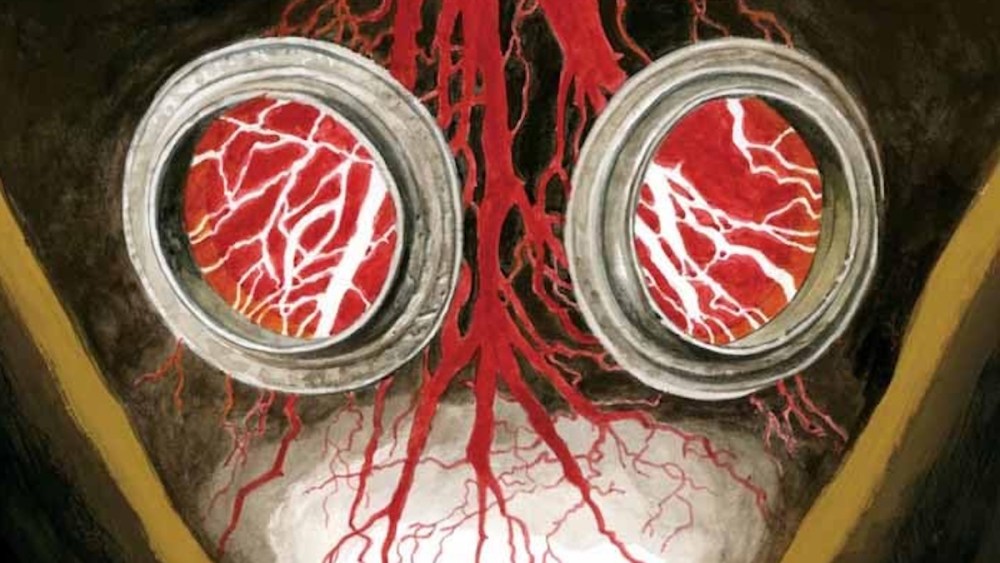
In Dust to Dust #1, a serial killer roams a small town in Depression-era Oklahoma. This is the first issue of an interesting new miniseries from authors JG Jones and Phil Blum. Jones also does illustrations. Although much of the book is colorless, it is rendered in striking duotones. Occasionally, flashes appear, usually red or brown, to mimic dry terrain. The landscape, the buildings, and even the people seem to be forever covered in a layer of dust from the winds and sandstorms that constantly blow through the valley. There, water is as precious a commodity as gold.
Reading this book felt like watching a great black and white movie, and I even saw similarities between the characters and actors from that glorious old movie.
Sheriff Meadows, a world-weary lawman who patrols the city on horseback, is reminiscent of Clark Gable, with the same strong features, quiet strength, and piercing eyes. He’s tough enough to go head-to-head with some of the roughest bullies in town, but not tough enough to show compassion and give gifts to a child whose family only has a wish. He discovers strange bones while on patrol and becomes obsessed with them. Is this a human bone fragment or an animal bone?
Sarah Grange is a reporter for a Chicago newspaper who has the misfortune of writing a story about this rural town. She was resourceful and had a brave personality, completely reminding me of Carole Lombard. She and Sheriff Meadows are a great pair, and I’m sure they’ll become more and more involved in the serial killer’s heinous crimes as the series continues.
image comic
Hillard, who owns most of the town, is a combination of Van Heflin and Orson Welles, with Heflin’s intensity and Welles’ commanding presence. He’s the type of guy who isn’t satisfied with just being rich, because everyone else should have nothing, and he and Sheriff Meadows are constantly at odds. There seems to be some history between the two, so I’m curious as to how the two became sworn enemies.
These three characters interact against the backdrop of many other characters who float through the city like ghosts, any of which could be the killer.
JG Jones’ art is exquisite, so detailed and perfectly rendered that you can feel the grit of the dusty streets and the steam rising from the muddy coffee served at the local diner. Early in the issue, the family leaves the farm to head to California, and as they finish packing, the son is seen playing with the dog in the surrounding fields. This artwork reminds us of the contrast between the boy and his dog’s innocence and Hillard’s smoldering corruption. This town is the epitome of all things good and evil.
I enjoy the slow pace of this issue, soaking up the setting and getting to know the characters while dropping hints that something sinister is going on beneath the surface politeness that covers the town. Enjoyed how you can. Setting the story in the 1930s during the height of the Great Depression is great. Because, despite being full of possibilities, that era is rarely used by creators.
I’m looking forward to seeing the story develop over the next few issues. I’m looking forward to future developments as it looks like there will be supernatural elements as well. If you’re looking for something original and unique in a market flooded with generic superhero books, check out this issue and get on the ground floor with this fascinating miniseries.
“Dust to Dust” #1 Review
Dust to Dust #1
J.G. Jones’s stunning art, along with the story’s Depression-era setting and engaging characters, combine to make for a captivating debut issue.
The page artwork and duotone style make reading this book feel like watching a great black and white movie.
The story’s Depression-era small town setting is unique and never feels claustrophobic.
