


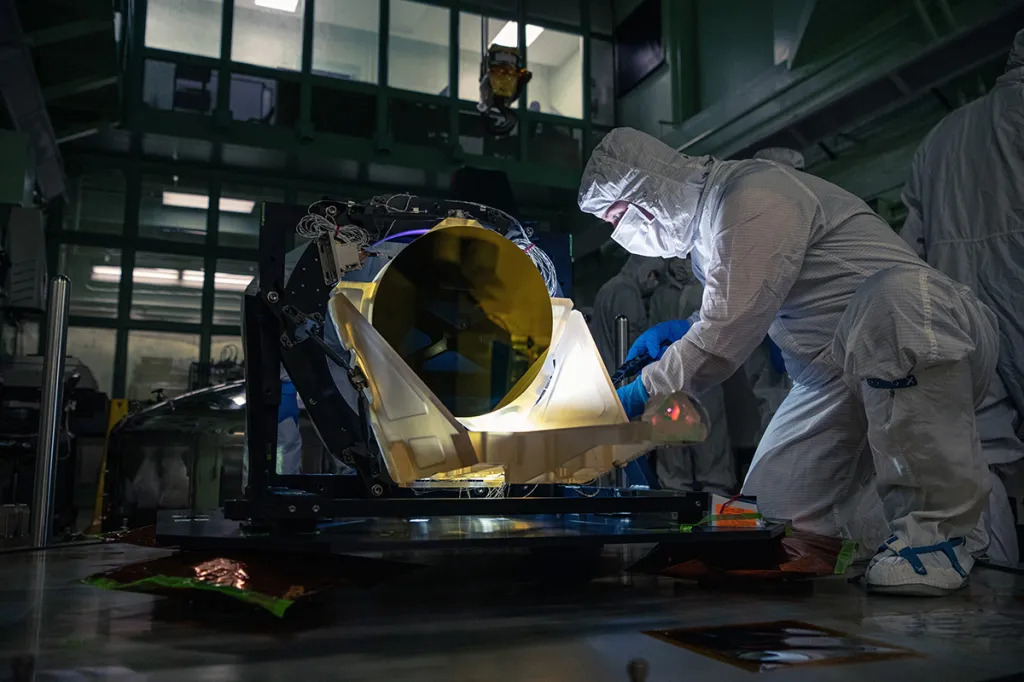
NASA has unveiled a prototype telescope for a new gravitational wave detection mission in space. The telescope is part of the Laser Interferometer Space Antenna (LISA) mission led by the European Space Agency (NSA) in partnership with NASA.
The goal of the LISA mission is to place three spacecraft in a triangular orbit about 1.6 million miles on each side. The three spacecraft will follow Earth’s orbit around the sun. Each spacecraft carries two telescopes and uses infrared laser beams to track the siblings. These beams can measure distances up to a trillionth of a meter.
Gravitational waves occur during the collision of two black holes. They were first theorized by Albert Einstein in 1916 and detected nearly a century later by the Laser Interferometer Gravitational-Wave Observatory (LIGO), a scientific collaboration of the National Science Foundation, California Institute of Technology, and MIT. Gravitational waves are detected when the three spacecraft deviate from their characteristic pattern.
The LISA mission is scheduled to launch in the mid-2030s. Detecting gravitational waves could offer “huge potential” to improve our understanding of the universe, including phenomena such as black holes and the big bang that are difficult to study by other means, according to the mission’s official website.
